in a dream
In psychology, there is a theory that every character appearing in a dream represents the dreamer, symbolizing different facets of their personality. Did the Japanese painter Tetsuya Ishida (1973–2005) know this theory? Whether he did or not, his work illustrates it perfectly, as demonstrated by the powerful exhibition on view at Gagosian in Paris until July 31. An exhibition worthy of a museum setting, it presents for the first time in France, through some thirty works, a world of hypnotic nightmares.
Struggling to find their place
More precisely, this universe emerged from what became known as Japan’s “Lost Decade,” the 1990s, when many young Japanese struggled to find their place in a country mired in economic recession, trapped by archaic customs and rigid hierarchies. In Japan, to exist socially is to hold a stable and respected job. Tetsuya was the youngest of four siblings, “the calmest and kindest” according to his older brother Michiaki. His father served on the city council of Yaizu, a port city in Shizuoka Prefecture.
Sustain Our Work with a Small Monthly Gift
Become part of the Judith Benhamou Reports circle.
Contribute, even from just €10
contemporary japanese surrealism
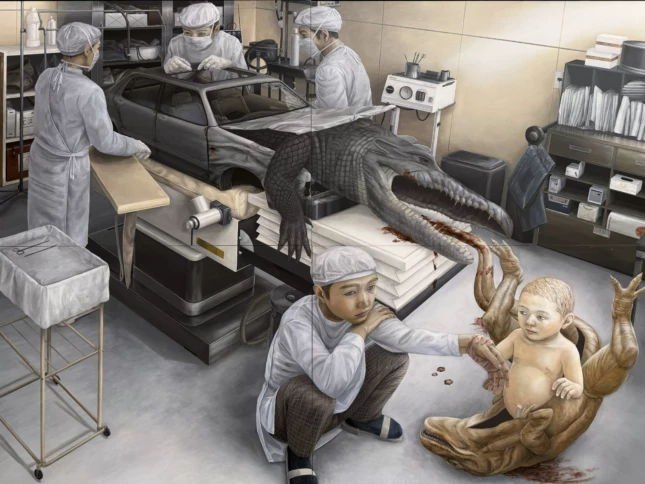
If he could afford to be a quiet and composed young man, it was because he had found in painting an outlet that could hardly be described as either calm or kind. His career lasted only ten years. He produced just over 200 paintings and never achieved success during his lifetime. Yet he succeeded in creating a unique artistic universe: a contemporary Japanese form of surrealism distinguished by extraordinarily refined and detailed painting. Through his recurring oversized faces, he expressed social anxiety and the fear of humanity turning into machinery.
Ishida wrote:
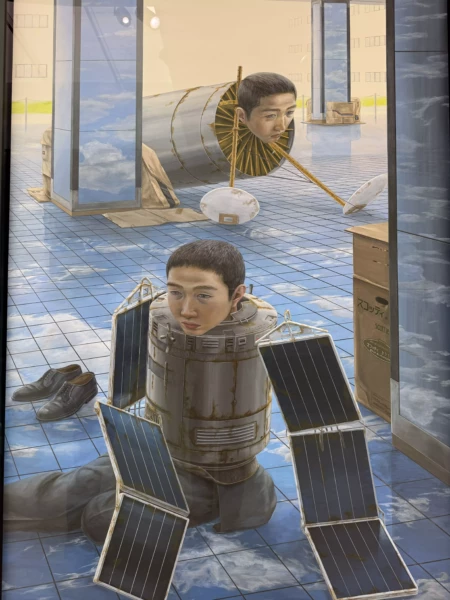
“I am afraid of the society I am about to enter. Eventually I will adapt to it by transforming myself, but I cannot do it. I feel as though I am living out the desires of others.”
At art school, where he studied graphic arts, he became friends with another young artist, Isamu Hirabayashi. Together they decided to keep records of their dreams. According to Hirabayashi, many of the paintings shown in Paris depict his friend’s dreams.
Supermarket version of the Pietà
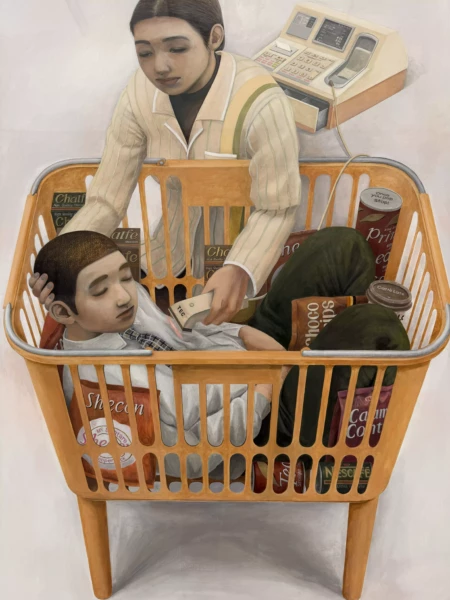
Among the most striking is an image resembling a supermarket version of the Pietà: a mother scans her son, curled up inside a shopping cart amid groceries. The child has become just another consumer product. In another painting, the character’s head is the only part of him able to escape from massive turbines inside an abandoned factory.
both a bed and a tombstone
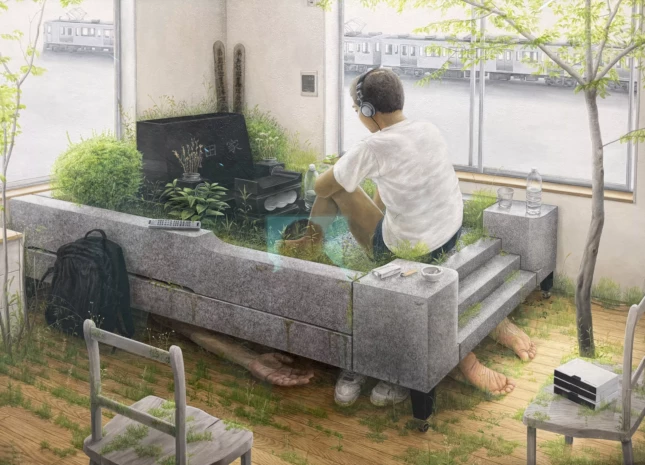
But the most haunting image is a large prophetic painting created six years before Ishida’s death—he would later be killed by a train. The canvas depicts a young man seen from behind, seated on an object that resembles both a bed and a tombstone. Beneath it protrude a pair of feet and an arm: the dead body. Through the window in the distance, a train can be seen passing by.
aesthetics of suicide
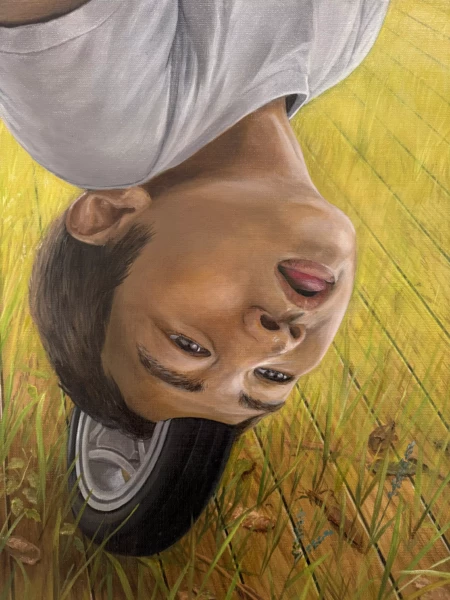
“Tetsuya was neither alone nor isolated,” explains his university friend, “but he had a pronounced attraction to the aesthetics of suicide, shared by figures such as the writer Yukio Mishima and the painter Van Gogh.” This is reminiscent of the despair of another artist of his generation who died by suicide: the Canadian painter of Chinese descent Matthew Wong, whose style was deeply inspired by Van Gogh.
Nick Simunovic
It was not until 2013, when Nick Simunovic, who oversees Gagosian’s activities in Asia, discovered the artist and exhibited his work in Hong Kong, that Ishida began to achieve posthumous recognition. This led, among other milestones, to an entire room being devoted to him at the Venice Biennale in 2015 and a major retrospective at the Reina Sofía Museum in 2019.
In 2026, Ishida continues to embody the image of a despairing youth.