90th birthday
What does an artist do after celebrating his 90th birthday? Nothing different from usual: he keeps working tirelessly.
Lee Ufan, the Korean artist who divides his time between Japan and Paris, has just marked this milestone. His work has probably never been shown in so many places around the world at the same time. Bridging Asian spirituality with Western conceptual and minimalist art, he has, since May, been the subject of a major long-term exhibition at one of America’s most prestigious art institutions, Dia Beacon, about ninety minutes from New York.
Sustain Our Work with a Small Monthly Gift
Become part of the Judith Benhamou Reports circle.
Contribute, even from just €10
In South Korea, Space Lee Ufan in Busan permanently presents his work. On Japan’s celebrated museum island of Naoshima, visitors can discover the Lee Ufan Museum. Closer to home, Lee Ufan Arles, which opened in 2022 in the heart of the Camargue capital, offers an excellent overview of his artistic practice. In Venice, the San Marco Art Center is staging an impressive retrospective through November 22.
palais des papes
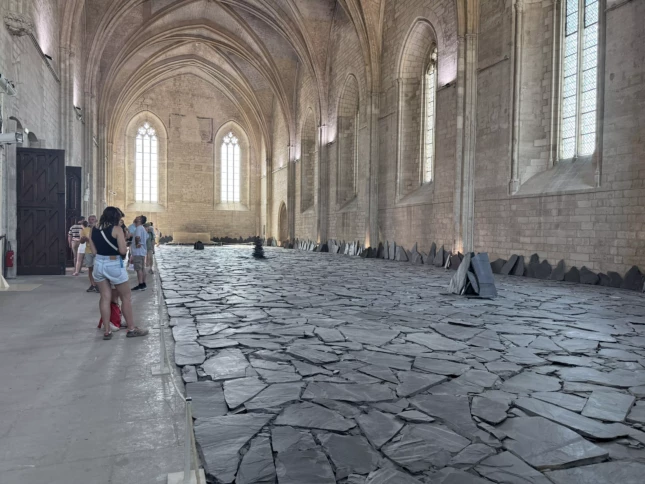
And then there is Avignon. Until November 15, the Provençal city is hosting nine monumental works inside the austere yet majestic Palais des Papes. The exhibition provides the perfect opportunity to rediscover one of Europe’s great medieval monuments. The experience is at once profoundly restrained and deeply spiritual.
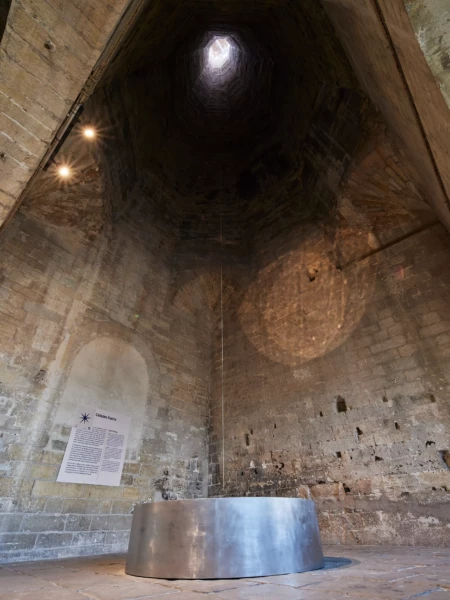
Lee Ufan raises questions that, in everyday life, almost sound like forbidden words: the soul, the tangible presence of the dead, and our capacity to love everything around us—including inanimate objects.
time to put your life in order
He explains candidly:
“As you grow older, people tell you it’s time to put your life in order, let things take their course, and prepare for the next stage. But I still have so much to do. I need to improve my work. At this point in my life, after spending so many years working alone, I am surrounded by people. Their presence gives me strength.”
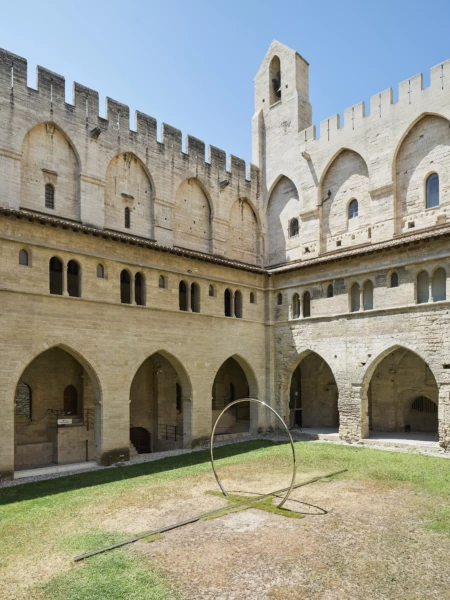
He certainly needed that strength to install 60 tons of slate slabs across the 650-square-meter floor of the Great Chapel. The stone completely covers the vast, cathedral-like space, normally left empty. The dark surface, cut into irregular shapes like a giant mineral puzzle, glistens in the intense southern light. The installation resembles the bed of a dried-up river, transplanted into the palace.
countless souls
Lee Ufan experiences the Palais des Papes as a place through which countless souls have passed. Inside the fourteenth-century building, he has placed rough, flat stones that would ordinarily be found outdoors. His entire artistic practice revolves around expressing tensions through the interaction of different materials.
A master of reduction—even in his vocabulary—he consistently gives his works the same title: Relatum, which is also the title of the exhibition. Derived from Latin, the word may here be understood as “being in relation.” It reflects the idea that the meaning and perception of an artwork change according to the context in which it is displayed.
sumptuous midnight-blue frescoes
The most magnificent space along the exhibition route is the Saint-Martial Chapel, whose sumptuous midnight-blue frescoes glorify the saint. At the center of this extraordinary setting, Lee Ufan has placed an oval boulder standing 1.3 meters high. He speaks of stones as though they were living beings:
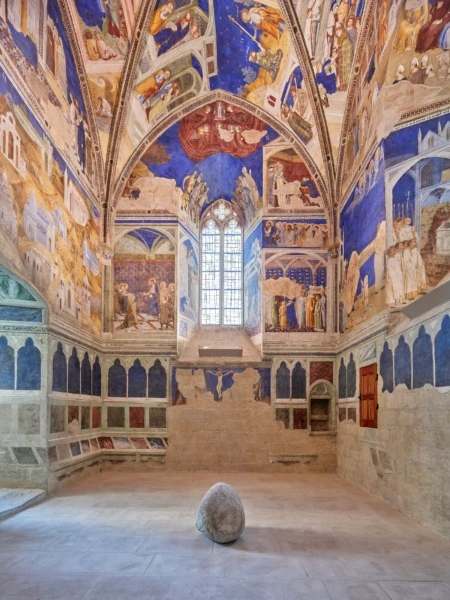
“They represent infinity. We have to look at them with new eyes. When we encounter stones, just as when we encounter people, there is an exchange of information. But I would say that stones contain something that goes beyond that.”
Those who know him well even say they have seen the artist embrace the massive rock as a personal welcoming ritual.
monumental paintings
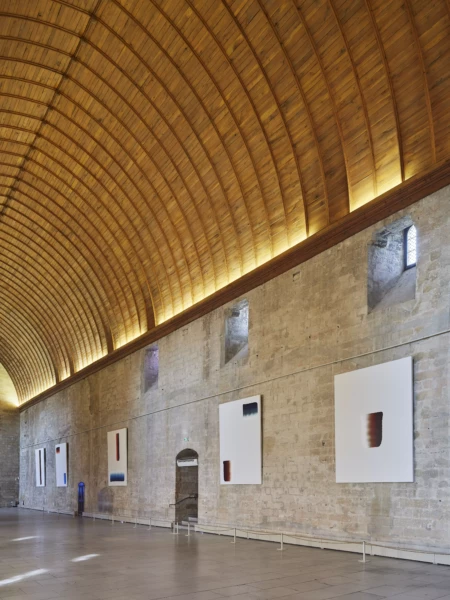
Another gallery is devoted to his monumental paintings. Using an oversized brush, Lee Ufan enters a meditative state, holds his breath, and executes a single long, powerful multicolored brushstroke. In Avignon, that solitary gesture dominates vast white canvases that can be seen as landscapes emerging from emptiness.
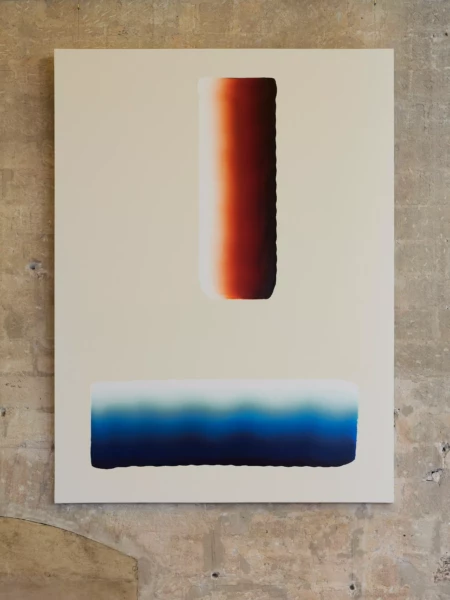
“From opposing elements, new spaces are born,” the master concludes.
canonballs
Leaving the Palais des Papes, crowds of backpack-wearing tourists walk past another pile of large stones without a second glance. A sign reads: “Bombard Cannonballs. Late 15th Century.” They were most likely used as defensive projectiles during the first siege of the palace in 1398–99. Yet they bear a striking resemblance to one of Lee Ufan’s Relatum installations.
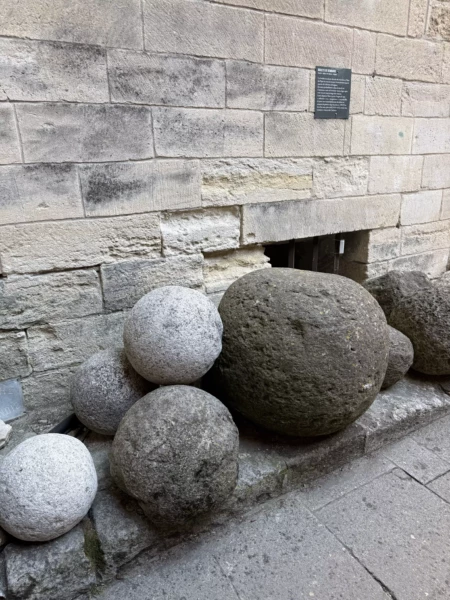
In Avignon, the Korean artist seems perfectly at home.