fate
Here are the brutal facts: the Venice Biennale, the world’s largest exhibition of contemporary art and usually a dependable source of wonder and discovery, is not a particularly distinguished vintage this year.
Part of the reason lies with fate itself. Its artistic director, the Swiss-Cameroonian curator Koyo Kouoh, died suddenly just months after her appointment. Five people were then entrusted with carrying out her vision, but the resulting exhibition — bringing together 111 artists — often feels muddled and strangely déjà vu despite a handful of commanding displays.
Sustain Our Work with a Small Monthly Gift
Become part of the Judith Benhamou Reports circle.
Contribute, even from just €10
Kaloki Nyamai
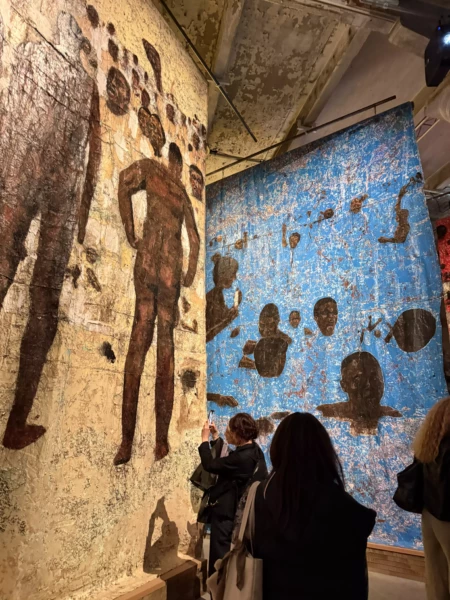
Among them are the monumental painted portraits, six meters high, by the Kenyan artist Kaloki Nyamai at the Arsenale. Through the dramatic brilliance of the situations he constructs, his work recalls that of the Mexican muralist Diego Rivera, though with an added touch of magic. Threads are clustered across the canvases, placed there symbolically as gestures of repair — attempts to mend a fractured world. A painter clearly destined for major recognition.
it’s not United nations
More fundamentally, however, if this Venetian edition disappoints, it is because political positioning, international resentments, violence and abuses of every kind have, for many participants, pushed art itself — good art — into the background.
Yet the Biennale is not the United Nations. Its mission is not censorship. It is meant to serve as a platform for different forms of artistic creation, works that must first possess an intrinsic visual or conceptual force to matter. It sometimes feels as though the art world has forgotten art’s primary function. As Gerhard Richter once said, art is the ultimate form of hope.
pathetic Austrian Pavilion
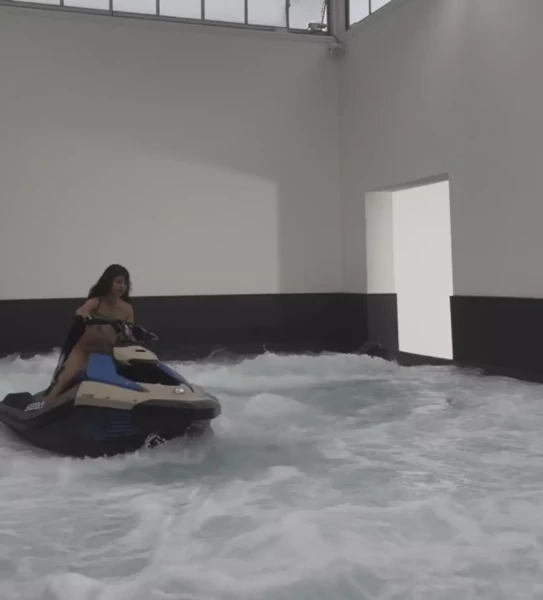
One quickly passes over the pathetic Austrian Pavilion, occupied by the choreographer Florentina Holzinger, who, under the pretext of concern for the oceans, stages for exemple a naked woman (not herself) marinating in purified urine, among other provocations. We’ve seen the nude before. We’ve seen physical suffering before too, including in the work of the Viennese Actionism artists. And the women standing in icy water on a jet ski?Marvellous for a Paris cabaret. But we could probably have done without that.
inventories from hardware stores
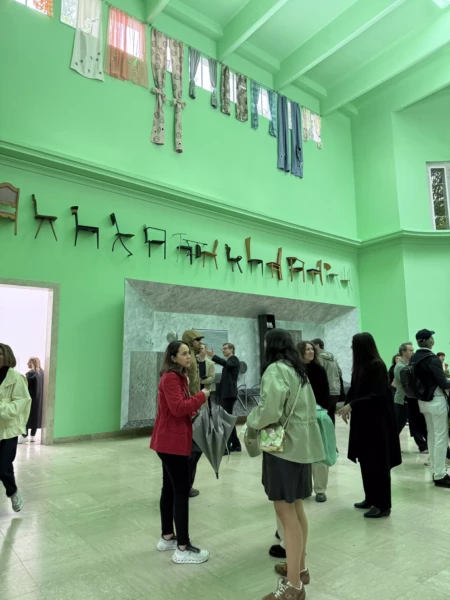
Likewise, many national pavilions resemble inventories from hardware stores or carefully arranged flea markets. The principle of the ready-made, pioneered more than a century ago by Marcel Duchamp — transforming ordinary objects into art simply through artistic designation — now feels thoroughly exhausted.
adriana varejao
Still, there are exceptions worth lingering over. In the Brazilian Pavilion, for instance, the national star Adriana Varejão conjures bloody entrails bursting trompe-l’œil-like from the walls, as though the buildings themselves retained traumatic memories. It is an explicit and powerful evocation of Brazil’s horrific slave-owning past.
Lubaina Himid
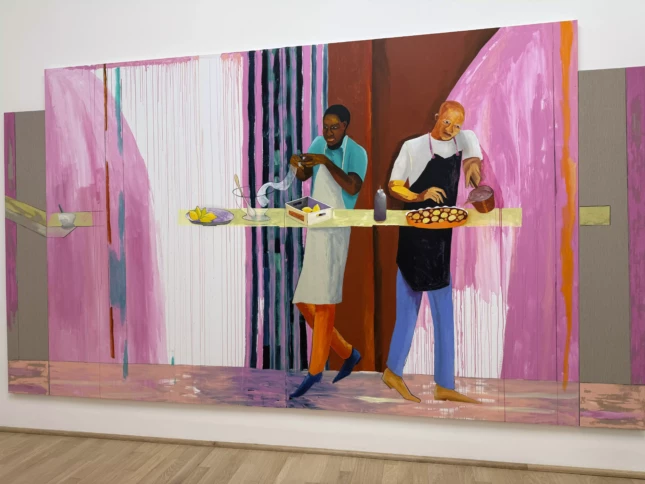
The British Pavilion belongs to the excellent painter Lubaina Himid, born in Zanzibar in 1954. Her magnificent color-saturated compositions, animated by an abundance of motifs, explore the search for home — home understood as emotional refuge — while life’s circumstances violently toss one about.
Alma Allen
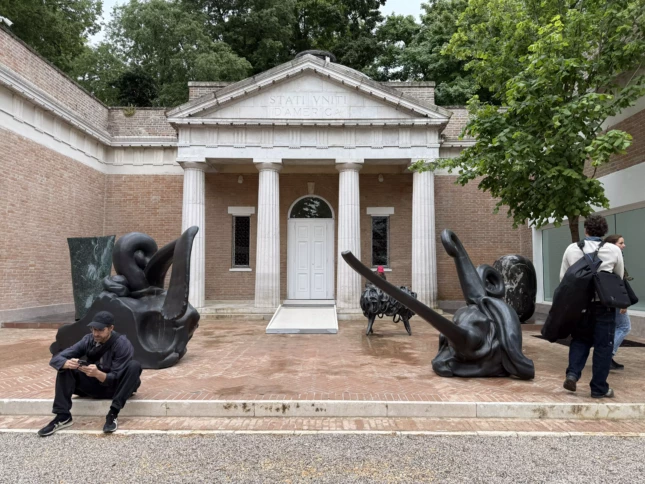
The scapegoat of the 2026 Biennale has become the artist Alma Allen, selected to represent America under the residency of Donald Trump. Given only four months to assemble his exhibition, he produced a rather bland ensemble of biomorphic sculptures, mostly in bronze, whereas his works in wood and marble — too sparsely represented here — possess a calming charm and a genuine harmony with nature.
“I was asked to put together an exhibition in four months. I had complete freedom to organize it. I have nothing to do with Trump. I’ve always been an outsider, a blacksheep” he said.
PRINCE AND JAFA
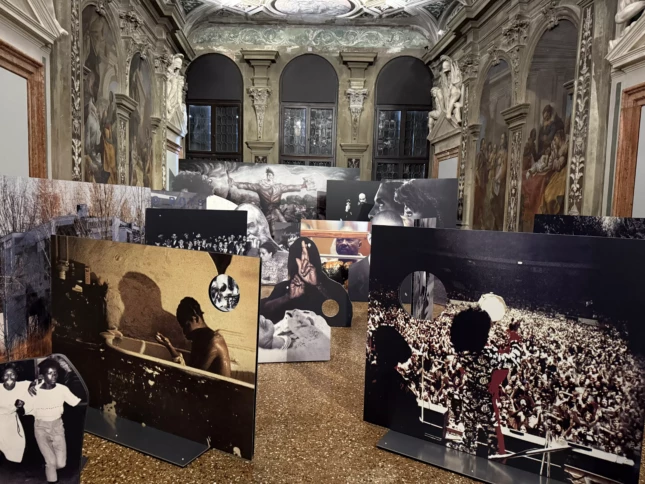
In truth, the finest things to be seen in Venice this season are unquestionably found in the Biennale’s off-site exhibitions.
At the top of the list stands the exhibition at the Prada Foundation, a dialogue between two American artists from successive generations, Richard Prince and Arthur Jafa (I have interviewed Jafa on numerous occasions since 2018). It is a perfect example of successful political art: two visions of America at its darkest and most wounded, constructed from appropriated imagery drawn from popular culture. The collision between the baroque splendor of the palace and the baroque excess of American suffering is extraordinary.
(I will soon publish a riveting interview with Arthur Jafa.)
LU Yang and the killing machines
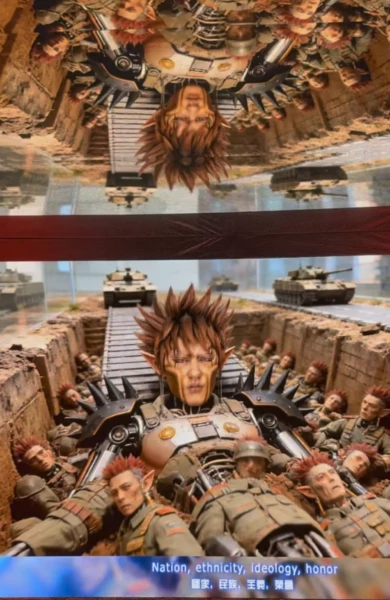
At the Espace Louis Vuitton Venezia, the young Chinese artist living in Japan Lu Yang has created what may be her masterpiece. Using artificial intelligence, she conceived a two-hour animated film depicting, among other things, robotized humans transforming into terrifying killing machines.
poetic su xiaobai
Finally, do not miss one of the most delicate and poetic exhibitions of this Venetian spring, at Palazzo Soranzo Van Axel. There, Su Xiaobai, a Chinese painter based in Germany, has suspended in space his thick yet perfectly smooth abstract canvases, composed of innumerable layers of colored lacquer with the collaboration of Stephen Little curator of Asian Art at Lacma and the staging by Kulapat Yantrasast.
The result is an aquatic, dreamlike environment — an immersion into silent beauty.
Here, at last, time stands still.
Also Worth Seeing
Georg Baselitz
The great emotional experience this May, following the death at 88 of the German painter Georg Baselitz, is to visit what became his final exhibition, completed while he knew he was dying.
At the Fondazione Giorgio Cini on the island of San Giorgio Maggiore, bodies — in fact portraits of his wife — fall endlessly into the abyss of existence against radiant gold backgrounds. A final, masterful gesture.
Lee Ufan
Near Piazza San Marco, at SMAC, a deliciously subtle exhibition unfolds in shades of gray by the artist whose touch is unfailingly precise: Lee Ufan, the Korean-born artist living in Japan whose work forms a perfect bridge between American conceptual art and Asian philosophy.
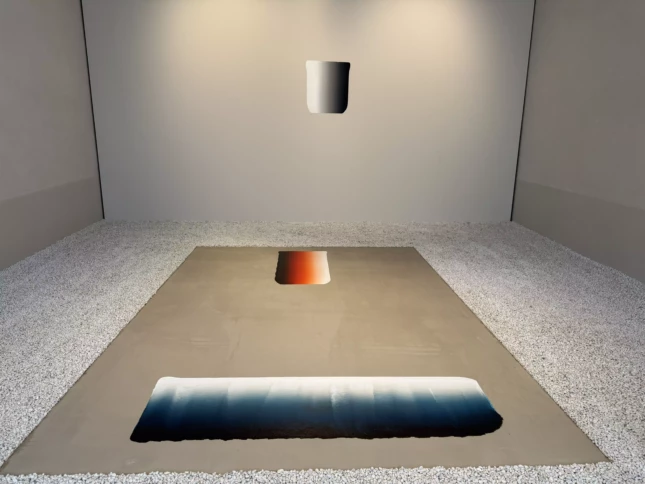
It is curated by Jessica Morgan, the director of the Dia Art Foundation.
At 90, Lee Ufan acclaim now spans continents. This May, the very American Dia Art Foundation inaugurated a permanent gallery devoted to him at Dia Beacon.
Amoako Boafo
At the sumptuous Palazzo Grimani, a survey devoted to one of the most heavily publicized figures in contemporary figurative painting today: the Ghanaian artist Amoako Boafo, trained in Vienna and adored by the art market.
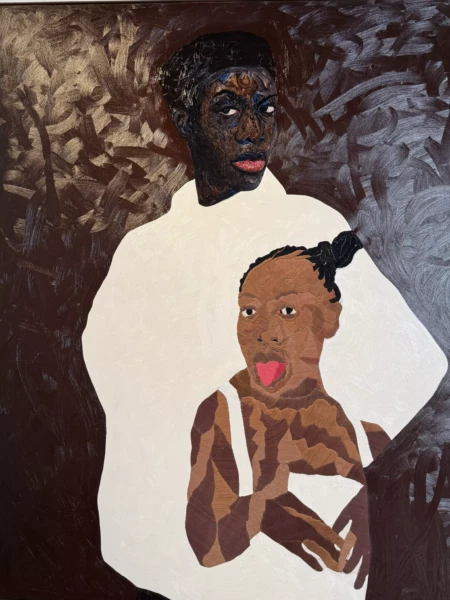
His portraits of Black figures propose a political reading of representation in contemporary art — an attempt to redress the injustices of the past. Here, he introduces a new technique alongside painting: embroidery. The result is beautiful.
Isola di San Giacomo
In 2015, the celebrated Turin collector Patrizia Sandretto Re Rebaudengo acquired an island located half an hour by boat from Piazza San Marco, Isola di San Giacomo.
This former Napoleonic military outpost, Isola di San Giacomo, is currently accessible only by private boat, though a vaporetto is expected to begin service later this year, allowing visitors to discover the two buildings on the island. It is poised to become one of Venice’s very anticipated new destinations.
As for Patrizia’s extraordinary house on the island, decorated by the filmmaker Luca Guadagnino — the director of Call Me by Your Name — it will remain closed to the public. But it is stunning.
Tino Sehgal
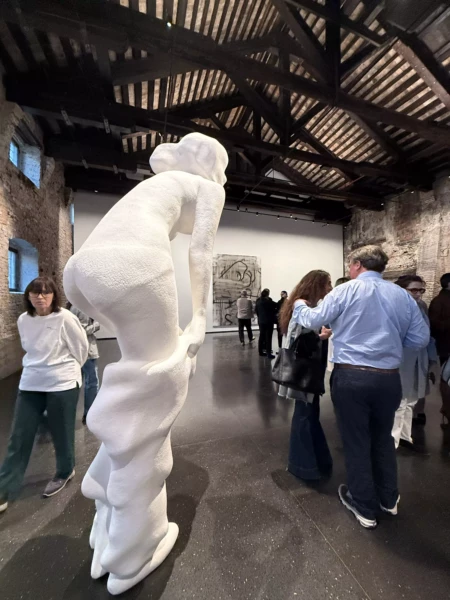
At the AMA Foundation created by hte Monegasque collector Laurent Asscher, one encounters one of the most beautiful works ever created by the German artist Tino Sehgal.
In complete darkness, a man and a woman lie on the floor kissing. It takes a long while before the eye can detect them in the absolute blackness. And then, suddenly, the image emerges. The outlines are blurred, almost painterly, as if lifted from an Old Master canvas.
This immaterial kiss achieves a perfect balance between the art of the old masters and performance art. An experience that must be encountered in person.
Plus
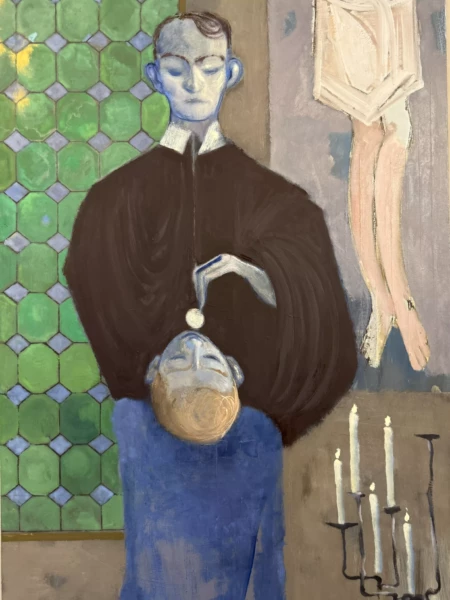
- Matthew Wong Interiors, fascinating paintings with densely saturated patterms. A show dedicated to a lesser-known subject in the work by the Canadian painter of Chinese origin who died at a young age.
- Anish Kapoor by himself at Palazzo Manfrin, A superb installation by the great British artist, now based in Venice, who once again demonstrates his ability to reinvent himself.
- Sanya Kantarovsky at the Instituto Veneto di Scienze. A very strange and fascinating world . Still young, but already a major figurative painter.
- and of course the major show of Michael Armitage at the Palazzo Grassi to whom I devoted recently a full feature