Keep playing
“An artist plays a great deal. One must keep playing,” recommends Annette Messager, born in 1943, with a bright gaze and a smile at the corner of her lips. “Besides, here I am trying to play with the spirit of the different rooms.” Yet if Annette plays, she does so with great seriousness.
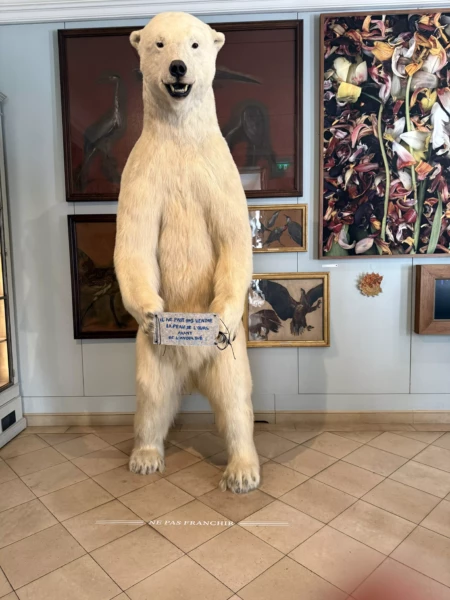
In this case, the internationally recognized French artist is referring to her new Paris exhibition at the Musée de la Chasse et de la Nature, titled “Une Hirondelle ne fait pas le printemps” (“One Swallow Does Not Make a Spring”). It runs through September 20 in the double, sumptuous Marais mansion dating from the 17th and 18th centuries.
Sustain Our Work with a Small Monthly Gift
Become part of the Judith Benhamou Reports circle.
Contribute, even from just €10
mischievous spirit
Her works are scattered throughout a path already particularly rich with permanent collections. The operation is so successful that it gives the impression her pieces have always been there, bringing a mischievous spirit to the display. It is conceived like a cabinet of curiosities, an homage to the great animal predators and other nature lovers of the past.
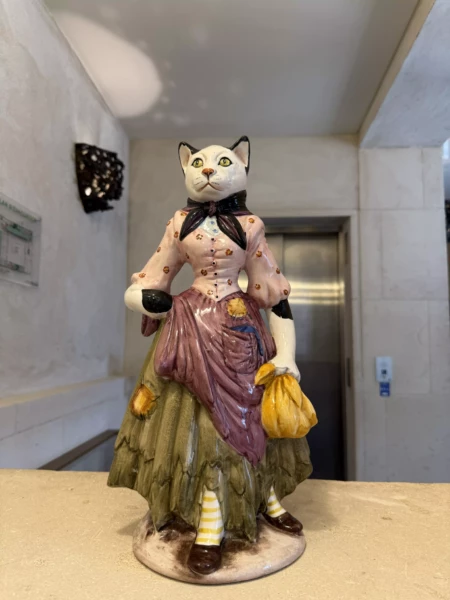
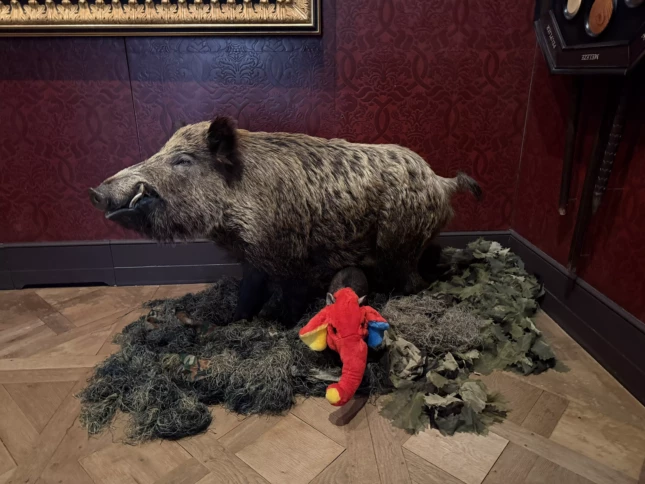
In the institution’s luxuriant environment, crossing paths with elephant feet or a threatening wild boar, one no longer knows who made what.
The rabbit holds a rifle
Still, in the arms room, the taxidermied rabbit holding a rifle leaves no doubt as to its author. It is positioned near a 17th-century painted hunting scene. The mother of the hunter-rabbit comments: “I have many taxidermied animals that I mess around with.”
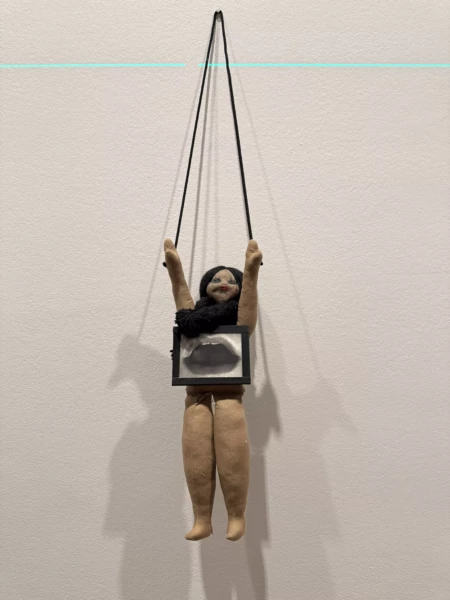
Messager’s intervention consists of 80 works. The universe of the artist who won the Golden Lion at the Venice Biennale in 2005 — already an animal — is populated by a fantastical fauna. Her work, commonly made of various assemblages, floats in an equivocal space between cruelty and cuteness, between childhood memories and sexuality or feminism.
personal Bestiary
Annette is first of all a collector of objects. Not the most precious ones, nor those in the best condition. It is their charm that seems to justify their entry into her great jumble. It is not simply a question of returning to childhood, since she admits, for example, that she never owned stuffed animals or a teddy bear, though they are extremely numerous in her personal bestiary. Then she tinkers with them, transforms them, and accumulates them too.
Thus, from a distance, you think you can identify an enormous tarantula hanging on the wall. Up close, you recognize bras attached to one another until they form the spider.
fatal and cute
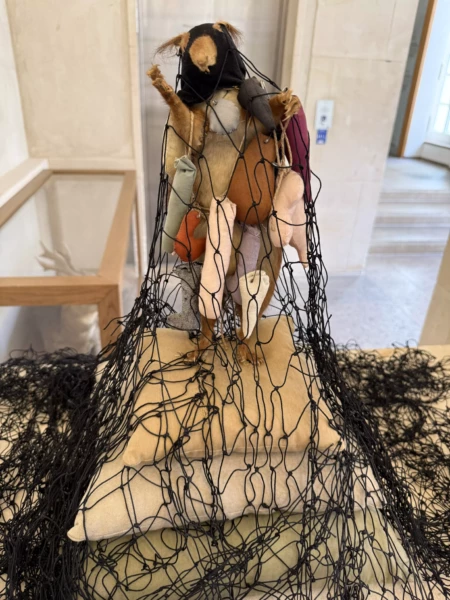
At the Musée de la Chasse et de la Nature, many of the little creatures she stages are often hindered. She has caught them in nets. “Perhaps because I spent my childhood by the sea, in Berck,” the artist observes. The scene is at once fatal and cute when, on the first-floor staircase, a taxidermied squirrel, in a very human pose, is trapped between the dark meshes.
Messager also nourishes a small obsession with snails. “I like them very much. Of course, they have the advantage of having no housing problem. But above all they are hermaphrodites. Male, with the possibility of having babies.”
children have left
Throughout the exhibition, they are arranged in small groups, modeled by Annette herself in dark metal shells. “The part involving touching, modeling, I like that. It is my way of appropriating them. They are mine. Until the moment they are exhibited. From then on, they will no longer come back to my home. It is like children who have left. They are grown up. I want to have room for other children.”
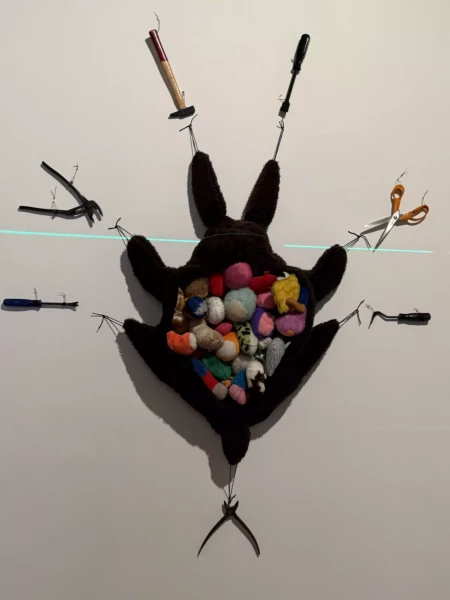
Farther on, Annette the fierce has attached to the wall, stretched out and flayed, a large stuffed rabbit that shelters, in its gaping belly, an infinity of small animals in colored fur. When asked about the symbol of this piece, titled “L’opération” (“The Operation”), she answers that she does not want to know it, for fear of disturbing her inspiration.
sophisticated ambiguity
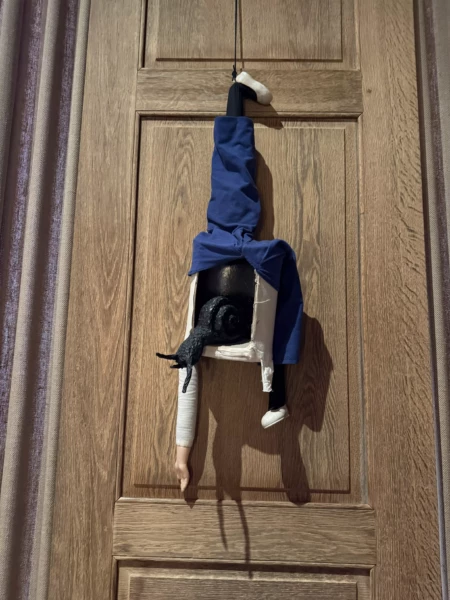
Do not trust the gently playful appearance of this exhibition. It works according to a principle of sophisticated ambiguity, and poetry too.