An important modern artist
Contrary to what reason might suggest, art history and the art market are not always in step. Consider Pierre Bonnard (1867–1947). He is recognized as one of the defining modern artists. Yet the prices fetched by his paintings at auction in recent months—from 2025 into 2026—have ranged from €76,000 to €533,000. This scale is far below that of other major figures from the first half of the twentieth century, such as the Belgian Surrealist René Magritte, for example, whose market operates in the tens of millions of euros. The explanation is, first of all, a matter of zeitgeist.
Mark Rothko
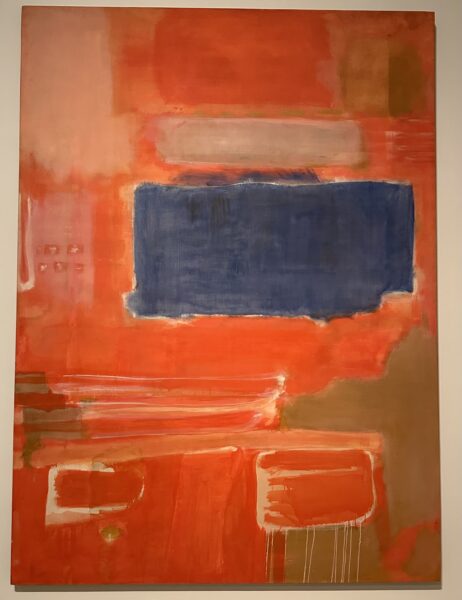
And yet Bonnard has one decisive thing in his favor: he is what the art world calls an “artist’s artist.”
Sustain Our Work with a Small Monthly Gift
Become part of the Judith Benhamou Reports circle.
Contribute, even from just €10
As early as the late 1940s, he was inspiring one of the leading painters of American abstraction, Mark Rothko (1903–1970). In December 1946, shortly before the French painter’s death, around fifteen of his late works were shown at the Bignou Gallery in New York. There Rothko—who would soon become a star of American abstraction—was dazzled by Bonnard’s work. As a 1997 exhibition at PaceWildenstein recounted, during the winter of 1946–47 Rothko, in the paintings now known as his “Multiforms,” quite literally borrowed fragments from Bonnard’s compositions.
Nathanaelle Herbelin
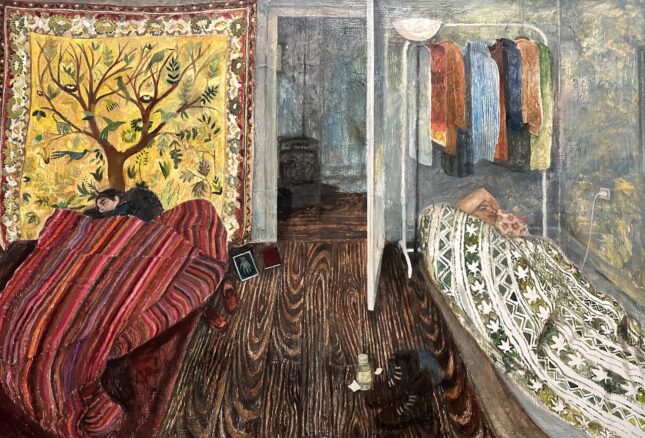
In the final part of his life, Bonnard possessed a kind of science of color, making it vibrate across broad, layered planes. That is what interested the American painter. Closer to our own time, it is also what fascinated the much-admired young French-Israeli painter Nathanaëlle Herbelin (born in 1989). In 2024, the Musée d’Orsay devoted an exhibition to her in dialogue with the Nabis painters, the group to which Bonnard belonged. She referred directly to his chromatic palette and to the intimate subject matter of the modern master.
Exalted colors
In fact, there are two great moments in Bonnard’s oeuvre. In the 1890s, he simplified line, at times even distorted it, and exalted color through unusual viewpoints. He was influenced both by Gauguin and by Japanese prints. This was his Nabi period. As time went on, he developed a body of work centered above all on intimate scenes—particularly his series of bathers and nudes in the bath—and on landscapes that became vehicles for an explosion of color.
Le CanneT, Côte d’aZur
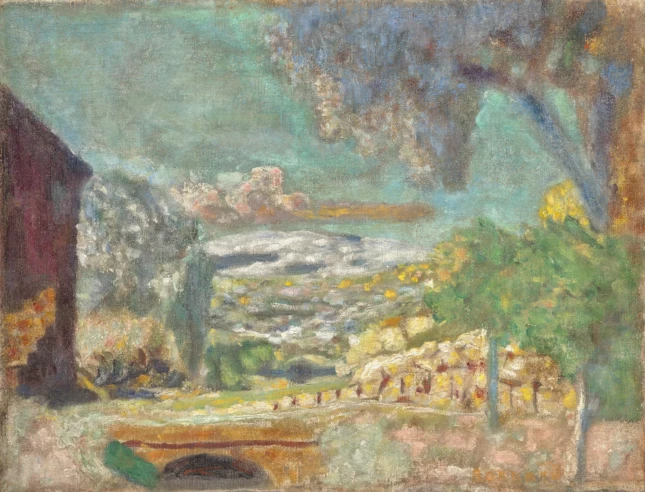
In 1926 Bonnard bought a house on the French Riviera, in Le Cannet. The landscape surrounding it and the rooms within it would provide the subject for more than 200 paintings. The colors, utterly removed from realism, unfolding from orange into pink, convey the heat of the South. Bonnard also took on monumental formats.
Intimism and decoration
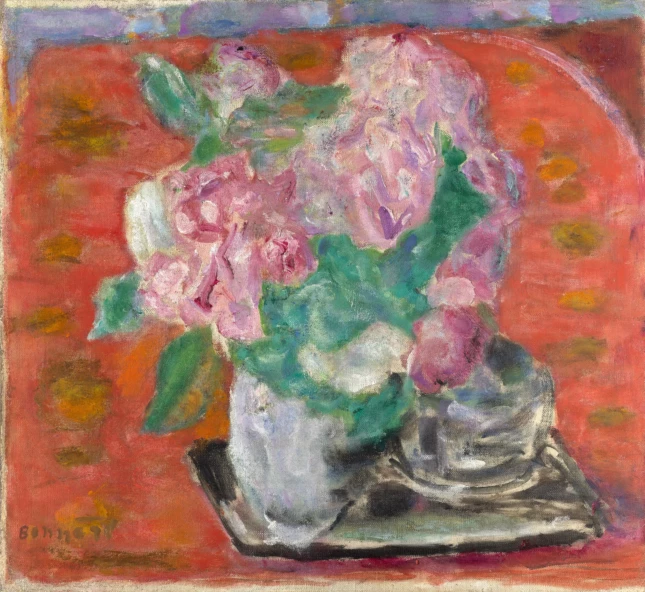
In 1943 he declared: “All my life I have floated between intimism and decoration.”
It is in the category of powerful decoration that Bonnard’s auction record belongs. It was set in New York in 2019. Terrasse à Grasse, a symphony of pinks, violets, blue-greens, and orange painted in 1912, sold for $17.4 million.
Current events in Paris offer two good reasons to take an interest in Pierre Bonnard.
Claude Terrasse
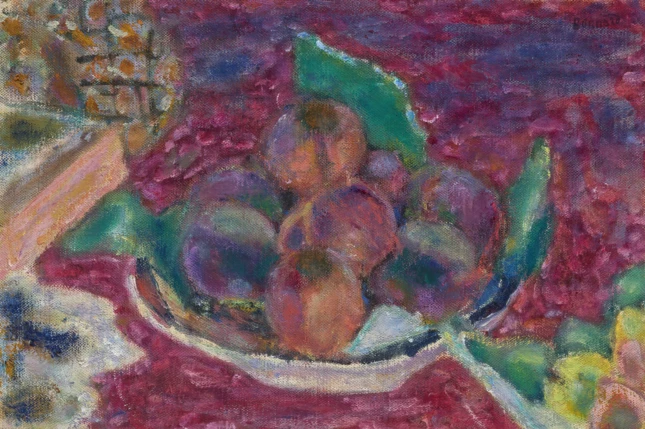
On April 14, Christie’s will disperse in Paris a collection of 60 works, very reasonably estimated at €2 million, that belonged to the artist’s brother-in-law, the musician Claude Terrasse (1867–1923). It is one of those groups of works of which France has the secret, preserved within the same family since its origins. Terrasse married Bonnard’s sister. He wrote operettas and other musical works, some of which were illustrated by the painter. For a time in Arcachon, the couple lived at Villa Bach, where private concerts were held, and whose programs, once again, were illustrated by Bonnard. The collection now being sold at Christie’s tells that whole story.
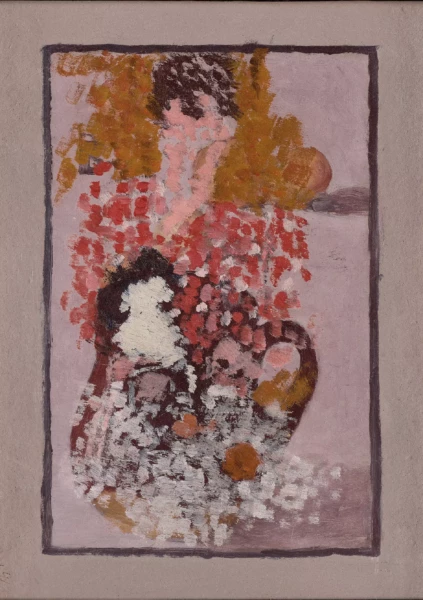
Around 1891, for example, Pierre Bonnard painted in gouache and India ink a Projet de programme pour la Villa Bach, in almond green and pale pink, animated by the figure of a woman beneath twisting trees (estimate: €10,000).
Paintings on fans
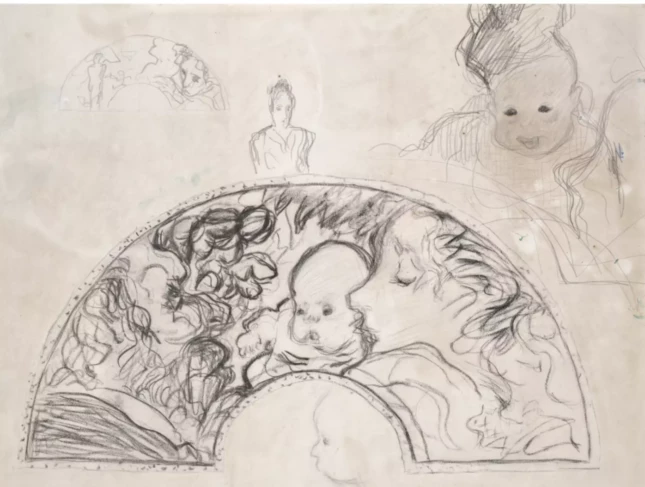
At the turn of the twentieth century, many painters were in the habit of making paintings on fans, an exercise whose chief function was to help make ends meet. Edgar Degas referred to them as his “articles, annoying to make.” Through June 21, the Musée d’Orsay is displaying a recent gift of 17 Impressionist and Post-Impressionist fans it has just received. Bonnard, too, made fans. A study for a fan depicting The Family of the Composer Claude Terrasse, in charcoal and executed around 1892, is estimated at €25,000.
Midi au jardin
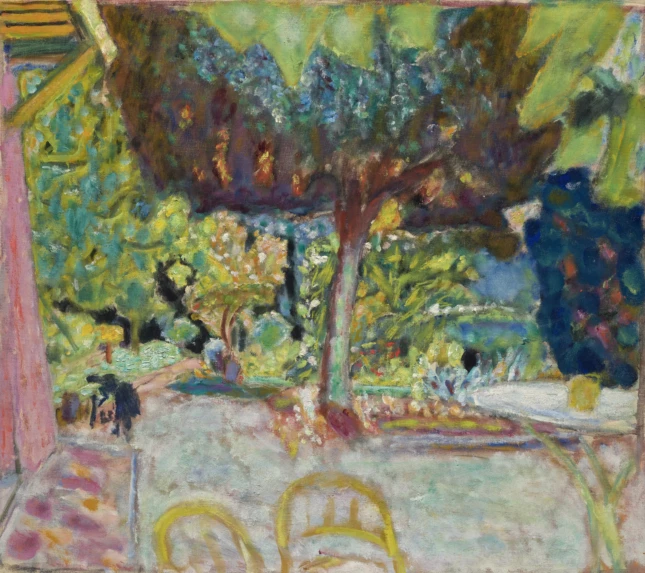
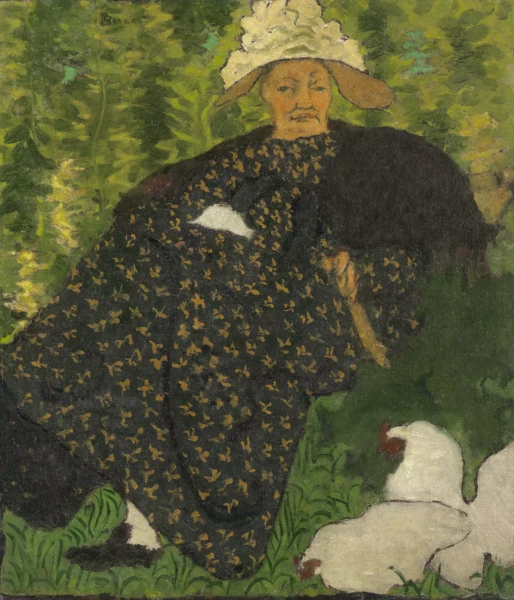
The most striking painting in the Terrasse collection was made just before Bonnard’s death, in 1946. It was exhibited only once, in 2006, in the retrospective organized at the Musée d’Art Moderne de la Ville de Paris. Midi au jardin shows a dark tree standing out against a range of greens. Estimated at €400,000, this composition, with its prestigious pedigree, should sell for a much higher sum.
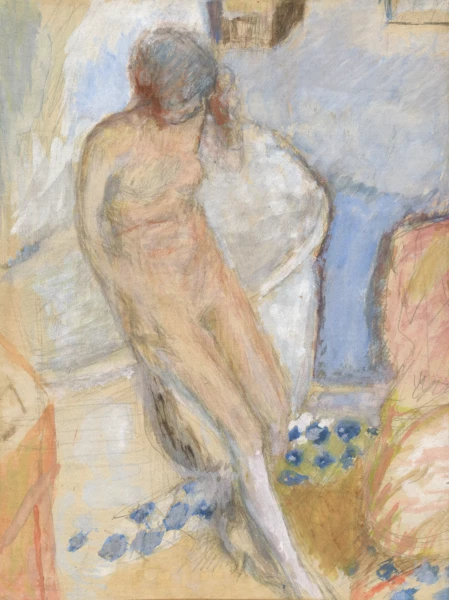
The same is true of Nu à la baignoire (estimate: €150,000), a gouache from the 1930s produced as a study for a 1931 painting now in the collections of the Centre Pompidou. In a world of melted whites and blues, a symbol of tranquility, the pinkness of Marthe’s body—the artist’s wife—appears in a mood of soft, vaporous gentleness. A small masterpiece. In the words of Valérie Didier, the Christie’s specialist for the sale, “The market has been flooded with Bonnards in recent years. Collectors favor works with exceptional provenance, as is the case here.”
Waddington-Custot gallery
In Paris, on April 8, the new Waddington-Custot gallery opened on rue de Seine. The French dealer Stéphane Custot, already established in Dubai and London, is showing both modern and contemporary artists there, but intends to make the Nabis one of his specialties. His inaugural exhibition is devoted to them, with five works by Bonnard on offer priced between €70,000 and €390,000.
“The Nabis have suffered through several successive downturns. First in the 1990s, with the disappearance of Japanese buyers, then around 2005, when collectors shifted massively toward contemporary art. For the past two years or so, we have seen a slight recovery in the market.”
Finally, the Paris market has recently been marked by the death of the dealer Waring Hopkins and the closure of Daniel Malingue’s gallery—its space was taken over by Kamel Mennour. Both, based on avenue Matignon, were major champions of the Nabis.
(1) Bonnard. Rothko. Color and light 1997 Pace Wildenstein. New York.
(2) Musée Bonnard is in Le Cannet also : https://museebonnard.fr/