the most fascinating exhibition
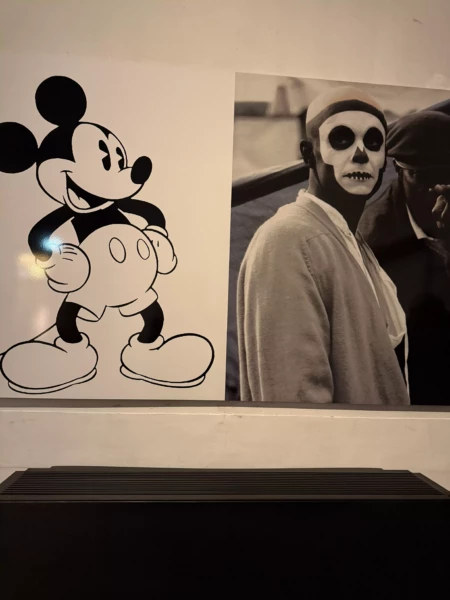
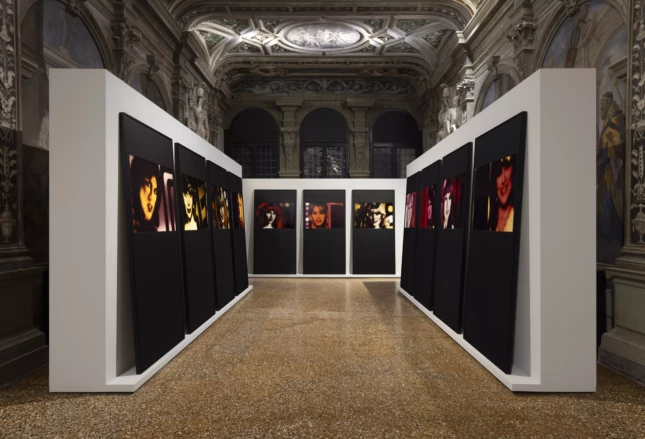
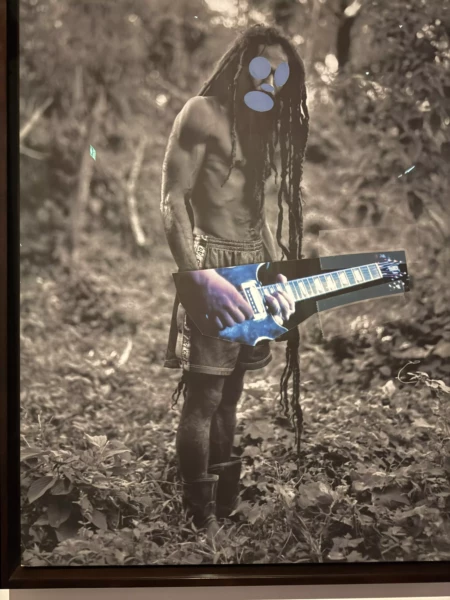
The most fascinating exhibition to see in Venice right now, at a time when the Serenissima has become the world capital of contemporary art thanks to its Biennale, is at Fondazione Prada. It is devoted to a dialogue between two American artists from different generations, Richard Prince(born1949) and Arthur Jafa(born 1960). One describes an America of popular myths, of straightforward glamour, and also of exhausted decadence; the other, a Black America marked by suffering, violence, and also glory through music. The whole is orchestrated by a well-known American curator, Nancy Spector, the former artistic director of the Guggenheim Museum in New York.
The aesthetic suprise
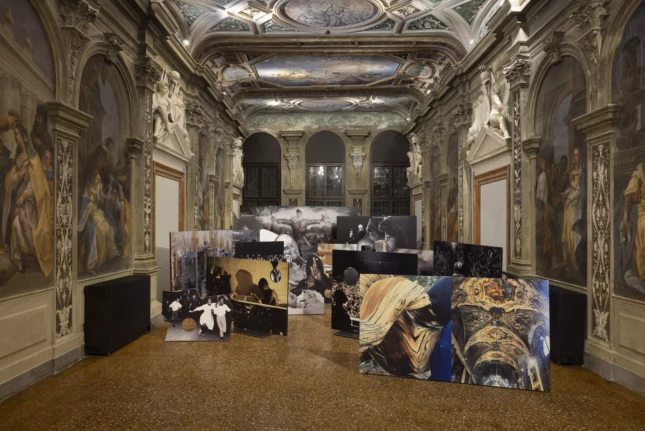
The aesthetic surprise of the project lies in the way the creativity of these three figures combines perfectly with the Fondation’s setting, a large, dark Baroque palace from the early 18th century, Ca’ Corner della Regina. Richard Prince certainly became famous through his magnified images of those solitary men of the American plains, cowboys, which were in fact clichés first taken from Marlboro advertisements. In the 1970s, long before the internet era, Richard Prince had a day job at the Time-Life press group that consisted of clipping articles and distributing them to the journalists who had written them. By the end of the day, only the advertisements remained in the magazines. The young Prince, fascinated by this raw material of pop culture, began sorting them. In this way he created a kind of catalogue of advertising imagery. Among them were the Marlboro ads that have since entered art history. In April 2020, in an interview with The New York Times, he explained: “With the cowboy ads, I could make something that almost looked like a still from a movie.”
Sustain Our Work with a Small Monthly Gift
Become part of the Judith Benhamou Reports circle.
Contribute, even from just €10
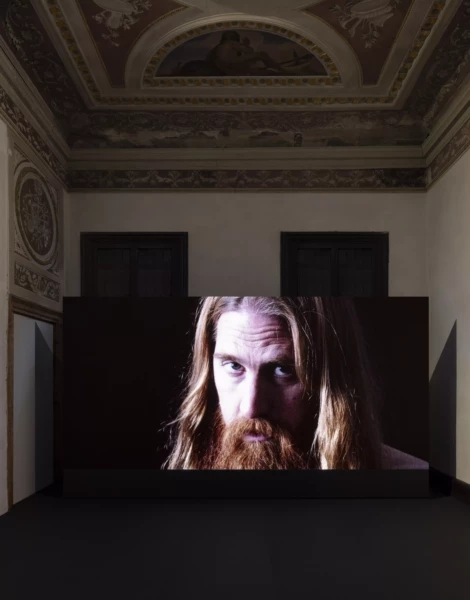
Jafa, first known for his absolute masterpiece of a video from the beginning of the 21st century, Love Is the Message, the Message Is Death, works from assemblies and combinations of images. I have followed him and interviewed him since 2017. Moreover, through July 5, MoMA in New York has also invited him to orchestrate an exhibition of 80 objects selected from the institution’s collections, under the title Less Is Morbid.
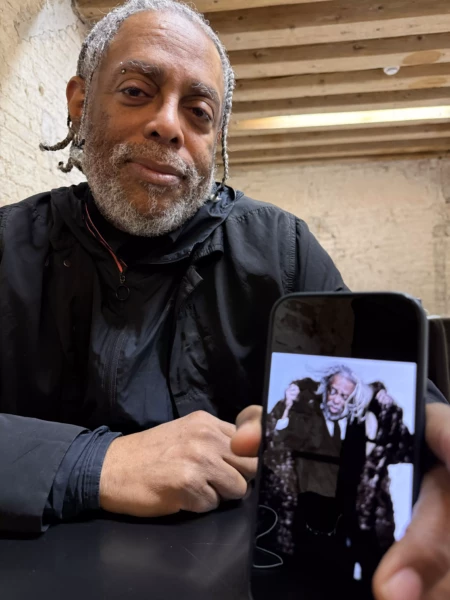
In Venice, on the occasion of our latest meeting, he speaks about his direct lineage from Richard Prince, their major shared point, which is appropriation, but also his idea of failure and the film project he is about to make.
One last detail: the title of the exhibition, “Helter Skelter,” refers, as is often the case with Jafa, to music. In this instance, it is a Beatles song, a highly unusual one within their discography, often seen as a precursor to heavy metal. In British English, a helter-skelter is also the name of a spiral slide.
The interview has been lightly edited for clarity and flow.
JB:Arthur, could we begin with the genesis of this project at Fondazione Prada in Venice?
AJ: I think the best place to start is Nancy Spector, who is the curator of the show. She came to visit me while she was doing studio visits with artists. I had never met her before, and I don’t know how familiar she was with my work.
As I often do, I was sitting in front of my computer, just talking. She noticed that I had a lot of Richard Prince images on the walls. It struck her, and she asked me why. So I explained to her everything I think about Richard Prince, his importance. I have talked about this quite a bit in the past.
Basically, in a nutshell, I have always seen myself a little bit as one of Richard Prince’s illegitimate children. I used to say that Richard Prince was the ultimate “ab-dad” — the bastard’s progenitor. The “ab-dad” does not necessarily know the bastard exists, but he is still the progenitor.
JB: That is very funny. When did you discover his work?
AJ: In the 1990s, mostly in magazines, in art journals. There was probably a ten-year gap between the first time I saw or read something about Richard Prince and the moment I actually saw a work by him in person. I may have seen one of the joke paintings at the Whitney Museum, something like that.
JB: But the joke paintings are not really part of your vocabulary.
AJ: Not at the moment. Anything can happen. I’m working my way through his work.
JB: So Nancy Spector identified many points of connection?
AJ: She was curious about that connection with Richard Prince. It may not be immediately obvious at first glance, but I think it is pretty apparent. At least 75 percent of what I do would not have been possible without his precedent. Very directly. Appropriation, for example.
JB: That is a major tribute.
AJ: It is simply a fact.
JB: Did you tell him that when you met him for the first time?
AJ: In a way, yes, but maybe not exactly in those words. When I got to Gladstone, (Barbara Gladstone Gallery) I spoke with Barbara Gladstone about the fact that my career as an artist had taken off late. Later than others, obviously. Barbara always said to me: “I have seen every possible version of recognition. A little too late is always better than a little too early. You are exactly on time.”
She often used Richard Prince as an example. She said that Richard had, in a way, been responsible for many things around him from the beginning — Jeff Koons, for example, though of course those artists did their own work. But Richard was organizing things, he was involved. That whole group of men, his peers, became very rich and very famous, and he did not, at least not right away. That obviously disturbed him.
His wave came later, maybe ten years after the others. And, apart perhaps from Jeff Koons, he has probably had the longest and most substantial career. Barbara would say to me: Richard Prince is a very good example for you, a very good model.
Then, as she got to know me better, she understood how much his work mattered to me. She even gave me a work by Richard Prince.
JB: Really? Which one?
AJ: I don’t remember the title. It was one from his gangs series. They had done an exhibition of them, which, to my mind, was incredible. Barbara said to me: “You know, when we first showed these twenty years ago, we didn’t sell a single one.” I was stunned. I couldn’t understand it, because those works are among my favorite series by him, probably in my top two or three.
For years, I had kept an article from Art in America about those paintings — literally for twenty years. And these were the paintings from that article. I could not believe that none of them had sold. One day, Barbara saw me walking through the space looking at them and said: “I’m going to give you one.”
I said: “What?” And she said: “Yes. And I know which one you like best.” I asked her: “How can you know that?” She said: “I can see it.” And she was right. She chose the one I preferred. It had hair metal musicians and King Kong on it.
JB: That is exactly your vocabulary.
AJ: I don’t think anyone could confuse my work with Richard’s. But without his precedent, without the fact that he pushed appropriation so far, it would have been much less straightforward for me. There are related strategies, and a lot of thematic overlap. We are both interested in American outlaw culture. I am interested in Black culture, which is, in fact, an American outlaw culture.
JB: Two sides of the same coin.
AJ: Absolutely.
JB: That is exactly what one feels when entering the exhibition. You are both speaking about the same thing: the dark side of American culture.
AJ: Yes, the dark side. Which is, in reality, American culture itself. Richard and I were talking about Cormac McCarthy and his novel Blood Meridian, and the way that book offers an incredibly incisive vision of the West, of contemporary Western civilization.
When I joked about Richard, I would say that we — meaning Black artists — are the illegitimate sons and daughters of Western art. Because we are very largely a product of Western art.
JB: You are part of it.
AJ: Totally.
JB: And today, you are an important part of it, thanks to you and a few other artists.
AJ: Mostly thanks to Jean-Michel. Honestly, if one has to give credit to someone, it is Basquiat. Black artists were part of the Western artistic tradition long before him, of course. But in terms of the ability to exist within the dominant art world, he is the beginning.
JB: And appropriation? How do you experience it? Stealing? Sampling? Is it moral?
AJ: I’m not interested in morality. I’m maybe more interested in ethics than morality. It is a pure, raw creative impulse: seeing something.
Of course, I have an intellectual framework. For me, Richard is the person who, more than anyone else, saw — or began to explore — what was on the other side of Duchamp’s urinal. I don’t know if Duchamp was the best artist of the 20th century, but he was clearly the most interesting. The urinal completely transformed our understanding of what art is.
But then the question becomes: what is on the other side? Richard, more than anyone else, explored what happens when you take something that, apparently, is not art, that you did not materially make, and through a kind of conceptual spell, turn it into a work of art.
JB: Duchamp did not produce very much. And he was an art dealer. He sold Brancusi and Picabia.
AJ: I know. But what I mean is that he was a genius.
JB: A genius, yes. He did not want to produce, he repeated his own work, with La Boîte-en-valise and later editions. And at the same time, he was an art dealer with his brain.
AJ: If you think in terms of Black aesthetics, you see this very clearly in music: the way people recycle music, dub versions, remixes. That is what Duchamp was doing. He was remixing his own work.
JB: That is a very good idea.
AJ: I wrote about this in an essay called My Black Death. One of the things I said there, and that I still think is true, is that Duchamp was part of Picasso’s crew. He made his Cubist paintings, Nude Descending a Staircase and those works. But Duchamp was smarter than everyone else in that group. Not necessarily the best artist, but certainly the smartest.
Picasso, Matisse and the others saw the formal implications of African artifacts. But Duchamp was the only one who understood that the energy around those artifacts came in large part from their contextual dissonance: a Black thing in a white space. I think Duchamp tried to recreate that energy, that friction. And that is how he arrived at the urinal.
JB: You are right. Duchamp came to America very early. Picasso never went to America. Matisse went there almost by accident. Duchamp also had a Brazilian mistress with whom he was very much in love. That may be connected to this question.
AJ: Absolutely. That is research. Think of Le Corbusier and Joséphine Baker. There is a cross-pollination there.
JB: Joséphine Baker and Le Corbusier? Yes. They met on a boat. He was so fascinated by her that he drew her while she slept.
AJ: Some of his buildings were said to have been based on the curve of her body, of her backside.
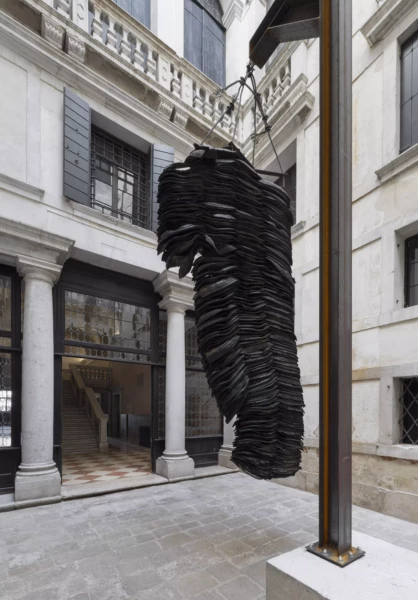
JB: Magnificent. To return to other curves: when you arrived in this palazzo in Venice, did you think it could suit your aesthetic? There is this gap between the grandeur of the palace and the darkness of American culture.
AJ: It is delicate, because I don’t want to speak for Richard. The Richard I speak about is, to some degree, the Richard of my imagination. I have got to know him, and he is incredible. But there is Richard the person, and then there is Richard the myth, or the legend.
That said, if I speak for both of us for a moment: we are savages.
JB: You are less savage than he is.
AJ: I don’t think so.
JB: He is tough.
AJ: He is very tough. He came here, looked at everything, made very discreet and very beautiful suggestions, edited the whole thing. But he is a real savage.
JB: And you, are you a savage?
AJ: In the sense that Americans are barbarians. When you ask whether we thought about the palazzo — no, not at all. We didn’t care about the palazzo. We were just doing our thing.
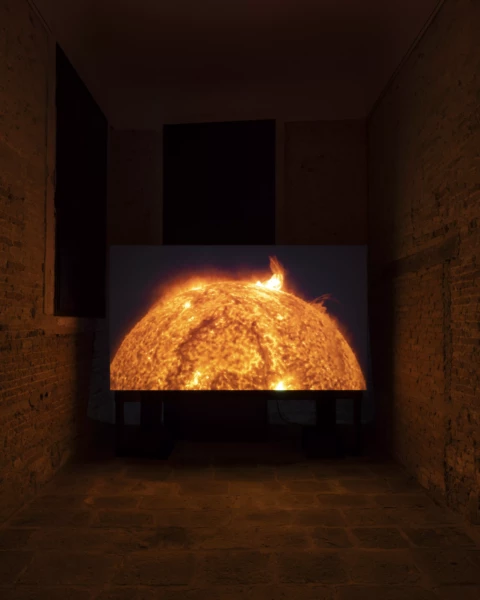
JB: And yet the result works perfectly. It is a surprise.
AJ: A lot of people have said that to me: it is unexpected, but unsettling. It works. But again, his work is one of the foundations from which my way of thinking about what I do was formed. So there are correspondences. I have looked at his work for so long, since my early twenties. At a certain point, it becomes internalized. It is metabolized.
JB: The other point in common is that you say you are savages, but you are also very sophisticated. Richard Prince is extremely sophisticated.
AJ: Nobody is more sophisticated than Richard.
JB: He is a bibliophile. His book collection was shown in Paris, and it was extraordinary.
AJ: Totally. But I don’t see any contradiction between being savage and being sophisticated. What I mean is that we are not going to let rules get in the way of what we want to do. That does not mean we ignore the ethical implications of appropriation, theft, sampling, whatever word one uses. It simply means we do not let them constrain us.
If you have ever seen Richard’s deposition — that 67-hour courtroom video — it is incredible. The lawyers try to trap him, and he simply answers the questions. Warhol is obviously a precedent. Richard was not the first to do this. But I don’t think anyone pushed it as far as he did.
I don’t necessarily steal the things he did. But if I have any sophistication, it lies in what I choose to steal, if one wants to call it stealing. I say “stealing” because I am not trying to deflect the way people want to formulate things. That does not interest me.
More and more, I say that I am less interested in making works about Black people than in making works like Black people. One of the things specific to Black people is that we have a very complicated relationship to ownership and proprietary values, because we were owned. So we do not necessarily respect those property laws in the same way. There is a form of radical pragmatism that consists in using what is available. And what is available is what surrounds us.
A large part of Black creativity, in my view, has to do with immaterial invention rather than material invention. Mainly because we did not have control over matter. We were matter. So a large part of our creativity is located in immaterial expression: music, dance, all those things.
JB: What you are saying is very important.
AJ: Even the fact that Black people enter art is interesting, because art largely involves manipulating matter. But the way we approach matter, the way we understand it, can be antagonistic to the great Western ideas about matter.
JB: Before sleeping, our brain is full of the images of the day, of music, of the newspapers we have read. Everything dances in our head. That is also what happens in some of your works.
AJ: Ultimately, I try to facilitate the emergence of works that are, on some level, quantum. I am not interested in pedagogical or simplistic things. I am not interested in “A is for apple, B is for ball, C is for cat.” I want things that have ontological integrity.
What I mean is that, as things, they are undeniable. My model is not necessarily art. What I aspire to is more like a mountain — Mount Fuji or Kilimanjaro. Is it a good mountain or a bad mountain? A beautiful mountain or an ugly mountain? That seems irrelevant to me. It simply is. My criterion is this: you have made a thing that cannot be denied when one sees it.
JB: I have interviewed you several times. Once, I came specially to Turin to meet you. I asked you about success, and you told me that, because success had come very late, whatever happened in the future, you would always be a man without success. A failure. Do you still feel that way?
AJ: Yes.
JB: Really?
AJ: Yes. The question came up again the other day. This whole idea of failure as an identity, as a badge — all of that is in the mind. I was talking about the French painter Bouguereau. He painted religious pictures and he was the greatest painter in the world. Today, nobody knows his name.
JB: William Bouguereau. Naked women in religious poses.
AJ: Exactly. So what is success? We don’t know. Success is determined in the flow of things. But in terms of identity, of self-understanding, between my twenties and my fifties, I had consolidated the idea of myself as a failure. Not as someone who had had no success, but fundamentally as a failure.
I still feel that. Every time I make an exhibition, I feel as if I am trying to prove something, to myself or to others.
JB: But that is good, isn’t it? Imagine someone who no longer had anything to prove.
AJ: Maybe. I still feel as though I am going to be found out. I have a very severe impostor syndrome. It is not that I lack confidence intellectually. I have always thought very seriously about the things that interest me. That is why the line I say most often now is: my art may be hit or miss. You can think whatever you want to think about it. But my rap is fucking elite.
That is undeniable. If only I could be paid for my discourse… I am trying to close the gap between my work and what I say.
JB: And now, what comes next?
AJ: I am going to make a film. A large part of what I am doing now consists in clearing the space I need to make my feature film.
JB: When?
AJ: Next year. I am ready.
It is funny. When I came in here and saw that the cut-outs of the work upstairs had been unpacked, they were not yet perfectly arranged. They were simply placed more or less where they needed to be. And the first thing that came to my mind — and it made me laugh — was: now I am ready to make my film.
JB: Thank you, monsieur.
AJ: Thank you always