Bold geometric forms
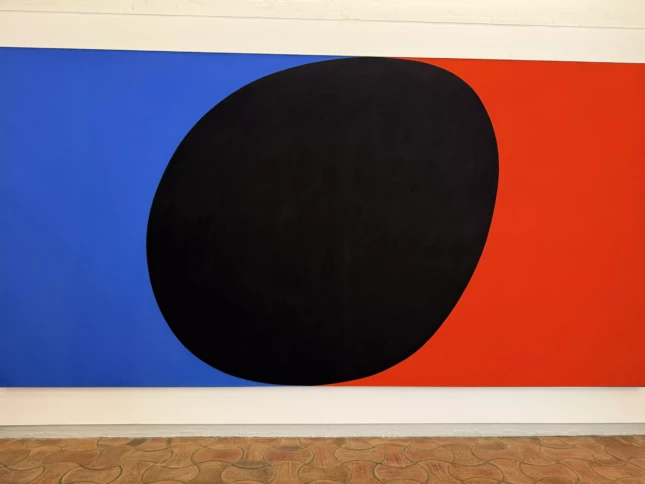
An immersive plunge into color. Bold geometric forms—squares, polygons and sweeping arcs—unfold across monumental canvases. Fiery reds, deep blues, luminous yellows and immaculate whites collide with striking intensity. This is the world of Ellsworth Kelly (1923–2015), one of the giants of American abstraction.
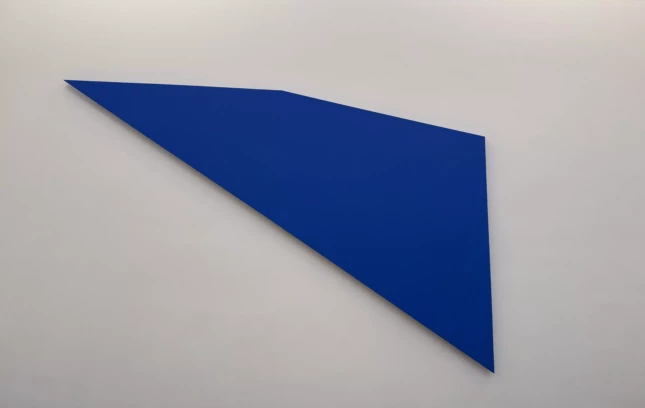
Yet it would be misleading to see his work as springing exclusively from the American tradition, whether that of the Abstract Expressionists such as Mark Rothko or the Minimalists like Sol LeWitt.
Sustain Our Work with a Small Monthly Gift
Become part of the Judith Benhamou Reports circle.
Contribute, even from just €10
Kelly developed the foundations of his artistic vocabulary during the years he lived in France. Indeed, in the United States he was often regarded as “too French.”
Isabelle Maeght
As early as 1958, the Parisian Galerie Maeght devoted a solo exhibition to his work. “We sold only one painting out of the twenty-two large-format works on display,” recalls Isabelle Maeght, granddaughter of the gallery’s founders, with characteristic wit.
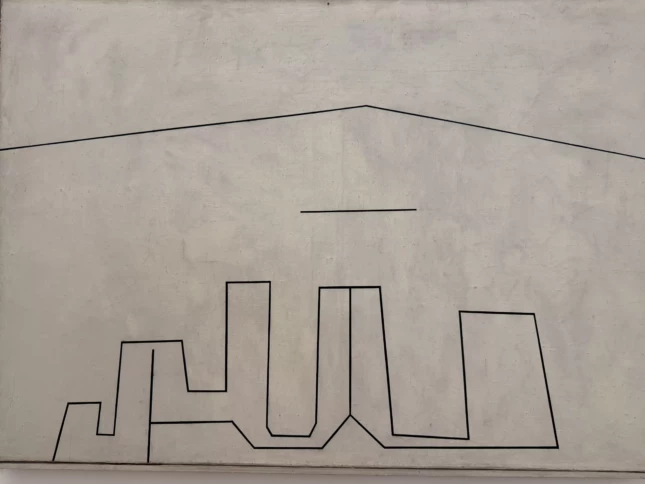
In France, following exhibitions at the Collection Lambert in Avignon in 2018 and the Fondation Louis Vuitton in 2024, it is now the Fondation Maeght (until 13 November) that turns the spotlight back on Kelly. Curated by Éric de Chassey, director of the École des Beaux-Arts de Paris and one of the foremost specialists on the artist, the exhibition uses Kelly’s fascination with water as its guiding thread. The result is both scholarly and remarkably accessible, demonstrating why his work occupies such a singular place in the history of modern art.
Jack Shear
Kelly always began with close observation of the world around him: the shadow cast by a window, the reflection of water shimmering across a wall. From these seemingly ordinary details, he distilled powerful compositions of form and color. His work embodies a remarkable paradox: although entirely abstract, it is rooted in direct observation of everyday reality.
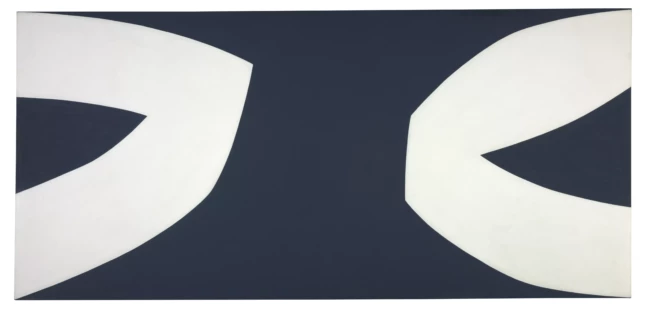
“His entire body of work is based on that. He looked at reality differently,” says Jack Shear, photographer, collector and Kelly’s partner for twenty-seven years.
The result is unmistakable. Kelly’s paintings are instantly recognizable. He never sought to assign meaning to his compositions. One of his best-known remarks perfectly captures his philosophy: “Everything is beautiful except what man has intentionally tried to make beautiful.”
Emerging abstraction
Kelly first arrived in France in 1944 with the American army. As it happens, he served in a unit devoted to camouflage. He returned from 1948 to 1954, and it was during those formative years that his abstract vocabulary truly emerged.
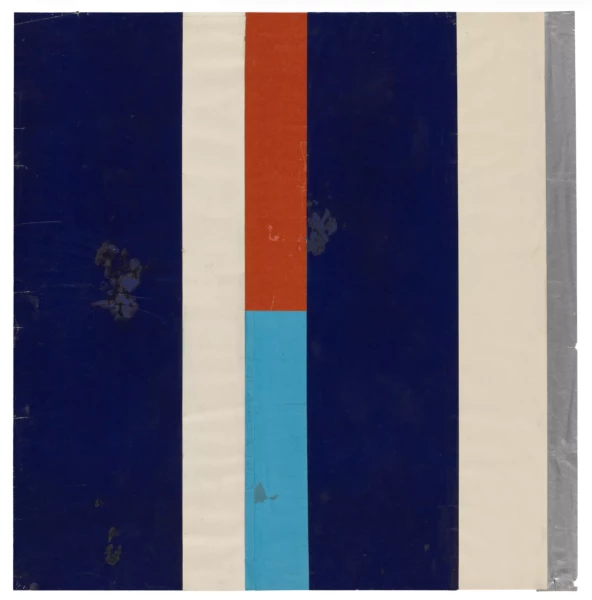
He appears to have experienced a kind of artistic revelation at Giverny, in the footsteps of Claude Monet. One of the highlights of the exhibition, Tableau Vert (1952), an almost monochrome canvas immersed in aquatic greens, clearly echoes Monet’s celebrated Water Lilies.
Above all, however, it is impossible not to see Kelly as the rightful heir to the late Matisse, whose cut-outs transformed colored shapes into autonomous forms. (Visitors should also not miss the outstanding exhibition Matisse 1941–1954, on view at the Grand Palais until July 26.)
Creative process
One of the exhibition’s greatest strengths is the way it patiently unpacks Kelly’s creative process. “From his 1973 retrospective at MoMA onwards, Kelly himself chose to display the sources of his inspiration,” explains Éric de Chassey.
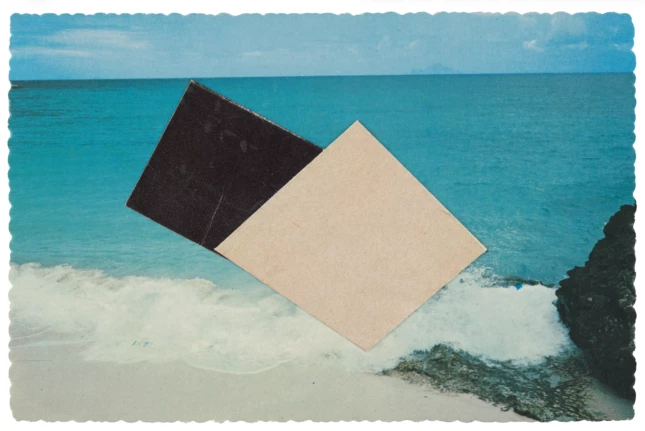
Photographs, drawings and an important group of postcard collages reveal how he gradually constructed his visual universe.
Finally, in the Fondation Maeght’s magnificent sculpture garden, alive with the sound of cicadas and shaded by towering pine trees, among works by Miró and Calder, visitors are greeted by a painted steel sculpture stretching four metres in length: a sweeping white curve ending in a sharp right angle. It stands as a powerful embodiment of Kelly’s art—at once rigorously abstract and deeply rooted in the physical world.