The history of African American art
He’s the missing link in the history of African American art: Ulysses Jenkins (born in 1946). We could locate him within this chronology between Charles White, a chronicler of black society through painting, who Ulysses was taught by, and the major artist of the current age, Arthur Jafa, who created the filmic masterpiece “Love is the message, the message is death”. The latter clearly discovered him in Los Angeles at the Hammer Museum, at the exhibition dedicated to him which ran until May 2022 (See here the last report about Arthur Jafa).
Sustain Our Work with a Small Monthly Gift
Become part of the Judith Benhamou Reports circle.
Contribute, even from just €10
Documenta
Ulysses Jenkins was a friend of David Hammons from the time when Hammons still lived in California, and he features in several of his videos. Jenkins also took part in Documenta in 1992. And yet for a very long time he has remained forgotten.
Video Griot
Until 30 July the Julia Stoschek Foundation in Berlin is taking their turn to showcase the work of this long overlooked artist, primarily comprising video. His rediscovery is owed to two curators, Erin Christovale and Meg Onli, who delved into and filtered through Jenkins’s archives. Onli is incidentally also due to be co-curating the next Whitney Biennial in 2024. Ulysses Jenkins did not travel to be here, but a very interesting video features him on the Hammer website, and from the outset the man described as a “video griot” accepts one thing: it’s difficult to pin down his work.
Experimental and psychedelic

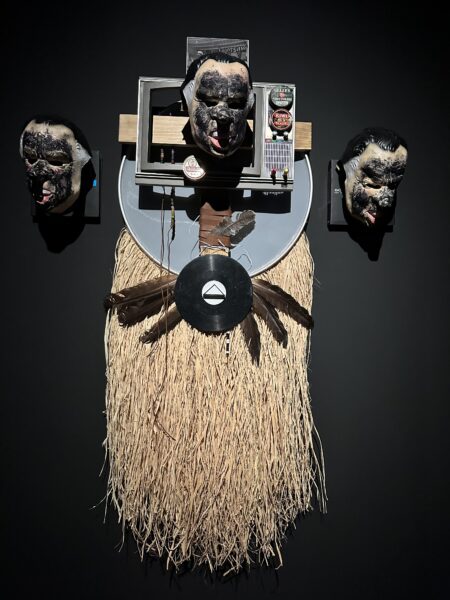
Ulysses Jenkins, the trailblazing black video artist, worked in an experimental, psychedelic, off-the-wall style: free. The market didn’t pose any kind of constraint for him because it didn’t even exist in this area. He took his first artistic steps as an abstract painter and sculptor before switching to moving images.
Meg Onli sums up for us the fruit of her research:
Kerry James Marshall

“In Los Angeles he was part of a burgeoning artistic community. Ulysses collaborated with many other artists such as David Hammons, Maren Hassinger, Senga Nengudi. He met Kerry James Marshall around 1978-79 (See here the report about the retrospective of Kerry James Marshall). There were four black students at the Otis College of Art. Today Los Angeles is an epicentre for art, but this wasn’t the case at the time. Ulysses studied with artists such as Betty Saar and Chris Burden. He showed his work very early on to Nam June Paik when he was visiting UCLA, and he really encouraged him.
David Hammons
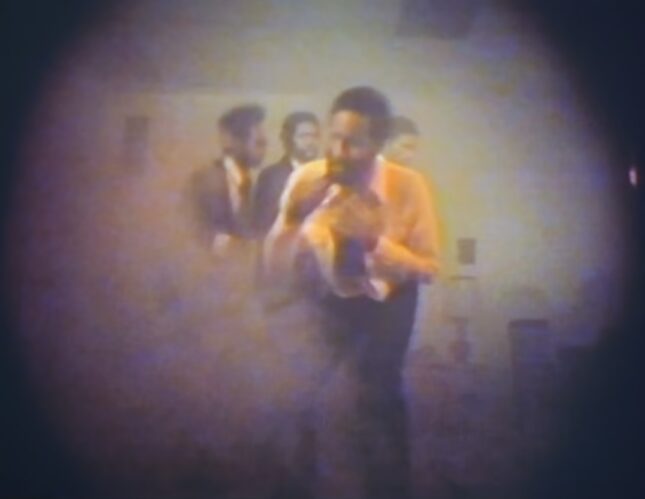
The story I heard from Ulysses was that one day he went home and David Hammons was on his sofa. He had heard people talking about him and wanted to know who he was. They became friends. When he had to leave for New York, Ulysses made a video resembling a documentary entitled King David, but actually it was David Hammons playing David Hammons. Since then they have always been in conversation. There is a video from 2006, if I recall correctly, called “in the midnight hour” where they are also in dialogue.
Dignity
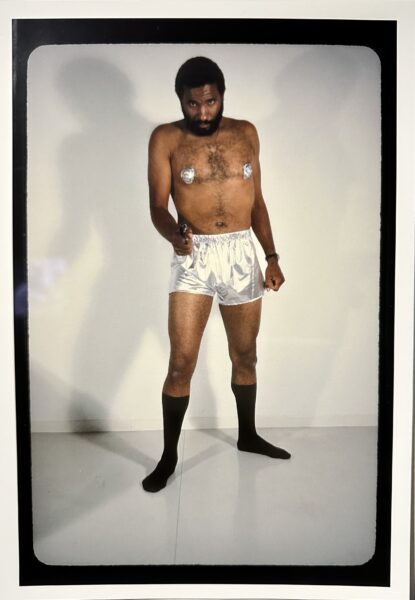
Charles White had a big influence on Ulysses. He was his teacher. One of his major preoccupations was the question of representation with a particular interest on the subject of dignity. What is the meaning of our representation within the community?
He wants to produce his own images, far from stereotypes, through his critique of the mass media.
Experimental artist
“Ulysses was an early experimental artist. He is very interested in found media. In this respect he is a worthy predecessor to Arthur Jafa. The same goes for Khalil Joseph and his Black New Project BLKNWS (1) which also draws on Ulysses’s legacy. Because from the 1970s onwards Ulysses literally produced community news in LA.”
Ulysses Jenkins is the grandfather of African American video art.
(1) A conceptual news program shown for the first time at the Venice Biennale taking the form of a two-channel installation connected to a newscast that blurs the lines between art, reporting, entrepreneurship, and cultural critique.