contemporary canon
When Ralph Rugoff, who for 20 years directed one of Britain’s leading institutions for contemporary art, the Hayward Gallery, decided to organize his final exhibition there as a farewell, he chose Anish Kapoor. The British artist, born in India in 1954, has long since entered the contemporary art canon. More unusually, he has never stopped reinventing himself.
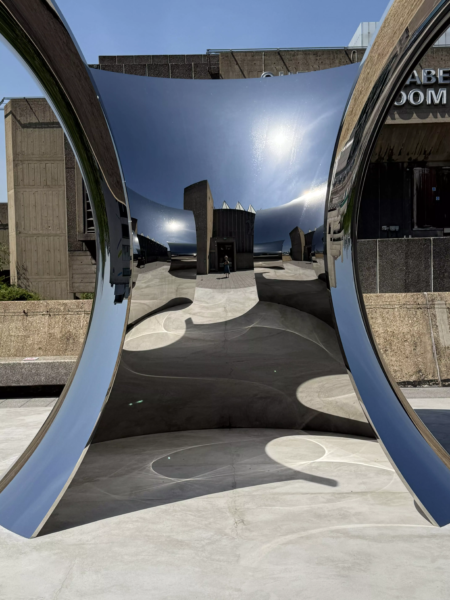
And this was already clearly visible at his Venetian foundation, Palazzo Manfrin, on the edge of the Ghetto, where his work could be seen through August 9.
Sustain Our Work with a Small Monthly Gift
Become part of the Judith Benhamou Reports circle.
Contribute, even from just €10
optical illusion
One of Kapoor’s first key exhibitions had already taken place at the Hayward Gallery, in 1998. The ultimate consecration came in 2009, with a retrospective at London’s Royal Academy that proved a major public success. In France, he made a lasting impression with Leviathan, his monumental installation at the Grand Palais in 2011, before temporarily “taking up residence” at the Château de Versailles in 2015.
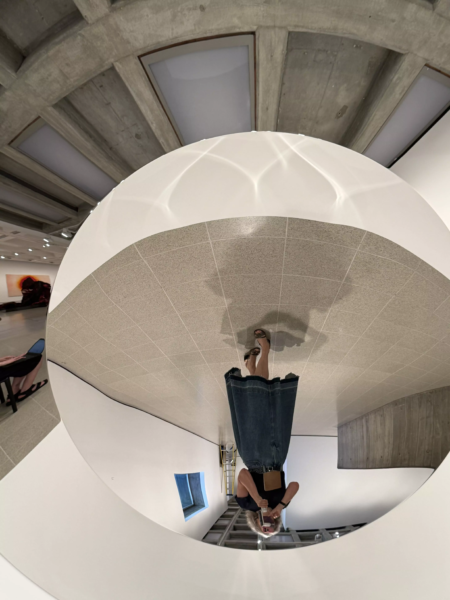
During the first part of his career, Anish Kapoor became known for inventing a world that, to put it briefly, played with optical illusion. At the same time, however, he was making a very different kind of work, engaging with dirty, repellent matter — the kind we usually prefer to keep out of sight. His Instagram handle, “Dirty Corner,” neatly sums up the spirit of this body of work.
First, giant blue discs
“Part of my work deals with our perception of reality. Is it full? Is it empty?” he told us in Florence in 2023, on the occasion of one of his exhibitions.
He was referring to some of his best-known works: giant saucer-like forms, presented like paintings on the wall and hung vertically. They are covered with an unfathomable powdery material which, combined with the concavity of the object, disrupts any accurate perception of its form.
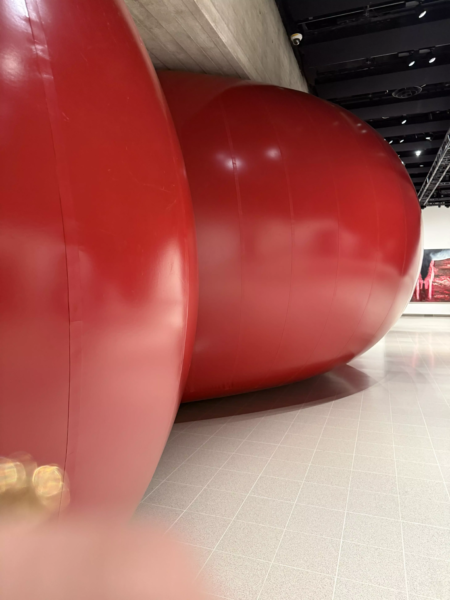
At first, these giant discs were often blue, in the exact shade associated with the celebrated French artist Yves Klein and his works coated in IKB, or International Klein Blue. Last year, the Jewish Museum in New York gave an excellent account of Kapoor’s early work.
sculpting raw color
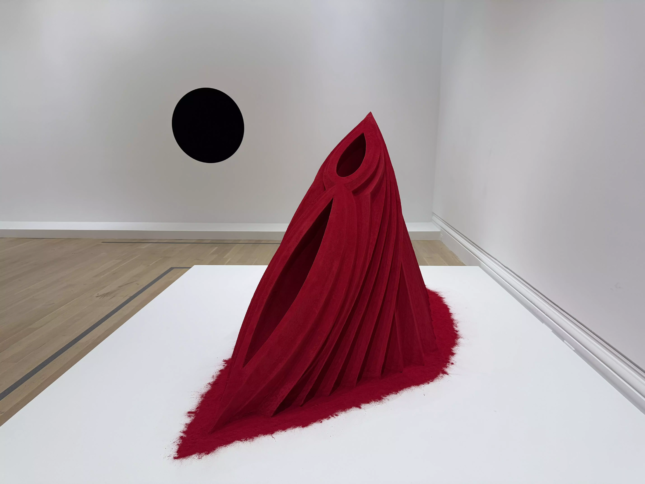
Even then, the artist was literally attempting to sculpt raw color.
Since then, the palette and the effects have multiplied, as can be seen today in the Hayward Gallery exhibition, on view through October 18. The show surveys 50 years of his work.
Today, his giant “discs” exist in an infinite variety of forms: in gleaming metal versions with mirrored effects, in color gradients, and even engraved with geometric patterns that generate kaleidoscopic effects. For his concave forms, he has also used an almost unreal, ultra-black material, the celebrated Vantablack, composed of carbon nanotubes. “This black is both a reality and a fiction,” he comments.
breathtaking part of the exhibition
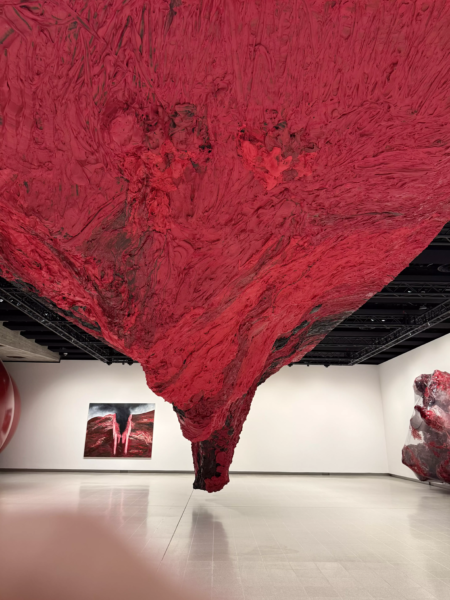
If Anish Kapoor once had his blue period, or his black period, in recent years he has developed a new blood-red vocabulary. This is the breathtaking part of the exhibition.
As he told us in 2023: “Today violence is everywhere. The body is at the center of my project.”
One of the most spectacular installations, Mount Moriah at the Gate of the Ghetto (2026), is a giant form hanging from the ceiling that resembles exposed flesh, or the invasive growth of some primordial womb.
In a similar vein, Ritual Expiation, made entirely of illusionistic resin, evokes oversized entrails: viscous, dripping, spread out before us. In the Bible, Mount Moriah is the place where Abraham was supposed to sacrifice his son at God’s command.
Imagine someone carrying a bomb
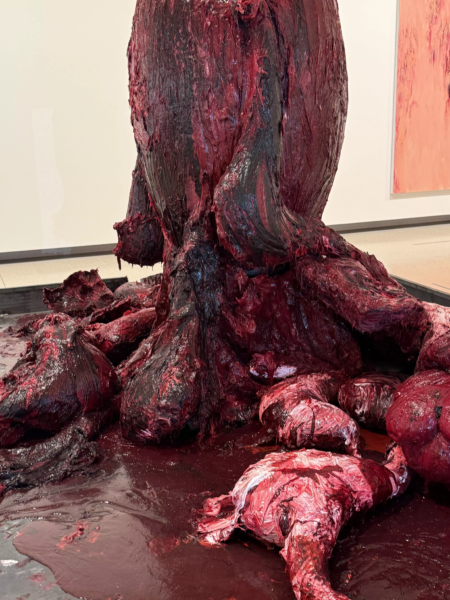
“The recent works evoke the idea of ritual. It is a deeply violent space and a sacred one at the same time. What is a ritual act? It is always a murder. Imagine someone carrying a bomb. The bomb explodes. What does that say? You are not killing yourself only for an emotional, political or other reason. You are going to paradise. The body itself is scattered into pieces.”
In the exhibition catalogue, the French writer Julia Kristeva has published an open letter to the artist. She writes: “You do not take leave of abjection. For me, your ‘abjects’ make me think of the Holocaust. Unnamed. Unnameable …”
The experience of visiting Kapoor’s exhibition at the Hayward Gallery does not leave you unscathed.
Through October 18.