global fascination
In contemporary art, certain young artists become the object of instant global fascination. Their power of attraction spreads across the planet, from museums to auction houses, via collectors. The German artist Florian Krewer, who lives in New York and was born in 1986, is one of painting’s current darlings. He is now the subject of a small exhibition inserted into the permanent collections of the Musée d’Art Moderne de la Ville de Paris through January, following the donation of three works to the municipal institution. It is worth noting that the show is sponsored, among others, by an Indonesian couple of collectors, Arif and Dianne Suherman.
Visual shock
We also know that his works have already been acquired by institutions such as the Metropolitan Museum, LACMA in Los Angeles, the Centre Pompidou and the Pinault Collection. At auction in 2026, in an uncertain climate for young artists, one of his paintings sold for 219,000 euros.
Sustain Our Work with a Small Monthly Gift
Become part of the Judith Benhamou Reports circle.
Contribute, even from just €10
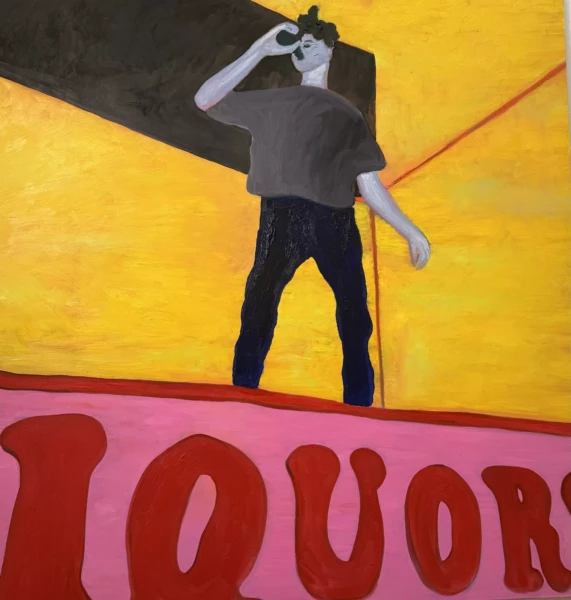
The visit to the Paris exhibition explains this success: the experience is a visual shock. It goes without saying—and it is worth stressing—that the visual effect of reproductions bears no relation to what one feels when seeing the works in person. A series of large canvases, in powerful, contrasting colors, are hung close together, almost edge to edge.
ghostly figures
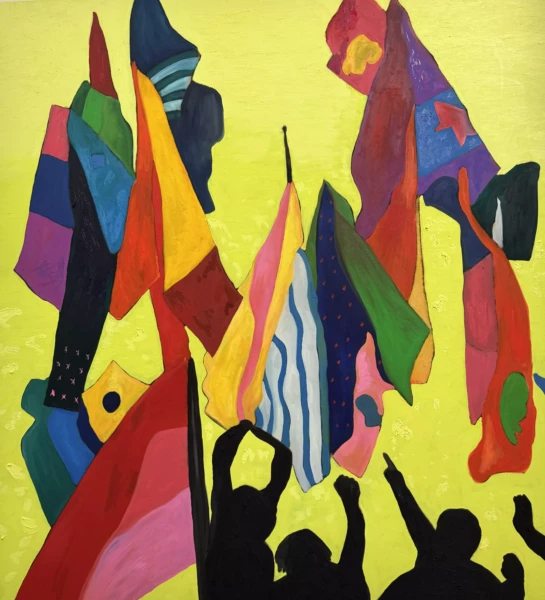
Krewer is a figurative painter, an expressionist in a twenty-first-century mode. His figures and animals — and there are many animals — are ghostly. In fact, he tends to describe situations whose meaning is never explicitly revealed. That is what makes them fascinating.
He himself has an almost childlike face. He speaks gently and attentively. This contrasts sharply with the appearance he has chosen for himself: tattoos all over his body and face, even on his eyelids. Above his eyes, two words have been marked indelibly: “Fear” on one side and “Love” on the other. One understands immediately: Florian is an intense being.
Against an acid-green background, he painted “La maison de l’espoir,” a dance of flags of every kind carried by figures shown as silhouettes, like shadow puppets. An expression of nationalist claims? “We are living through a very worrying period,” the artist says softly.
Violet body
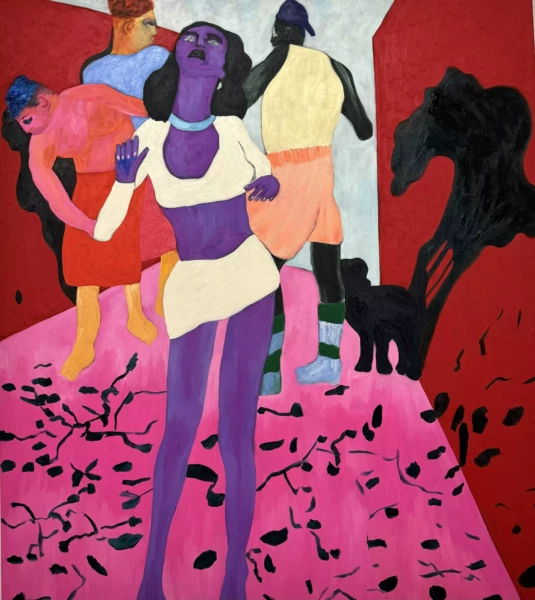
In another urban composition, in the foreground, he depicts a woman with a violet body; behind her, young men, baseball caps worn backward, their silhouettes blue, pink or black, seem to be searching for something on the ground. Each of them is looking in a different direction.
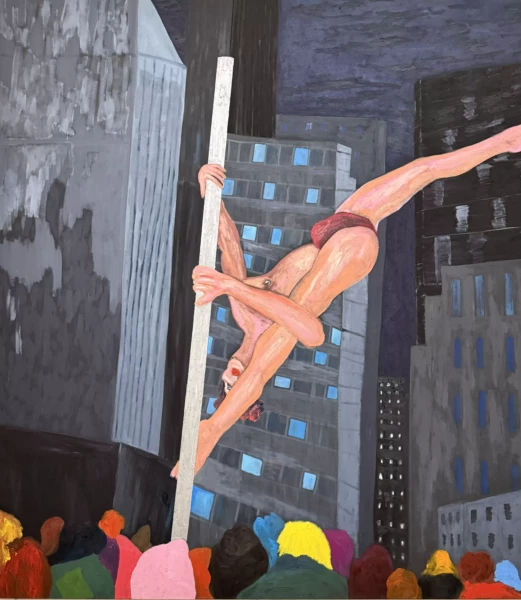
“I often take photographs of friends, of people close to me and so on, whom I catch in interesting movements. From that I sketch a drawing that gives the composition a direction. Then I enter a kind of tunnel. In my studio in the Bronx, I try to be in a state of calm. But I like not having everything under control. The conception of a painting can take from a week to a month, and sometimes I go back to it. It can also happen that Gordon — Gordon VeneKlasen, owner of the eponymous gallery in New York and London — comes by and challenges me…”
to be different
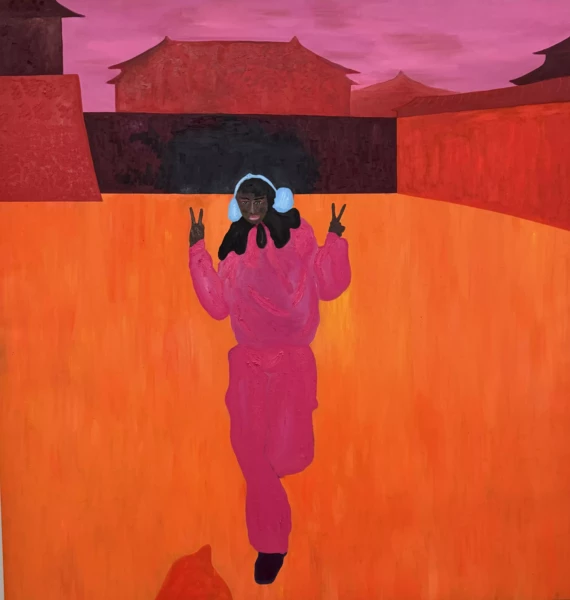
Unlike many painters, Florian does not want to keep the works around him. “It is too painful. I like them to be elsewhere, safe. And I want to continue on my path.” He confesses that since he has been in New York, he feels better, because people there accept different personalities more readily than in Germany. What is at stake here is sexuality, femininity, transgender identity: belonging to a minority that can assume what it is.
Peter Doig
No biography of the artist fails to mention that, at the famous Kunstakademie in Düsseldorf, he was a student of one of the maestros of contemporary figuration, Peter Doig (born in 1959). While Doig uses colors that are just as powerful, he also works extensively with motifs, whereas Krewer practices forms that are at once somewhat soft and stripped down.
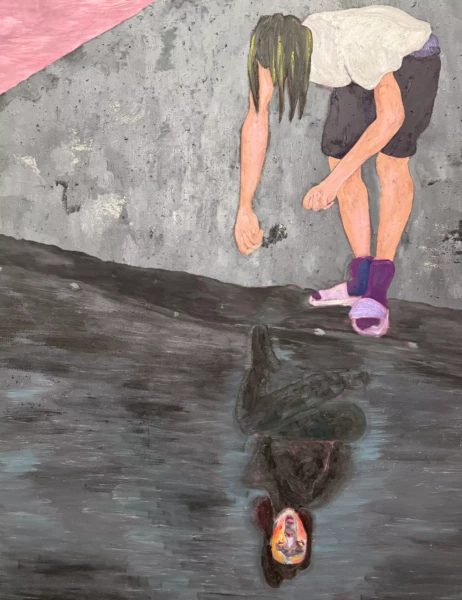
And when Florian is asked about his artistic references, he speaks first of Goya, then mentions Baselitz, who is on view at the Musée d’Art Moderne. “It is extraordinary to be here. For now, I have no other dream,” he concludes.