The power or ordinary objects
You will never look at a bottle rack the same way again. Nor at a urinal. Since the early twentieth century, thanks or owing to Marcel Duchamp and his famous “readymades,” ordinary objects have been granted a kind of superpower, conferred by the sole decision of whoever arranges them and proclaims himself an artist. That gesture opened one of the major chapters in the history of twentieth-century art. In the early 1960s, for instance, as an echo of the world’s hyper-industrialization, a creation stripped to its barest essentials emerged in the United States, devoid of feeling or flourish: Minimal Art.
Arte povera
It took industrial elements as they were, wooden or metal beams, crates, neon tubes, and transformed them, at grand scale, into works of art. One might also recall, in the late 1960s, those Italian artists who, with their Arte Povera, made use of raw, rough, even archaic materials, tree branches, coal, glass, to propose new forms.
Sustain Our Work with a Small Monthly Gift
Become part of the Judith Benhamou Reports circle.
Contribute, even from just €10
minimal langage
The Palestinian-Lebanese artist Mona Hatoum, born in 1952 and based in London, is the legitimate heir to all of these movements. “After a period devoted to video and performance,” she says, “as soon as I had the opportunity and returned to working with materials, I used that minimal language.”
As early as the 1990s, Hatoum was a pioneer in this regard. She invented three-dimensional works built from juxtapositions, accumulations, and transformations of common objects that take on poetic meaning, an almost psychological dimension.
3 monumental works
Through November 9, she is the subject of a forceful exhibition at the Fondazione Prada in Milan, not vast, but precise. She had been offered an enormous space. But Mona likes to play with containers. Within the industrial buildings transformed by architect Rem Koolhaas, she chose instead a difficult site: the former cisterns, with their soaring ceilings. There she has installed three monumental works that fill these volumes with perfect authority. Each belongs to a key element of her vocabulary. Each is a metaphor for our era, and all three can be distilled into three words whose meanings blur together here: beauty, fragility, instability.
glass bubbles
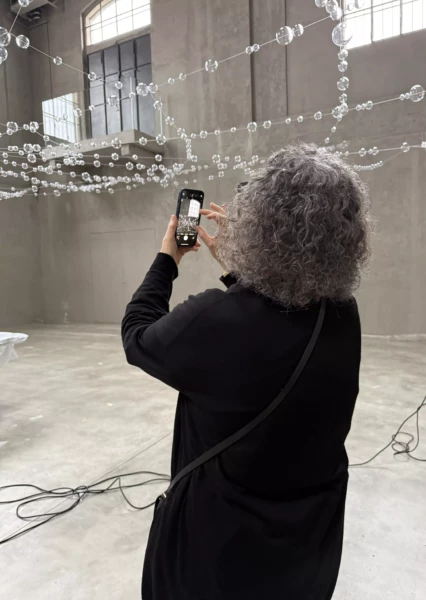
First cistern: imagine a gigantic spider’s web stretching its threads across an entire ceiling, threaded with a multitude of large, transparent glass bubbles. Does the web threaten us, or does it embellish the space? “I have been making spider’s webs for at least twenty years,” Hatoum says, “in different materials and different formats. The first was placed at the head of a hospital bed. It gave that feeling of being trapped, like the spider, which of course spins its web to catch insects. But there is also something magical, something fascinating, in those taut threads.”
expressing ambivalence
The artist always works from a desire to express ambivalence. “I like it when things are beautiful but at the same time produce a contradictory feeling, danger, for instance.” Nothing should be merely beautiful, even if she enjoys recounting how the celebrated Lebanese poet and artist Etel Adnan (1925-2021), during her 2015 retrospective at the Centre Pompidou, stood for a long time watching the play of light in the glass bubbles suspended from the ceiling.
map of the world
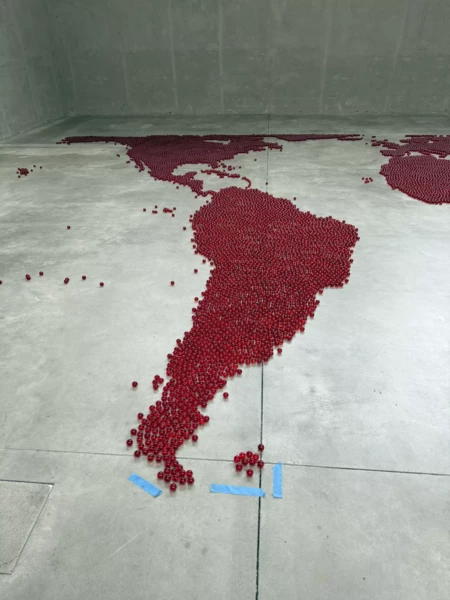
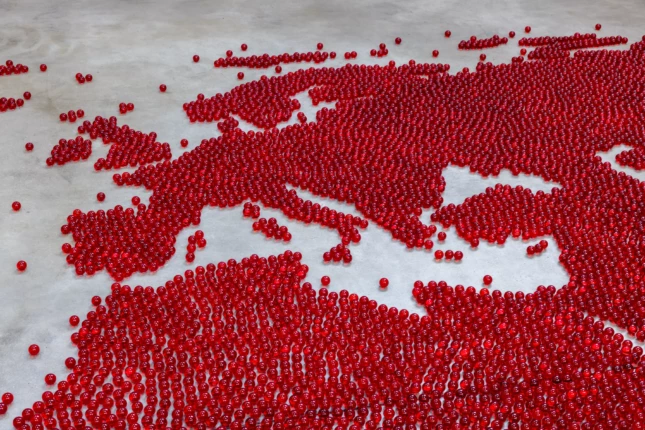
In the second room, Mona has conceived a map of the world. She first made her name, in part, through world maps rendered in the weave of Oriental carpets, as if geopolitics had slipped into an Oriental style drawing room. Here, on a grey concrete floor, blood-red glass beads have been placed in a configuration that forms a giant mappemonde. A single careless gesture would be enough to redraw the borders of nations. A single clumsy step enough to slip on the world. More than thirty thousand translucent glass balls compose this unstable, fragile configuration. The piece has never felt more urgent than in these times of war, from the Middle East to Eastern Europe.
accumulation of cages
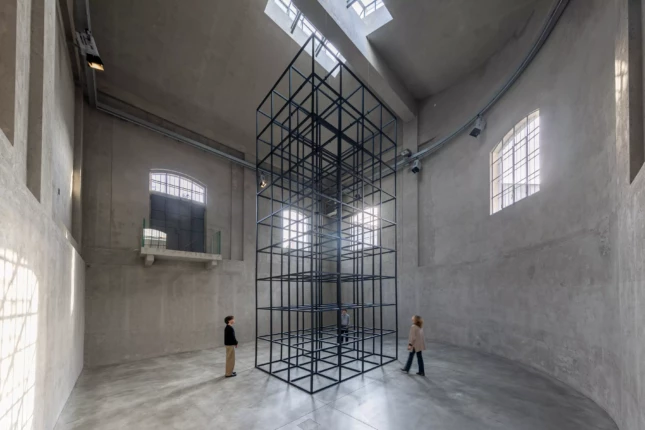
The third part of this journey through the Hatoum universe, elegantly titled “All of a Quiver,” is the one most faithful to the vocabulary of Minimal Art. She has imagined a metal grid structure, an accumulation of cages rising to a height of 8.5 meters. This three-dimensional structure contorts itself at random, accompanied by the creaking of its own frame. Like a shiver running through a body, movement travels through the grid very slowly, top to bottom, shaking it gently before subsiding. Nothing in this world is stable. That, certainly, is Mona Hatoum’s message.
Mona Hatoum, Over, Under and in Between. Fondazione Prada, Milan. Through November 9. fondazioneprada.org
(The interview video with Mona Hatoum was filmed during the installation of the artworks.)