official results
Art lovers often believe that the information provided by public auctions is valuable in two key respects: first, because the official results are accurate and complete. Prices achieved are systematically accessible in catalogues published online by auction houses, as well as in publicly available art databases.
Second—and above all—auctions are assumed to reflect the pure interplay of supply and demand, offering a reliable snapshot of market trends. But today, things are no longer so straightforward.
Sustain Our Work with a Small Monthly Gift
Become part of the Judith Benhamou Reports circle.
Contribute, even from just €10
Under the influence of increasing financialization in the art trade, mechanisms have emerged that soften both sides of this equation.
cascading effect
Auction results now have a cascading effect on sentiment across all levels of the market. The more positive the headline figures, the better it is for the auction house.
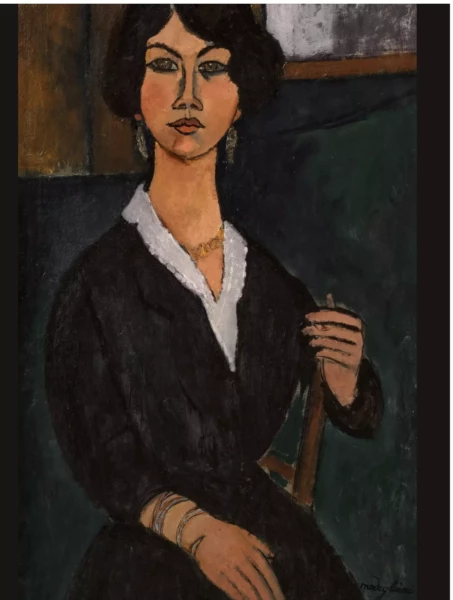
Thus, on May 18 at Christie’s in New York, following an exceptionally successful 20th-century sale (which brought in $1.1 billion across two sessions), catalogue editors quietly removed all online reference to a Modigliani painting that had been included in the sale. It was one of the few “withdrawn” lots—that is, works that failed to sell. The estimate of $30 million had apparently proven too ambitious for Almaisa, a 1917 painting depicting a beautiful young Algerian woman.
reassuring sellers
As for the idea that auction results are the transparent outcome of supply and demand, it is important to note that in today’s New York market, by the time works reach the auctioneer’s hammer, they are already at the very end of their valuation journey. The most significant collections or lots are often guaranteed in advance by the auction houses, which in turn may “re-sell” those guarantees to third parties. A full set of tools now exists to attract and reassure sellers, ensuring a certain price level regardless of bidding activity on the day. It is even said that art investment funds discreetly allocate part of their capital to financing auction guarantees.
exceptional results
All of this said, the results of Sotheby’s and Christie’s spring sales in New York in 2026 were exceptional—especially given the turbulent global economic and political backdrop. One dealer offers his interpretation: “Wealthy people have even more money. Financial markets are very strong. As a result, liquidity flowing into art transactions has been enormous.”
grégoire Billault
Grégoire Billault, chairman of contemporary art at Sotheby’s, adds: “The market once again demonstrates its extreme resilience, unlike most sectors today. But above all, this season the quality of the works offered was exceptional.”
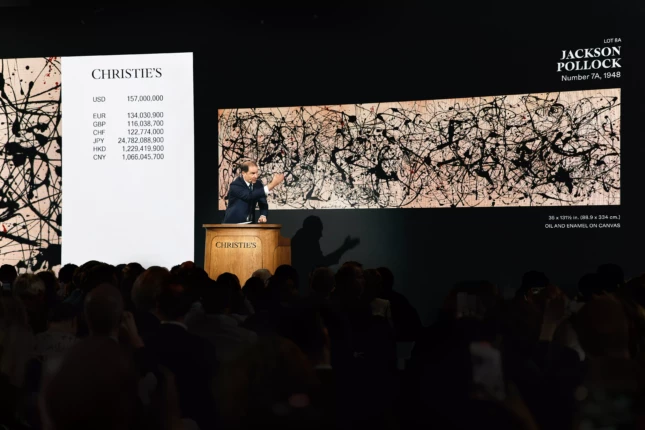
In general, “blockbuster” modern and contemporary works dominated. Big names, major works, prestigious provenances… At Christie’s on 18 May, two lots from the collection of the American press magnate and seasoned collector S. I. Newhouse exceeded the symbolic threshold of $100 million each.
A rare 1948 Jackson Pollock painting, a long, lyrical example of Abstract Expressionism, sold for $181.2 million, while a striking sculpture, Constantin Brancusi’s Danaïde in matte gilded bronze (1913), fetched $107 million.
It is not known whether the relatively flashy promotional videos has a postive effect on the auctions.
In total, Christie’s 16 works from the Newhouse collection brought in $631 million (against an estimate of $462 million).
Adrien Meyer
More broadly, this season’s demand reflects a certain sophistication. According to Adrien Meyer, who conducted the auction of the Newhouse collection at Christie’s, “We are witnessing the emergence of new collectors, well advised. They have recently made fortunes, are mostly American, and are looking to diversify their investments.”
Matisse
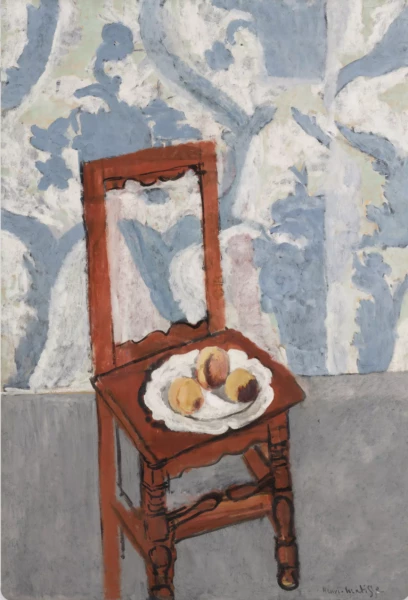
One had to be a connoisseur to look twice at a large Henri Matisse painting (130 x 90 cm), estimated at $25 million and sold for $48.4 million at Sotheby’s on May 19. La chaise lorraine (1919) depicts a simple chair with a bowl of fruit placed on it, set against a backdrop of arabesque-patterned fabric.
While the artist is best known for his languid women in lush interiors—as in his 2018 record Odalisque couchée aux magnolias ($80.7 million)—here, references to art history likely played a key role: the chair can be read as a nod to Van Gogh’s The Chair with His Pipe (1889), while the fruit clearly echoes the still lifes of Paul Cézanne just like the chair, deliberately depicted in a somewhat unstable balance.
Rothko

Mark Rothko, an artist whose oeuvre is both rare and singular, died at 66. Yet, between May 14 and May 19, no fewer than six of his works came to auction in New York. One of them, large (236 x 175 cm) and particularly luminous, achieved a new record for the artist at Christie’s: $98.3 million. It had belonged to a major American museum benefactor who recently passed away, Agnes Gund. She had purchased it directly from the artist in 1967 during a studio visit.
At this level of pricing, it is clear that art buyers are also purchasing legend and narrative.
Yu nishimura

Finally, far from the great modern classics, the young Japanese figurative painter Yu Nishimura (b. 1982) saw one of his 2017 paintings—depicting a thoughtful young woman in an autumn forest—sell for $998,400. Last December, he had been exhibited in the Paris space of the French gallery that discovered him, Crèvecœur. I interviewed him on that occasion. His works, all acquired by institutions during the exhibition had been priced between €20,000 and €200,000.
The art market is now highly selective—but the sums involved, case by case, remain enormous.