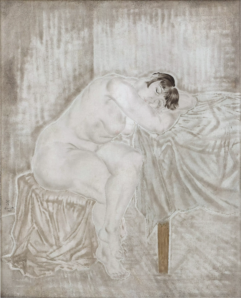
as one might salute gods
The long lines outside the world’s leading museums are proof enough. For the public, the priority is generally to seek out the “great names” of art. Drawn by these supreme touchstones, visitors pay them a kind of dutiful, almost blind homage, as one might salute gods. Michelangelo, for instance, sits at the very summit of the pantheon of those we call universal geniuses. Rodin, for his part, is regarded the world over as a towering artist.
Blockbuster
The acclaim granted to these giants of creation already existed in their own lifetimes. Today, bringing the two artists face to face, as the Louvre has wisely chosen to do in its new blockbuster exhibition, allows us to dissect and deeply understand the fiery passion of these seekers of the absolute. It is a sculptural game of ping-pong played out across 200 works. A rare opportunity to hear their quests, at times answering one another, at times colliding.
Sustain Our Work with a Small Monthly Gift
Become part of the Judith Benhamou Reports circle.
Contribute, even from just €10
vital energy
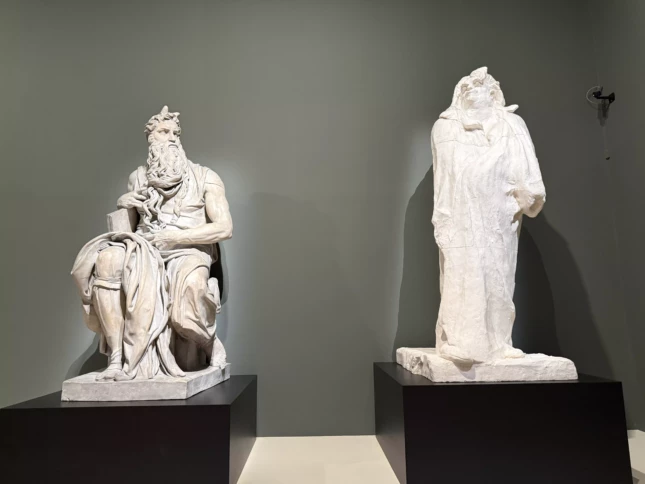
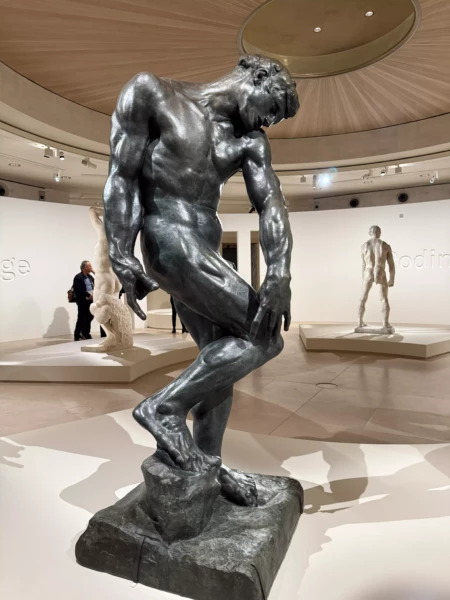
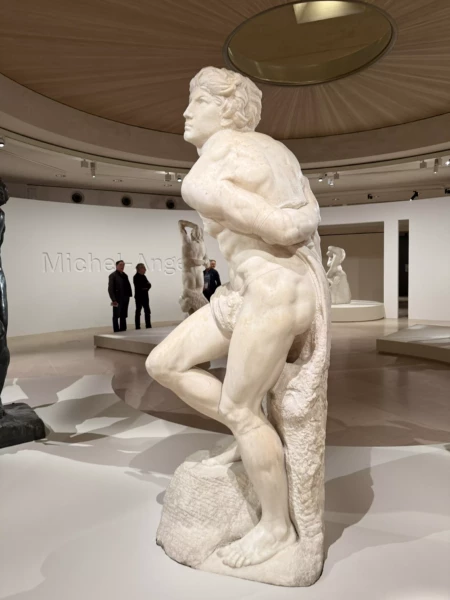
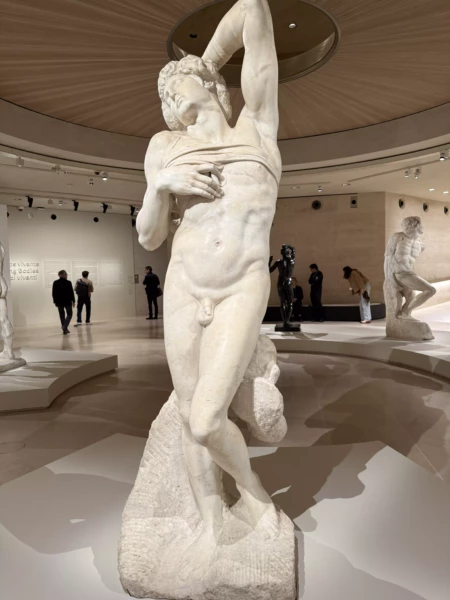
It demonstrates that two men, one born in 15th-century Italy and the other in 19th-century France, burned with the same ambition: to give the bodies they shaped a vital energy. To animate their plaster, marble, terracotta and bronze. This is made clear from the moment one enters the exhibition, where the Louvre’s two Michelangelo Slaves seem literally to dance opposite, among other works, Rodin’s L’Age d’Airain. They groove. They feel strikingly modern.
nourished at the breast of his elder’s art
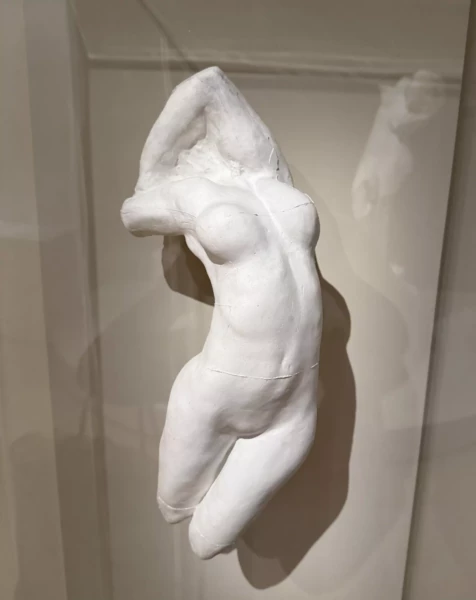
Michelangelo took the sculpture of Greek and Roman antiquity as his ultimate reference point. Rodin, meanwhile, nourished himself at the breast of his elder’s art. In 1876, he made an initiatory journey to Florence, where he went back to the source. “You will not be surprised to hear that from the very first hour I arrived in Florence I have been studying Michelangelo, and I believe that this great magician is leaving me a little of his secrets,” the French sculptor wrote to the companion of the time.
non finito
What secrets? One example is that the young Auguste borrowed from his elder a highly unexpected sculptural practice that heralded all of modern art: the non finito. In other words, the deliberate choice to give a work the appearance of being unfinished. Visible traces of making, roughly worked material.
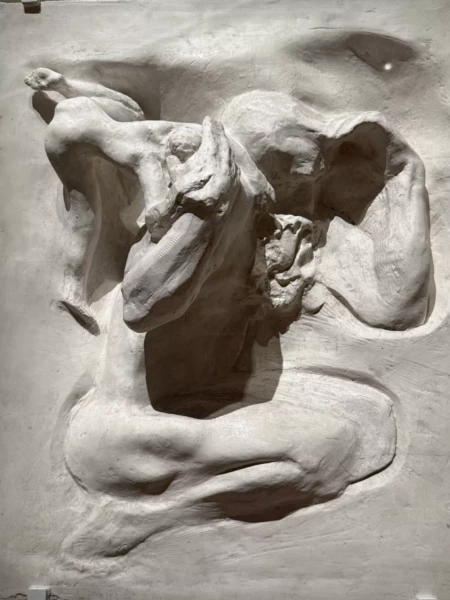
The point is to show that the virtuoso hand of the artist has passed through it, and that he does absolutely as he pleases with his subject. Yes, the sculptor stands above ordinary mortals. The unfinished also creates a suspension of the gaze. One may also imagine it as a reference to the damaged remains of antiquity, which Rodin collected. Finally, the non finito makes it possible to play with effects of texture, setting a highly polished area against a rougher one that still bears the marks of the sculptor’s tools.
with three more centuries of misery
The pairing of the two artists is no recent invention. It is a classic of art history, thoroughly explored since the beginning of the 20th century.
As early as 1911, the German philosopher Georg Simmel wrote of Rodin: “He is Michelangelo with three more centuries of misery.”Of course, the most striking juxtaposition in the exhibition is that of the Louvre’s two Slaves — the Dying Slave is especially erotic — shown right beside Rodin’s Age d’Airain and one of his Meditations. To breathe life into his stone statues, Michelangelo invented figures with serpentine forms. Nearly three centuries later, they reappear in the Parisian sculptor’s work.
Vessels, muscles, bones
In the time of one as in the time of the other, there was only one way to shape the body: one had to plunge into it. Vessels, muscles, bones. How does the human mechanism work? It is said that Michelangelo went so far as to carry out dissections himself. Contemporary testimony even praised his virtuosity in handling the scalpel. “The great crucifix in the Basilica of Santo Spirito in Florence shows how precise his anatomical knowledge already was very early on,” says Marc Bormand co curator of the exhibition.
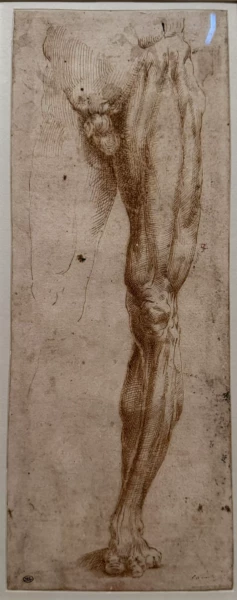
Specialists suspect that between 1854 and 1857 Rodin, for his part, attended dissections at the medical school. Indeed, in each sculptor’s studies, the body is literally broken down into parts: torso, arms, legs. And of course both men worked from live models, exploring every morphological detail, every slightest movement. Then form emerges from matter, for as Michelangelo himself declared: “The greatest artist has no conception that a single block of marble does not already contain within itself.”
The torso as a sculptural object
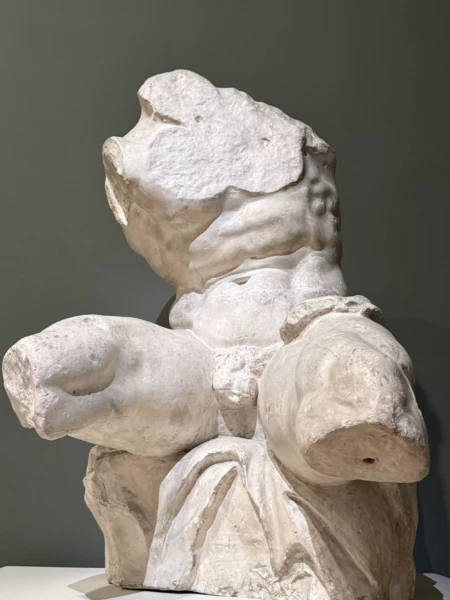
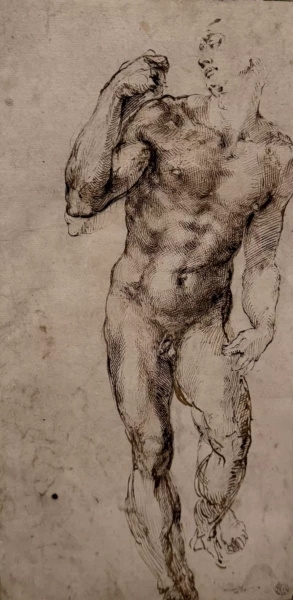
It is the legend repeated for centuries. When the sublime Belvedere Torso was rediscovered, a rare fragmentary marble sculpture dating from the Hellenistic period — the exhibition includes a copy of the work, whose original is kept in the Vatican — Michelangelo, who admired it beyond measure, flatly refused to complete it, despite being asked to do so. The exhibition includes drawings of torsos made by the Renaissance genius. Rodin, meanwhile — perhaps as a tribute to his elder — would be the first to dare create a sculpture representing only a torso. For Rodin, a partial work was in no sense an incomplete one. His Inner Voice, for example, is deliberately deprived of arms.
The cloak and the nude
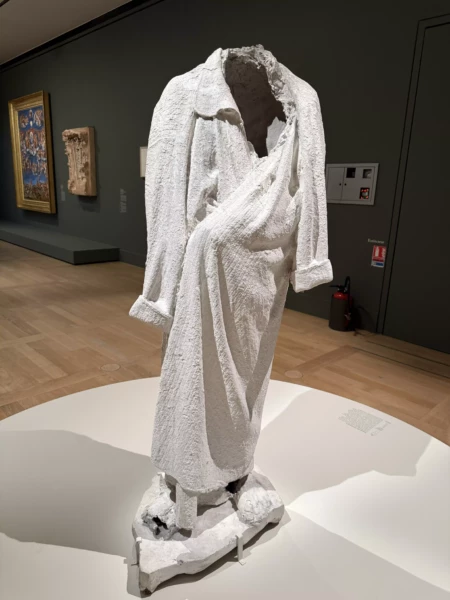
In traditional sculpture, drapery serves to reveal the underlying forms of the body. When Rodin set out to depict a Balzac he wanted to be powerful and virile, somewhat in his own image, he first chose to represent him nude, and then to clothe him – We know that nude, he is depicted with an erection . Four long years were needed before he arrived at a result he found satisfactory. The cloak was made from an actual dressing gown, which the master dipped into a basin of plaster to cover the body of this kind of giant. The immensely rich Musée Rodin still possesses the plaster garment that caused such an uproar among devotees of classical sculpture.