A legend of Montparnasse
She is everywhere and nowhere at once. Marie Vassilieff (1884–1957) was a Cubist painter of genuine force, was one of the defining presences of early-twentieth-century Montparnasse. She was a neighbor and compatriot of Sonia Delaunay, a student of Henri Matisse, an accomplice of Fernand Léger, and the fleeting object of the Douanier Rousseau’s romantic ambitions — a proposal she declined.
Peggy Guggenheim
She designed for the fashionable couturier Paul Poiret, counted Jean Cocteau among her closest friends, and in 1938, on Cocteau’s personal recommendation, exhibited at Peggy Guggenheim’s London gallery before Guggenheim had become an institution unto herself. That chapter of Guggenheim’s life is now being told in full. Through October 19, 2026, the Guggenheim Museum in Venice is presenting a sweeping survey of Guggenheim’s adventures as a dealer — a show that will subsequently travel to the Royal Academy in London and the Guggenheim in New York.
Sustain Our Work with a Small Monthly Gift
Become part of the Judith Benhamou Reports circle.
Contribute, even from just €10
At the Biennale
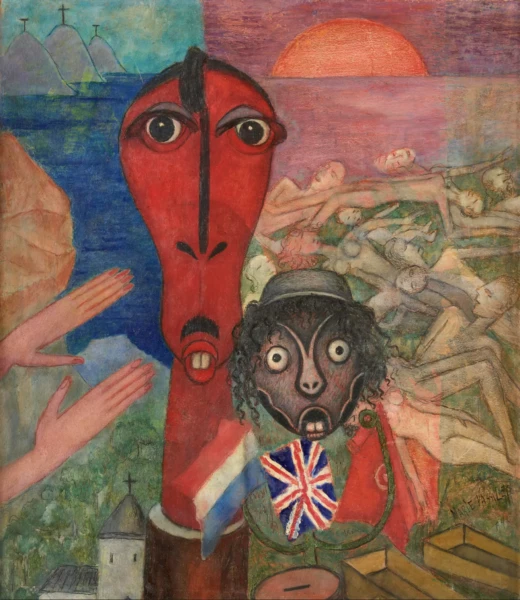
Its catalogue devotes an entire chapter to Vassilieff. Two years ago, at the Venice Biennale, curator Cecilia Alemani made Vassilieff’s work central to her vision of modernity’s forgotten genealogies. In Paris, she appeared in Pionnières at the Musée du Luxembourg in 2022 and in Le Paris de la Modernité at the Petit Palais in 2023.
And yet. Despite this accumulation of institutional attention, Vassilieff has never quite broken into the canonical story of the modern movement.
She remains, in the standard art-historical telling, a secondary figure in the great Parisian drama of the early twentieth century — vivid, indispensable to the atmosphere, but not quite a protagonist.
outsider statue
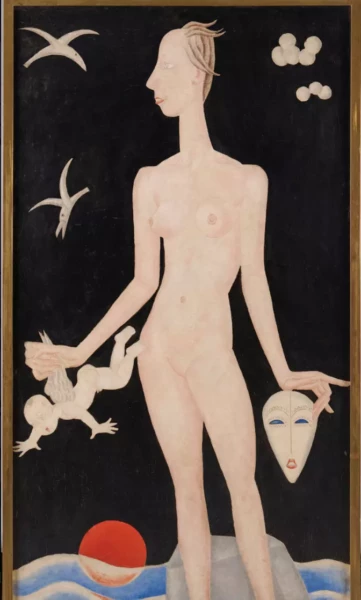
Her persistent outsider status can be attributed to at least two compounding disadvantages: she was a woman in a world that was structurally male; and she was, by fierce personal conviction, never represented by a dealer.
Without a gallerist to champion her work during her lifetime or her memory afterward, Vassilieff’s legacy was left largely undefended. “Her success during her lifetime should not be underestimated,” says Benoît Noël, a specialist historian and the driving force behind the new Comité Marie-Vassilieff. “For instance, she was the subject of articles in the international press.”
Benoit Shapiro
Benoît Shapiro, whose Paris gallery Le Minotaure has championed her work since the 1990s, offers a more candid diagnosis: “During her lifetime, the attitude toward her fabric objects wasn’t one of complete respect. They weren’t considered serious enough.” Today, needless to say, they are precisely what the moment demands.
On June 8, 2026, far from the French capital, an event unfolds in her honor. The auction house Rouillac, based in Vendôme, has organized a sale devoted entirely to Vassilieff at the Château de Villandry, in the Loire Valley. The 144 works on offer belonged to Claude Bernès, a dedicated private collector who died in 2025. Bernès worked in the insurance industry; Vassilief history was his avocation. For fifty years, he spent his leisure hours and his modest savings assembling the most significant private collection of Vassilieff’s work in existence.
Vassilief: the auction
Before the sale, the works were briefly exhibited in Paris — fittingly, in Montparnasse, in the very passage on the Avenue du Maine where Vassilieff ran her Cubist academy in 1912 and her legendary wartime canteen for artists. Auctioneers Philippe Rouillac and his son Aymeric recall: “He truly gave of himself — intellectually and financially — to build an international research network around this extraordinary artist.” The core of the collection was assembled at a 1977 auction dispersing the holdings of Raoul Germain, a physician from the Gironde who had been Vassilieff’s primary patron.
with Matisse
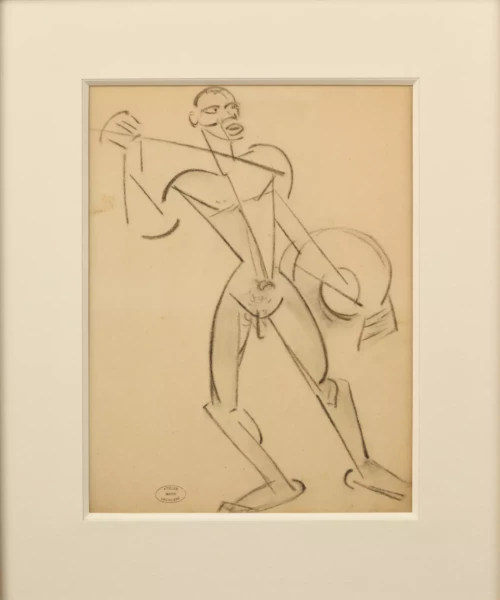
Vassilieff was born in Smolensk in 1884, the daughter of a prosperous landowner. A scholarship granted by the Tsarina brought her to Paris, where in 1908 she became a student of Henri Matisse, seized by his painting in a way that would define everything that followed. Her fate was sealed. She founded an academy, then a canteen for the artists; she fed the avant-garde while Europe tore itself apart. The catalogue for the Villandry sale, organized chronologically, gives a full picture of her range. The early Cubist drawings — historically significant as among the earliest examples of the idiom, mostly depicting athletes — carry estimates of around €800 apiece, a negligible figure.
Russian support
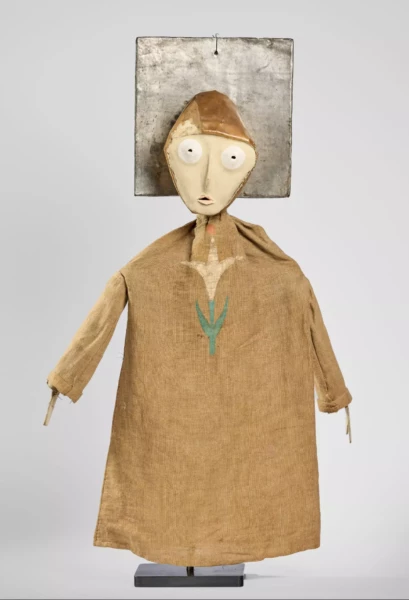
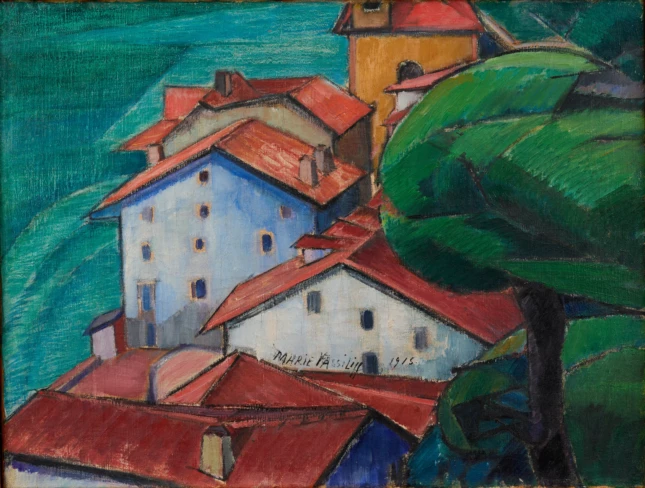
The highest estimate in the sale, €50,000, is assigned to the 1915 Spanish Cubist landscape — the same year as the polychrome nude that fetched €680,000 in 2021, Vassilieff’s auction record. The market context, however, is complicated. As Shapiro explains: “Most of the major results were achieved between 2001, when Russian collectors entered the art market, and 2014, when economic sanctions curtailed their activity. Her market has fallen back considerably since then.”
that’s history
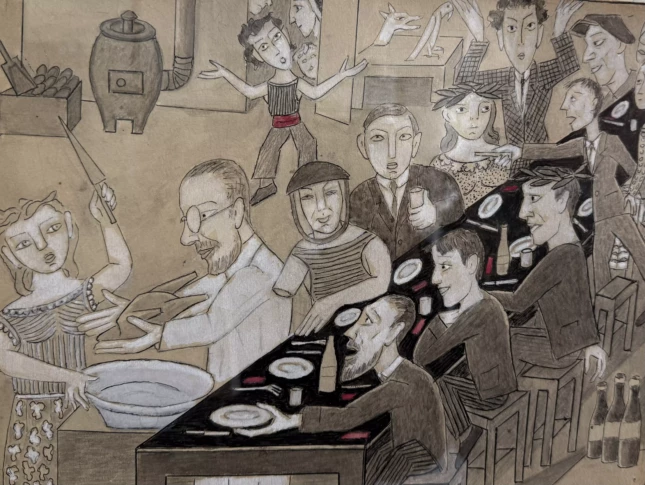
Among the sale’s most historically charged lots is a drawing in ink on paper depicting the dinner party Vassilieff organized on January 14, 1917 — an event that has since passed into legend. The occasion was a banquet in honor of Georges Braque, Picasso’s co-inventor of Cubism, who had returned from the Front having undergone trepanation. Vassilieff’s drawing records the scene with precision : Matisse passes a turkey to the hostess; Picasso wears a laurel wreath; the writer Blaise Cendrars is identifiable by the arm he lost two years earlier. Modigliani — whom Vassilieff had deliberately not invited, knowing his taste for alcohol and his capacity for disruption — arrived uninvited and proceeded to make a scene. The estimate of €16,000 seems destined to be shattered; It would be entirely logical for this historic work to be acquired by the Musée National d’Art Moderne through a preemptive bid.
Paul Poiret
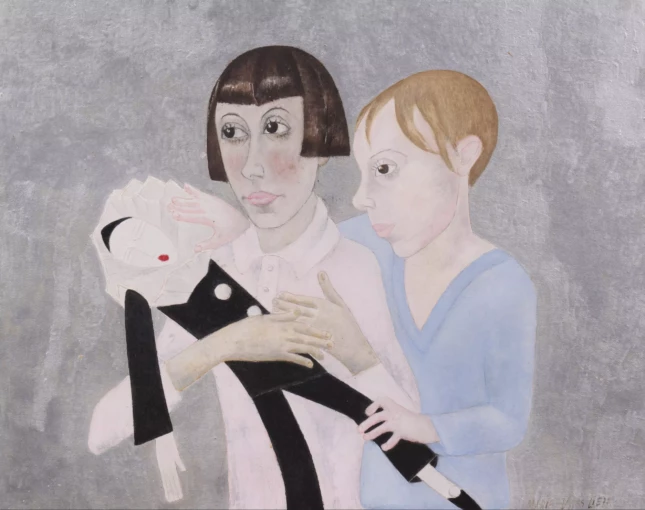
After the war, the famous couturier Paul Poiret commissioned Vassilieff to produce doll-portraits of Parisian society — and she found, in the form, an outlet that was entirely her own. She knew exactly what she had made: “I consider them to be genuine avant-garde sculpture,” she wrote. “I imitate marble, ivory, silver, gold, and bronze.” The 1922 Salon d’Automne disagreed, rejecting the dolls outright.
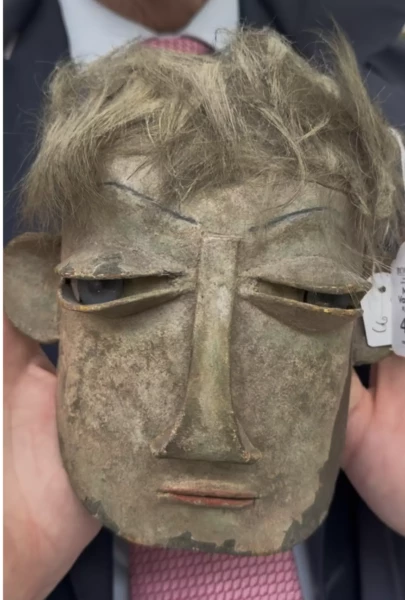
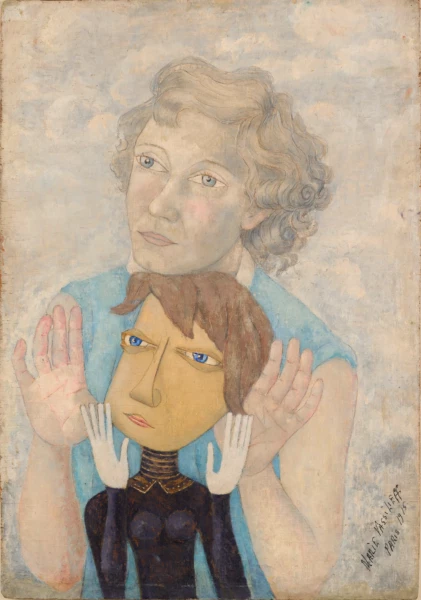
The catalogue’s most striking painting is a pastel-toned 1929 canvas titled Self-Portrait with Doll-Portrait, in which the artist poses above her own fabric effigy ( estimate:€50,000) . A cardboard self-portrait mask from the same year, is estimated at €5,000.
Haunting mask
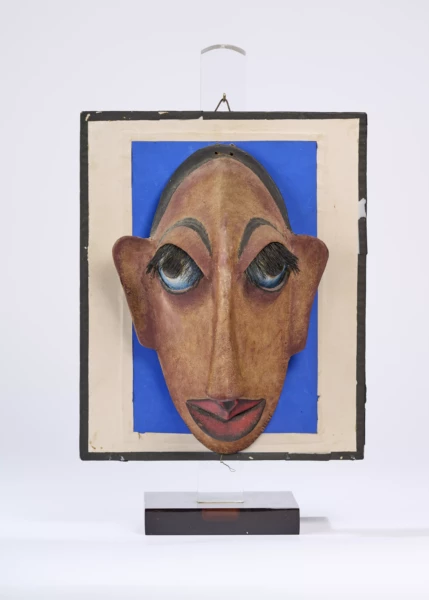
Perhaps the most haunting mask in the entire sale is the one portraying the poet and musician Claude Duboscq, a friend of Vassilieff, made in 1939 — one year after his suicide. It is dominated by vast blue eyes and a dramatically elongated nose, stylized in a manner that owes something to African sculpture. Its estimate is €2,000.
Later in life, Vassilieff moved into a new mode in her painting inflected by Surrealism yet beholden to no movement, blending Russian folk traditions, Byzantine iconography, and African visual grammar into something that was hers alone. A unique style.The estimates in the sale begin at €2,000.
I am a free woman
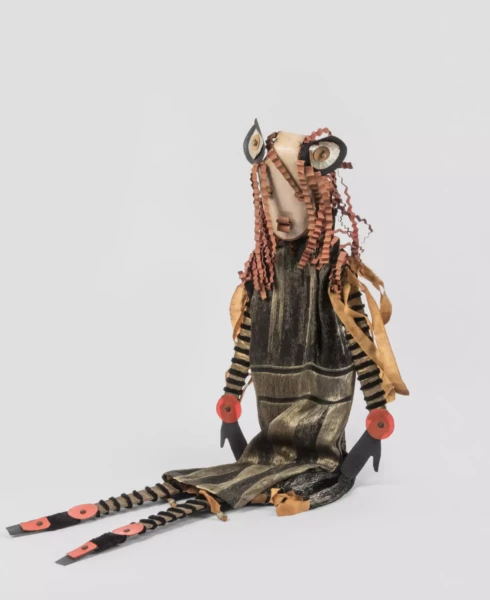
Attached to her independence to the very end, despite her poverty, she declared: “No one can tie me down. Perhaps people become attached to me, but that is your affair. I am a free woman.” It is certainly this freedom that the art market has continued to penalize until now. The future, however, should prove her right.
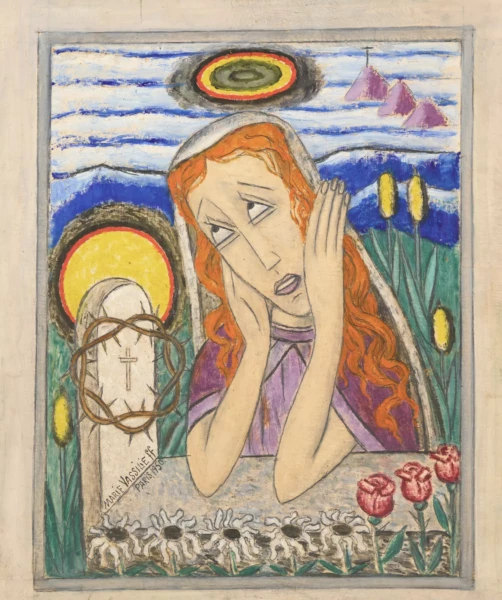
The sale takes place June 8, 2026, at the Château de Villandry, Touraine.
Full catalogue: rouillac.com