Sustain Our Work with a Small Monthly Gift
Become part of the Judith Benhamou Reports circle.
Contribute, even from just €10
Magical beliefs
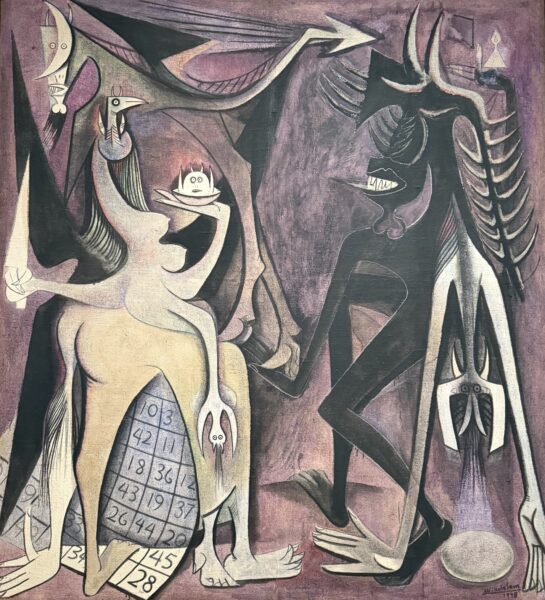
It is an extraordinary world, steeped in magical beliefs and the polar opposite of a Western Cartesian mindset. It is inhabited by hybrid beings, stretched to the extreme, hidden within a luxuriant flora. In this pictorial territory, beings merge into dense crowds amid plants from which hands, eyes and mouths suddenly emerge out of nowhere. The fantastic universe – some have called it surrealist – of Wifredo Lam (1902–1982) is presented at MoMA in New York through April 11.
When I don’t sleep I dream
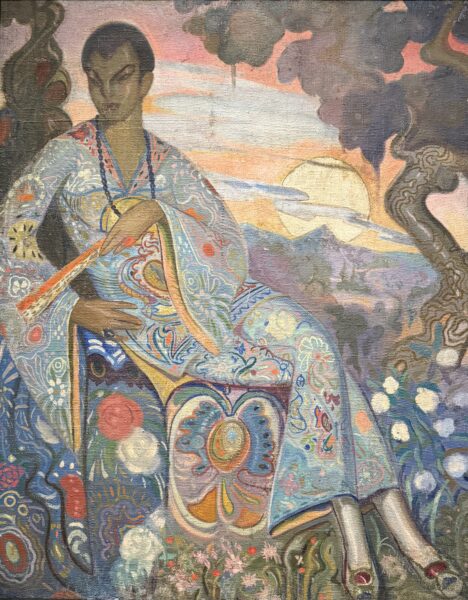
The title of this major retrospective is taken from a quote by the artist: “When I don’t sleep I dream,” for he invites us into a waking dream. Wifredo (without an L) is the incarnation of métissage, of the “Tout-monde,” as the Caribbean thinker Edouard Glissant would say. He was born in Cuba, of Chinese and African descent, and also lived in Spain and France before spending the end of his life in Italy.
Centre Pompidou

The painter was already the subject of a large exhibition at the Centre Pompidou in 2016, which sought to restore his full importance. But this new New York version goes a step further, placing him in the Olympus of modern art. There are several reasons for this. First, it is a visual feast. The exhibition, hung thematically, makes us dance along with the painter’s imagination. Then, it is both spacious and clear. A very large space and pale walls, rather than the brown ones used in Paris, lighten the viewing experience.
Eskil Lam
His son Eskil, present at the opening, rejoiced in the quality of the exhibition while acknowledging that the artist remains underrated. “I hope the exhibition will open people’s eyes to his importance. He is difficult to slot into a single category.”
Pain hidden in its songs

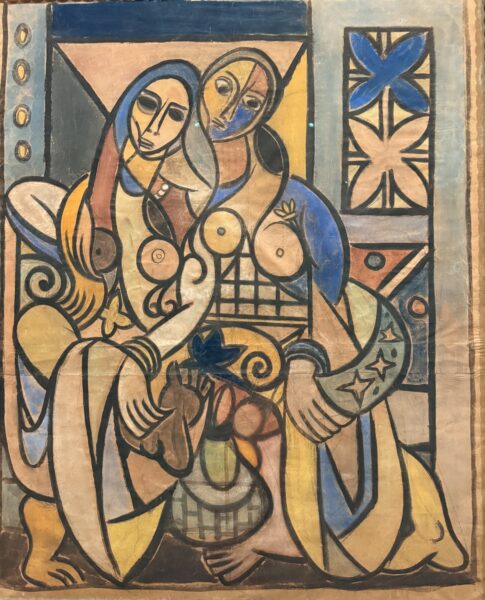
Lam himself said (the quotation is reproduced in the exhibition catalogue): I’ve been considered a painter of the School of Paris, a Surrealist painter, or whatever other movement, but never as a representative of the painting I truly do, in which I believe I largely reflect the poetry of the Africans who arrived in Cuba, a poetry that still holds much pain hidden in its songs.”
First , cubism
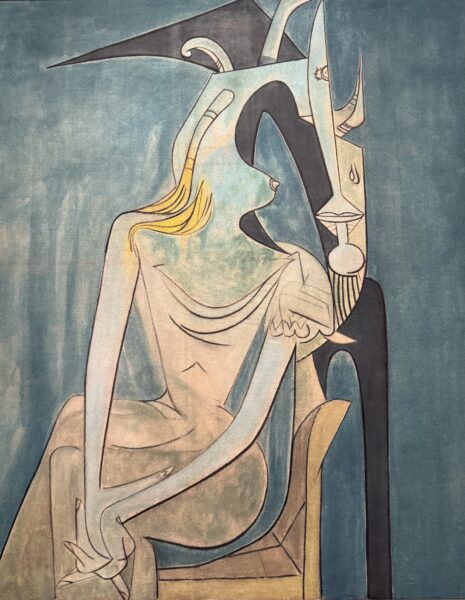
The eighth child in a modest family, he first trained as an artist in Spain, where he went in 1923. His vocabulary was then Cubist. At the time, his style could be described as a blend of Fernand Léger and Picasso for the geometric forms, Alexej von Jawlensky for the simplified figures, and Matisse for the colors. It was Picasso whom he first met when he arrived in Paris in 1938. Tribal African art was then a subject of great fascination in avant-garde circles. The Spaniard found him a studio.
Christophe Cherix
Through him, Lam met the leading figure of Surrealism, André Breton, and his whole circle. A complex alchemy then took place, which would give rise in the Cuban painter to an extraordinary body of work. As the exhibition’s co-curator Christophe Cherix – who since September 2025 has also been director of MoMA – explains: “He was deeply impressed by African culture, which he paradoxically discovered more fully in France than in Cuba.”
A blend of Yoruba religion and Catholicism
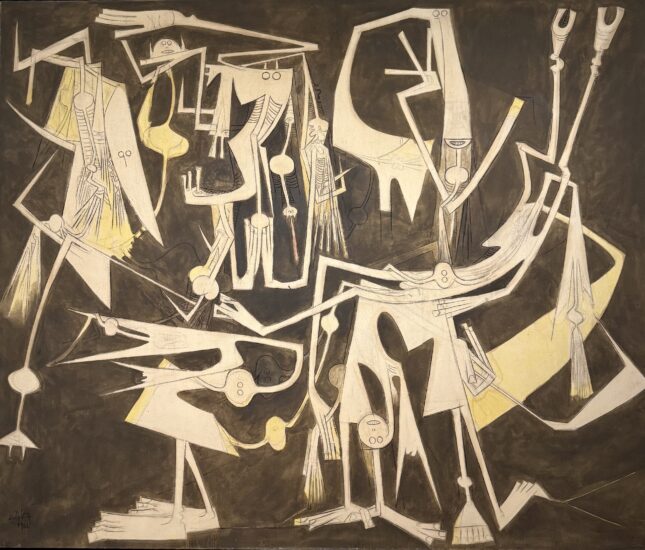
Childhood memories resurfaced. As a child, Wifredo had been immersed in the local voodoo cult – what is known as Santería, a blend of Yoruba religion and Catholicism – thanks to a deeply mystical grandmother(1). In 1941, with the war, the painter returned to the land of his origins. “Here in Cuba there were things that were pure Surrealism,” he would later say. Between 1941 and 1949, Lam painted no fewer than 400 canvases. In them we find that unprecedented pantheon which would secure his place in art history. His contorted figures resemble animated totems or bird-gods, an esoteric forest in motion.
Dreams
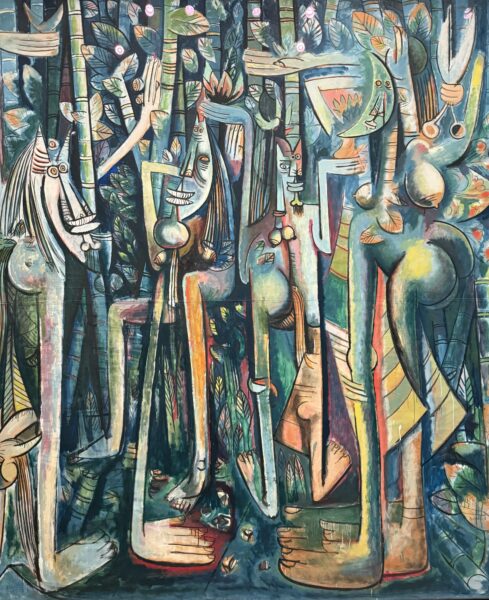
Wifredo now sleeps forever. He invites us to keep dreaming.
(1) It is also interesting to note that many contemporary artists are drawn to these different manifestations of voodoo. This is the case, for example, of the French painter Pol Taburet, of Guadeloupean descent, shown last March by the Fundación Sandretto Re Rebaudengo in Madrid, or Woody de Othello of (born in 1991), of Haitian origin, exhibited by the Pérez Art Museum Miami through June 28, 2026 or Belkis Ayon from Cuba again, shown recently in different institutions.
Through April 11. MoMA, New York.