Sustain Our Work with a Small Monthly Gift
Become part of the Judith Benhamou Reports circle.
Contribute, even from just €10
Manuel Borja -Villel
In times of uncertainty, alongside the shouting oracles from the world of economics, strategy and politics, artistic minds are venturing their own alternative vision. Such is the case of one of Spain’s art stars, Manuel Borja-Villel, former director of Madrid’s Museo Reina Sofia and co-curator of the most recent São Paulo Biennale. At the Centre Pompidou-Metz, in the exhibition “Après la fin: Cartes pour un autre avenir” (“After the End: Maps for an Alternative Future”) running through Sept. 1, Borja-Villel is showcasing 40 artists of diverse styles, disciplines and eras, in the same spirit that presided over the São Paulo Biennale.
Escaping the current Western order
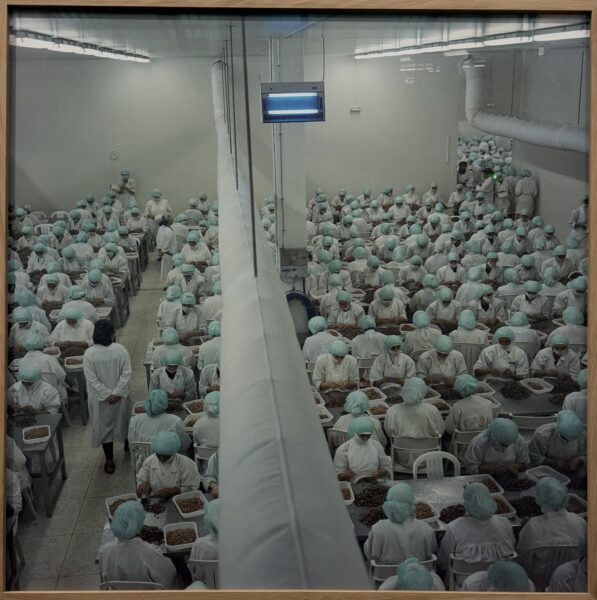
“We’re mixing Caribbean and Middle Eastern cultures, water and desert,” he explains. It’s a question of escaping the current Western order, of examining other ways of living in society, particularly in cultures that predate the major colonial conquests. At its core, it’s a matter of listening to forms of creative expression that have since been marginalized.
Victor Anicet
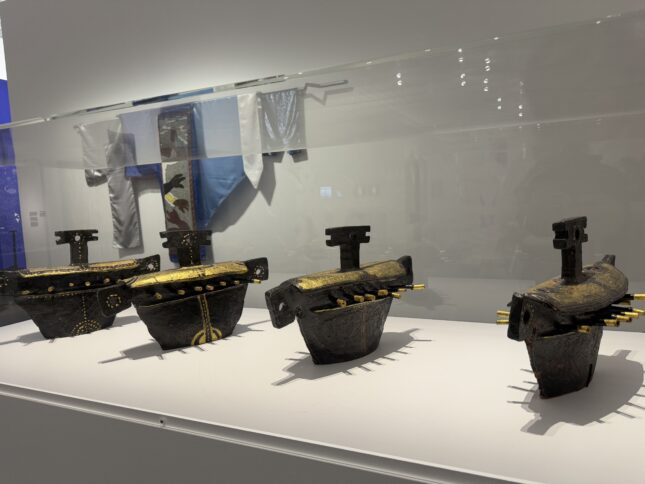
In practical terms, visitors are invited to take a stroll—the exhibit features many video works—but with uneven effect. For the form of the artists’ intentions, however well-intentioned, is not always successfully executed. Among the best “discoveries” the exhibition highlights is Victor Anicet (born 1938), a major artist in Martinique who is little-known in mainland France. He creates ceramics that are inherited from folk art forms, like the terracotta pieces in the shape of Noah’s Ark exhibited in Metz, their deep holds seemingly designed to contain slaves during the transatlantic crossing (See here the report about Edouard Glissant and his influence).
To appreciate is to support.
To support is to donate.
Support JB Reports by becoming a sustaining Patron with a recurring or a spontaneous donation.
The masterful room
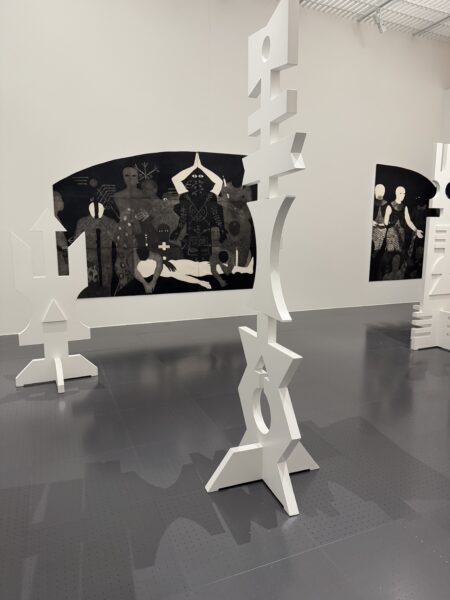
Above all there is one masterful room that alone justifies the trip. It contains works by three major artists whose forms and inspirations coexist in beautiful harmony. The first is Cuban artist Belkis Ayón (1967-1999), a major recent rediscovery in contemporary art, who has been the subject of a series of exhibitions in the United States, Madrid and at the Venice Biennale.
Amazing Belkis Ayón
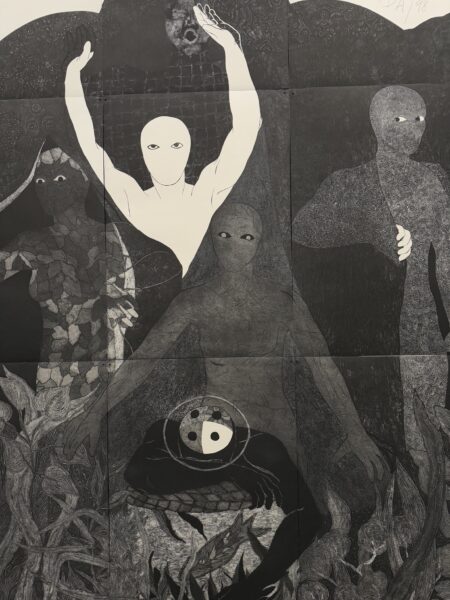
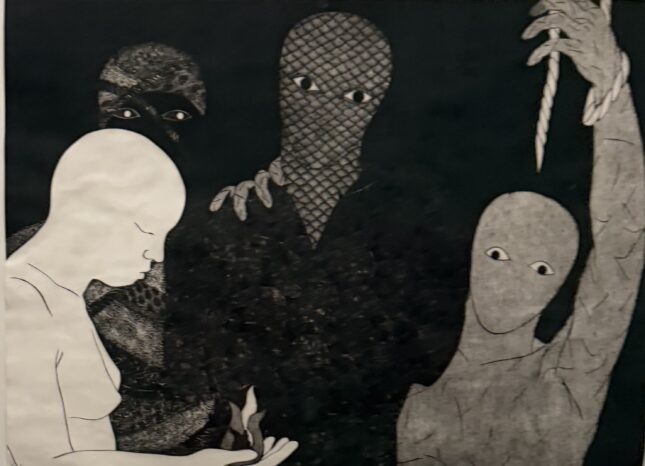
She developed a sort of two-dimensional theater, mostly in black and white, depicting enigmatic scenes from a secret Afro-Cuban society. The characters are portrayed as ghosts, their faces covered by hoods.
She even designed a special reproduction technique to produce these charcoal-textured images. “She infiltrated this circle of solidarity among Afro-descendants that didn’t accept women. Her fate was tragic: She committed suicide,” explains the curator. (See here a report speaking of Belkis Ayon).
Rubem Valentim
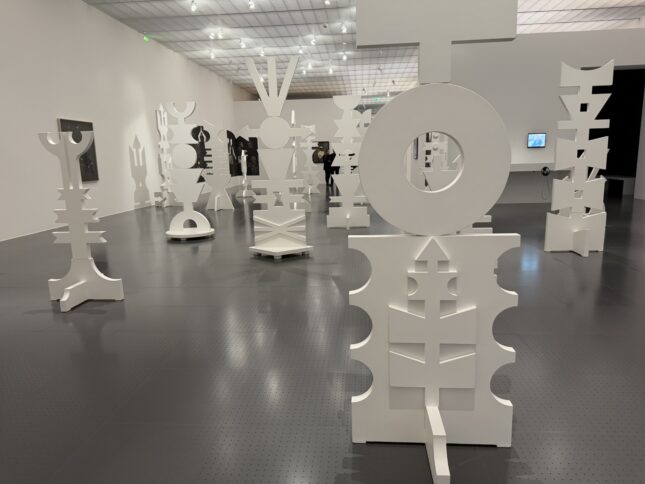
Ayón’s work is in conversation with the geometric totems by Afro-Brazilian artist Rubem Valentim (1922-1991). In Brazil, there is a voodoo cult, Candomblé, inherited from the period of slavery, around which Valentim created a skillful alphabet combining African motifs, which he erected in the three dimensional forms exhibited here. “All these totems are gods,” Borja-Villel explains. “This helps us understand that other modernities exist beyond those with which we are already familiar.” (See here a report speaking about the market of Rubem Valentim)
Wifredo Lam
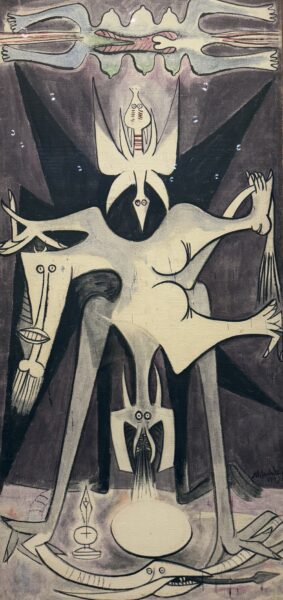
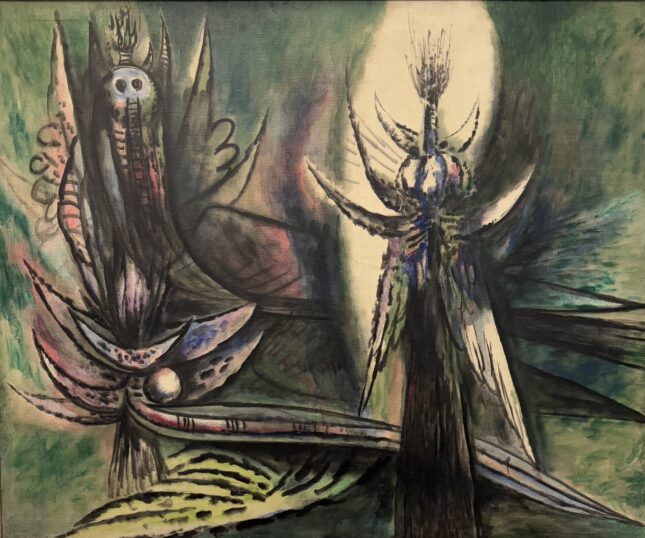
The totem motif also appears in the work of Wifredo Lam (1902-1982), the Cuban Chinese artist who was associated with the Parisian Surrealists in the late 1930s. In his work, voodoo gods are entangled in the smoke of his complex compositions. “Western modernity and African tradition blend and assimilate. Here, oppression gives birth to liberation,” concludes Borja-Villel optimistically, referring to his “map for another future.”
Through Sept. 1. www.centrepompidoumetz.fr