
Duchamp at Moma
This is one of the major events of the spring in American museums. Through August 22, MoMA is devoting a show to one of the leading artists of the twentieth century: Marcel Duchamp (1887–1968). As it is explained: “Over a six-decade career, Duchamp challenged the very definition of the artwork, ushering in a new era of creative license…”
Retinal art
For him, being an “artiste peintre” ( a painter) creating what he called “retinal art,” something pleasing to the eye, was about the worst thing imaginable. Timely enough, on April 23 Phillips is holding in New York a sale entirely dedicated to Duchamp. It includes 109 lots estimated at $1.2 million, comprising works he conceived as well as tribute works made in his honor. Duchamp, alongside Picasso, though in an altogether different vein, is one of the key foundations of twentieth-century art.
Sustain Our Work with a Small Monthly Gift
Become part of the Judith Benhamou Reports circle.
Contribute, even from just €10
Readymades
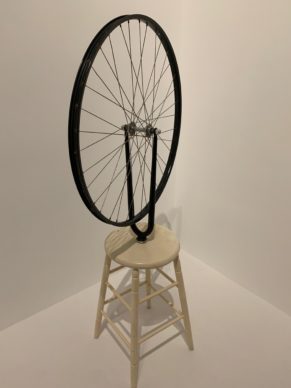
He spawned countless heirs to an art that swept away all the principles accumulated over centuries of Western creation. In so doing, he set the tone for a conceptual art grounded more in ideas than in purely aesthetic pursuit. In the early twentieth century he devised a new category of works known as “readymades,” ranging from a urinal, presented upside down, to a bottle rack to a bicycle wheel. All that was required was for him, having declared himself an artist, to decide that it was so.
Signature
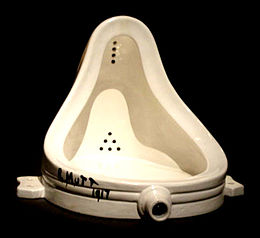
The proof lay in the signature, which, moreover, was often not even his own name but a pseudonym such as R. Mutt or Rrose Sélavy. Once the principle was accepted, Duchamp opened the door to every possibility. And that is exactly what happened.
FRancis M.Naumann
Phillips’s sale is remarkable in that it has been organized by a “curator” who is in fact one of the finest specialists on Duchamp’s work, Francis M. Naumann.
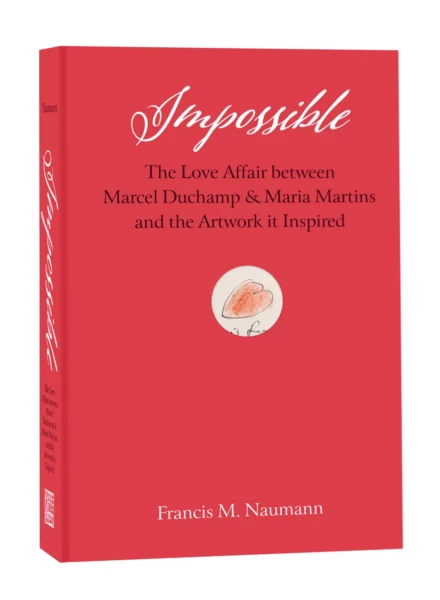
He is also a dealer, art historian, and writer. Naumann has just published a book devoted to the wild yet impossible love story between the artist and the Brazilian woman who was herself a Surrealist artist, Maria Martins. By his own admission, around 80 percent of the works in the sale belong to him. And yet the uninitiated viewer may well come away disappointed. Duchamp’s body of work is extremely limited. The artist had no real interest in producing new pieces. With only a few exceptions, he stopped doing so in the early 1920s. The MoMA exhibition bears this out, as the New York Times art critic noted: “With a couple of major exceptions, his output consists of enigmatic small objects, hardware store items and piles of scrappy notes handwritten in a minuscule script.”
Gagosian
In that regard from April 25 through June 27, Gagosian is presenting in New York, at its new space at 980 Madison Avenue, an exhibition devoted to Duchamp that includes, among other things, the complete set of the ready-mades reissued under the direction of the Italian dealer Arturo Schwarz in 1964.
something of a dilettante
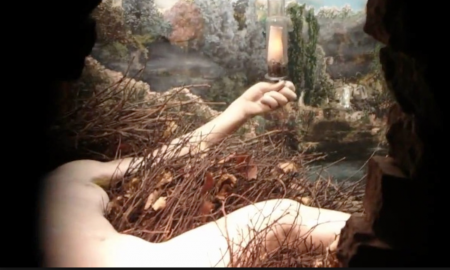
In truth, Marcel was something of a dilettante, loved playing chess, and had friendships in the art world that seemed sufficient to occupy him. Thus he worked on his final piece, Étant donnés, which is permanently on view at the Philadelphia Museum of Art, from 1944 until his death in 1968. And he insisted that the work only be shown after his death. It is an installation viewed through a peephole in a wooden door, revealing the hyperrealistic body of a woman, posed in an “Origin of the World” position, lying in a landscape.
The Picabia auction
But it would be too simple to claim that Duchamp hated the art market. Quite the contrary: he played with it a great deal. In 1926, for example, he organized from start to finish an auction of paintings by Francis Picabia—his great accomplice—at the Hôtel Drouot in Paris. He also acted as agent and dealer for the sculptor Constantin Brancusi, another close friend, and did a great deal to help introduce him into American collections.
repeating,repeating
Even so, as far as his own work was concerned, he largely contented himself with repeating works he had already produced, in different forms. Naturally, the April 23 Phillips sale reflects this. To this day, the record for a work by Marcel Duchamp is still held by Belle Haleine, Eau de Violette, an exceptionally rare fake perfume bottle from 1921 from the Pierre Bergé–Yves Saint Laurent collection, which sold in 2009 for €8.9 million.
It was the highly discreet French private dealer Alain Tarica who had the work acquired for the great couturier and his companion.
the Boîte-en-valise

To make some money, Duchamp repeated his own strategies of reproducing his work in different forms. Phillips’s sale includes, for example, a portable summary of Duchamp’s oeuvre conceived in 1941, the Boîte-en-valise. Into a suitcase, the artist fit all his works, reproduced as miniatures. As a side note, Box number 1 had been acquired by his friend, the famous collector Peggy Guggenheim, who used it as a footrest under her desk. It is now part of the institution’s collection in Venice.
80 replicated mini-works
Duchamp needed money to live, and refused to produce new things. So, according to his catalogue raisonné, he made between 60 and 75 Boîtes-en-valise in 1941, then 30 more in 1958, 30 in 1961, 30 in 1963, 75 in 1966, and another 47 that same year. Impressive. The example offered by Francis M. Naumann dates from 1966 and contains 80 replicated mini-works. It is estimated at $350,000 and was acquired in 2020 for €290,000. The record price for this emblematic object dates from 2015, when a 1941 example sold for €2.6 million.
LHOOQ
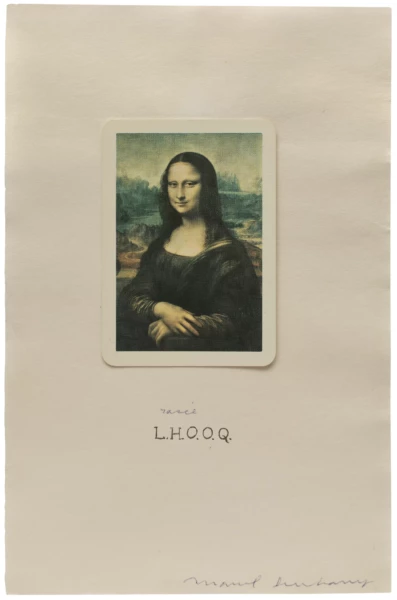
Among Duchamp’s most famous works is one that looks like a schoolboy prank: a reproduction of the Mona Lisa to which the artist added a mustache and the letters LHOOQ (“Elle a chaud au cul” for “She is horny”) in 1919. Duchamp would later explain that it was a disenchanted comment on his Dada period, in the wake of the slaughter of the First World War, the Mona Lisa representing a kind of national treasure.
wayward Mona Lisa
A late example of LHOOQ is being offered by Francis M. Naumann on April 23. He explains the circumstances of its creation: “In 1965 Duchamp made a card for the dinner of the New York gallery Cordier & Ekstrom. He used the image of the Mona Lisa reproduced on a playing card with LHOOQ but without adding the famous mustache. As a result he added the word ‘rasée’ [shaved]. Arnie Ekstrom himself told me the story.” This relic is estimated at $30,000. Here again, Duchamp repeated the gesture many times. The record price for this wayward Mona Lisa, €1 million, was reached in 2016 for a 1964 version issued in an edition of 35.
French communist party
As a side note, the French Communist Party owns an even more precious version, dated 1930. It had been given to them by the poet Louis Aragon, who had himself received it from Duchamp. The work is now on deposit at the Centre Pompidou.
Nu descendant…
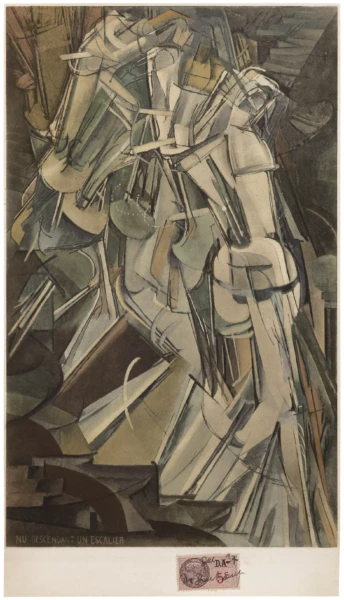
Finally, among Duchamp’s best-known works is Nude Descending a Staircase, the stencil replica Marcel made in 1937 after a 1912 painting. Indeed, when he was still very young—before renouncing painting—he had produced a canvas based on the principle of motion studies in photography. The work, here executed on a small sheet of paper (35 x 20 cm), had been given to some of his friends.
belonging to David Bowie
In 2016 an identical version that had belonged to the singer David Bowie sold for €146,000. Collector Bowie and Marcel Duchamp could only have made sparks fly.
More broadly, despite its historical importance, the market for this immense twentieth-century artist—with his highly limited body of work and its extremely technical aspects—may remain off-putting for some collectors. Unless current museum attention turns in favor of Duchamp, alias Rrose Sélavy.
1) Nothing has yet been officially announced, but the exhibition is expected to travel to Paris in 2027, under the aegis of the Centre Pompidou, after its stop in Philadelphia.
(2) Impossible. The Love Affair Between Marcel Duchamp & Maria Martins and the Artwork It Inspired. 2026. Abbeville Press (not translated).