Art Basel Qatar: a new model, a new center of gravity for the art world—and new antagonisms as well
Share this article
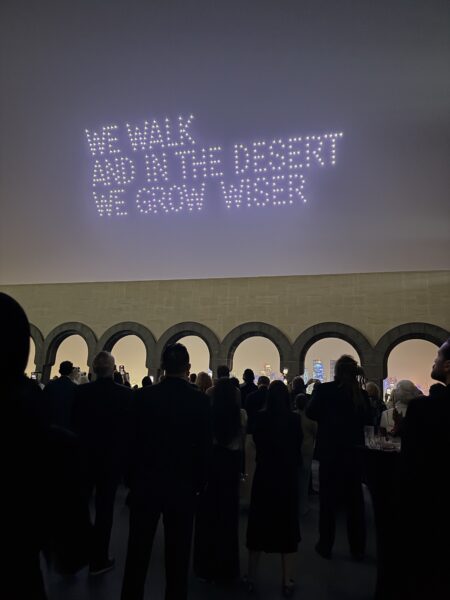
Jenny Holzer
Geostrategic tensions
Beyond the acute geostrategic tensions currently undermining the climate across Middle Eastern countries, another, more subterranean conflict is also playing out locally. Its aim is to generate happiness without causing any human loss. It allows each of the protagonists to assert a form of “soft power,” culturally anchoring them on the international stage. This is the war of art and its market.
Dubai
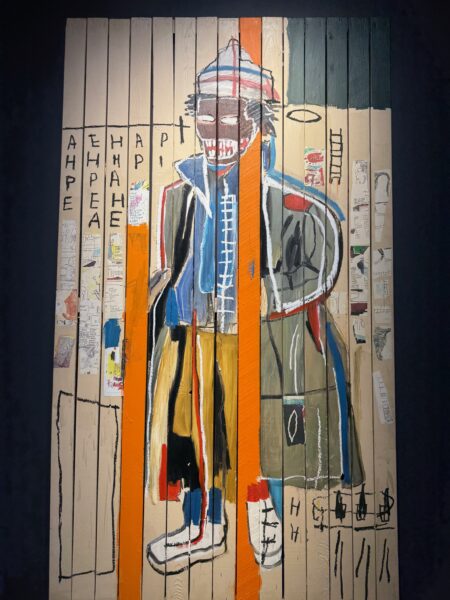
Jean Michel Basquiat @Art Basel Qatar
Historically, Dubai led the art market, even though the city of the United Arab Emirates is better known for entertainment than for its cultural offer. Art Dubai, founded twenty years ago, nonetheless benefits from a significant community of tax exiles and other potential buyers who have yet to truly assert themselves as major art consumers.
Israel
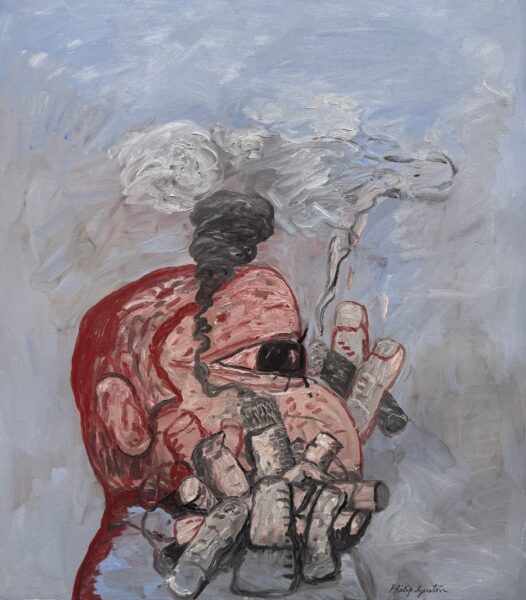
Philip Guston @ Art Basel Qatar
Israel, for its part, enjoys a genuine artistic scene, coupled with exceptional public collections of modern and contemporary art in Jerusalem and Tel Aviv. Beyond the fact that the Jewish state is frequently ostracised, it takes no institutional communication initiatives despite the excellence of its museum programming and has organised no commercially oriented events.
Egypt
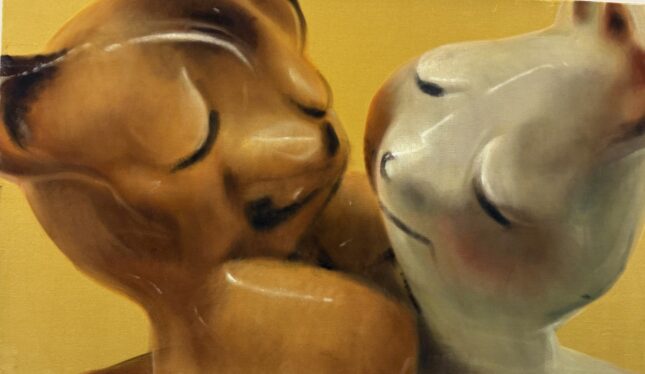
Issy Wood @Art Basel Qatar
By contrast, neighbouring Egypt, which has just reopened its Grand Egyptian Museum with great fanfare, introduced in January, for the first time within the institution, a mini contemporary art fair, Art Cairo.
Saudi Arabia
Above all, however, an open competition—measured in billions of dollars—is now unfolding between three states: Saudi Arabia, Qatar and Abu Dhabi. Saudi Arabia is multiplying initiatives in the field of contemporary art. Beyond the biennials and museums currently planned, on January 31 Sotheby’s staged an auction in Riyadh that met with notable success, including a record result of 2.1 million dollars for a painting by a legend of national art, Safeya Binzagr (1940–2024). By contrast, Riyadh Art Week, a fair/exhibition held in April 2025, has for the moment not been renewed. In Riyadh, the Diriyah Biennale has just opened. Ill be writing about it soon.
Abu Dhabi
Abu Dhabi’s sovereign wealth fund has taken a stake of nearly one billion dollars in the auction house Sotheby’s. The Emirati capital will also inaugurate a new format for its local fair in November. Renamed Frieze Abu Dhabi, it will gain international visibility in the field of art commerce, while a gigantic Guggenheim museum is scheduled to open in Abu Dhabi in December 2026.
And Qatar
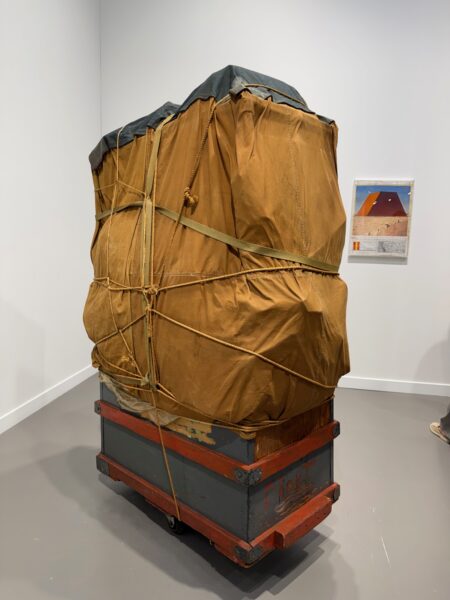
Christo @Art Basel Qatar
Qatar, meanwhile, is offering not only a freeport facilitating the movement of artworks, but also a visa designed to attract artists, the “Creative Visa.” Above all, Doha is organising, for the first time, a fair in collaboration with the global leader in the field, Art Basel. This is Art Basel Qatar, open to the public from February 5 to 7, 2026.
Geostrategy and boycott
It goes without saying that international politics intersect here with the geostrategy of the art market: some international collectors—and certain dealers as well—are boycotting the country because of its anti-homosexuality legislation and its policy of protecting Hamas.
Sheikha Al Mayassa
Qatar, with Sheikha Al Mayassa Al Thani, sister of the reigning emir, at the helm of its artistic strategy, has invested personally and massively in the venture. Her wager is long-term. “We are patient. We build layer upon layer,” she states.
Wael Shawky
For its inaugural edition, Art Basel Qatar does not replicate the usual model of the Swiss behemoth. The fair presents only 87 galleries (compared with nearly 290 in Basel), and each is devoted to a single artist. The selection process is led by an artistic director, an Egyptian visual artist based in Qatar, Wael Shawky (born 1971). Celebrated though he is, in no way a commercial artist. He produces films and animations often linked to mythology. “I approached this mission as a work of art. I am an artist who believes in the mixing of different cultures. From one stand to the next, connections can be woven between the works.”
Noah Horowitz
Noah Horowitz, CEO of Art Basel, adds: “Investment in museums and art is enormous across the entire region. We serve as catalysts.”
Quality
Indeed, for this first edition of Art Basel Qatar, the level of quality is particularly striking. This is evident first in the presence of major classics of contemporary art. New York’s Acquavella Gallery made the trip with, among other works, an extraordinary 1985 self-portrait by Jean-Michel Basquiat, priced at 40 million dollars; Gagosian with extremely rare works from the 1960s by the Bulgarian-born Christo, when he was just beginning to wrap objects, priced up to 1.2 million dollars; and Hauser & Wirth with a grotesque-style self-portrait from 1978 by the American painter Philip Guston (1913–1980), recently the subject of an exhibition at the Musée Picasso in Paris, priced at 14 million dollars.
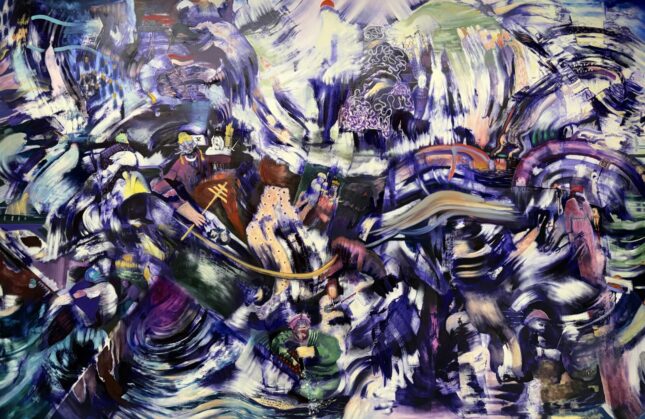
Ali Banisadr
Above all, Art Basel Qatar is determined to foreground artists from what is known as the Global South, and more specifically from the MENASA region (Middle East, North Africa, South Asia). One of the most striking works is a large-format painting, poised between abstraction and figuration, by Ali Banisadr (born 1976). The American artist, born in Iran, is presented by the French dealer Emmanuel Perrotin, ( prices ranging from 45,000 to 650,000 euros).
Ali Banisadr
At Art Basel Qatar, artists are invited all expenses paid by the fair’s organisers. Banisadr, like some forty others, made the journey. He explains: “Each painting takes several months to complete. On the different abstract layers, characters gradually appear, telling stories that are, among other things, connected to current events.” Steeped in art history, Banisadr references Max Ernst or Goya, with swirling colours punctuated by a multitude of enigmatic figures.
Sustain Our Work with a Small Monthly Gift
It’s very simple. Just $10 a month allows us to keep going.
Reliable information is valuable.
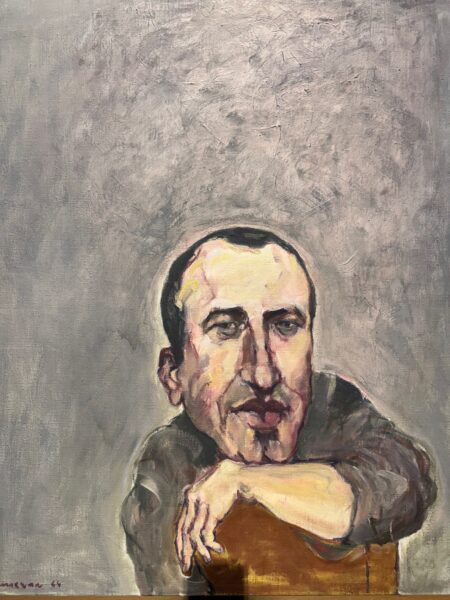
The Lebanese gallerist Andrée Sfeir-Semler came to Doha with three canvases by one of the major figures of classical contemporary painting from the Middle East, the Syrian artist Marwan (1934–2016), who lived for many years in Germany.
His intention is clearly visible: the dilution of the human figure over time, leading to near abstraction, with prices (ranging from 500,000 to one million dollars). According to the gallerist, the prices of his works have doubled in recent years. In Paris, the Institut Giacometti devoted an exhibition to him through January 25, 2026.
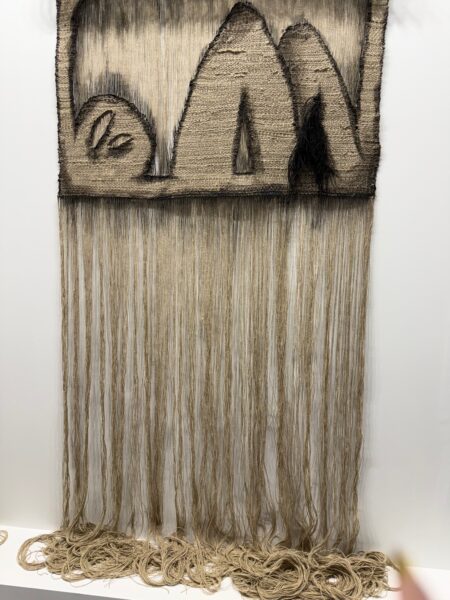
Manal Al Dowayan
Manal Al Dowayan
The Saudi artist Manal Al Dowayan (born 1973) also came to present her work on the stand of the Madrid-based gallerist Sabrina Amrani. She represented her country at the Venice Biennale in 2024 and is currently exhibited at Arduna, the brand-new temporary museum created with the Centre Pompidou in the AlUla region of Saudi Arabia.
Al Dowayan’s subject is women. Here she proposes, in sinuous forms, a stylised, almost abstract representation of the female body within a vegetal weave ( priced at 80,000 dollars).
Pascale Marthine Tayou
Galerie Continua is showing paintings and sculptures by the Cameroonian artist Pascale Marthine Tayou (born 1967), who lives in Belgium. He was awarded the Grand Prix de Sculpture by the Académie des Beaux-Arts in January 2026. His work explores the links between African art and Western culture. His masks, made from a mixture of blown glass and fabric and crowned with bronze branches, speak, according to the artist, of “the necessity of knowledge of tradition,” (priced at 48,000 euros).
Commercial success
On the opening day of Art Basel Qatar, the lingering question concerned the fair’s commercial success. Given the tensions in the region, many collectors—particularly Americans—had cancelled their trips. However, even before the public opening, the emir of Qatar’s family, known for its voracious appetite for art, had already gained access to the event.
Another centre of gravity
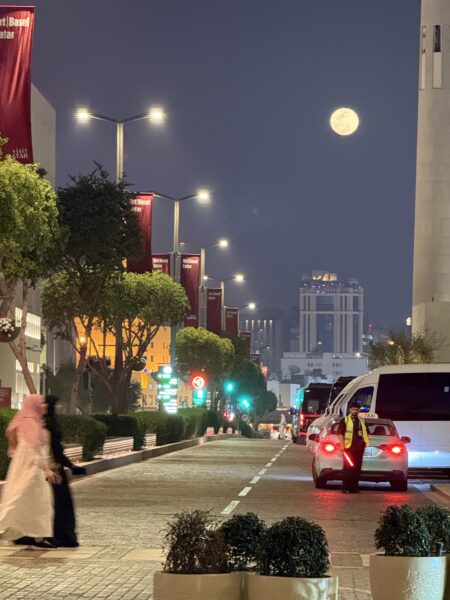
In this impeccably organized country, which feels like a futuristic Swiss version of Islam and the desert, Art Basel Qatar proposes another centre of gravity for artistic creation, more oriented toward the East. In an economically difficult period for contemporary art, there is little doubt that this shift will have positive consequences, in market terms, for artists perceived as having local roots.
Doha
Share this article
Support independent art journalist
If you value Judith Benhamou Reports, consider supporting our work. Your contribution keeps JB Reports independent and ad-free.
Choose a monthly or one-time donation — even a small amount makes a difference.
You can cancel a recurring donation at any time.
JB Reports use cookies to ensure that we give you the best experience on our website. If you continue to use this site we will assume that you are happy with it.