Accross the Atlantic
Color. Freedom. Death. Three words offer a way into the world of Kerry James Marshall (born 1955), one of the major American painters of our time, yet still surprisingly little known in France. Until now, only a handful of his paintings had been seen in France, notably in the Pinault Collection. At last, the Musée d’Art Moderne de Paris is giving him a retrospective, on view through January 24.
Sustain Our Work with a Small Monthly Gift
Become part of the Judith Benhamou Reports circle.
Contribute, even from just €10
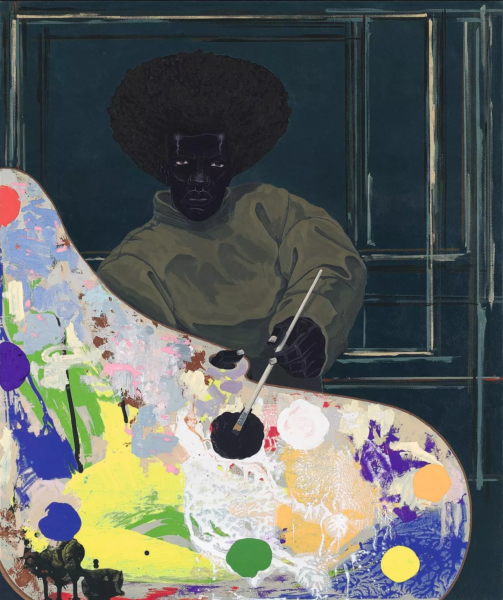
Across the Atlantic, however, KJM, as insiders call him, is a celebrity, one of the central figures in Black consciousness and contemporary painting. Arthur Jafa, for instance, frequently acknowledges Marshall as a major reference and a friend.
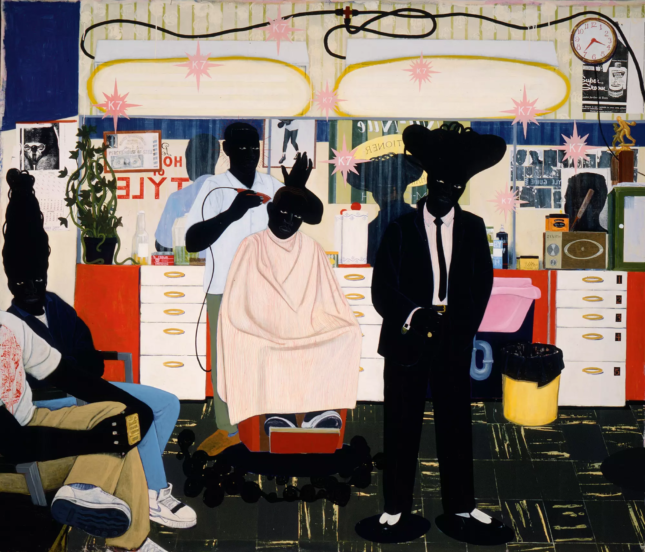
He is, above all, a storyteller. To construct his narratives around the African American experience, he deploys, with immense skill, an abundance of motifs, forms and color contrasts, often across very large canvases.
The London version of the exhibition, shown last fall at the Royal Academy, unfolded inside a setting that resembled a multicolored candy box. In Paris, installed in the sweeping curves of the Art Deco museum building, the effect is very different. The 70 works quite literally explode against the institution’s white walls.
Color
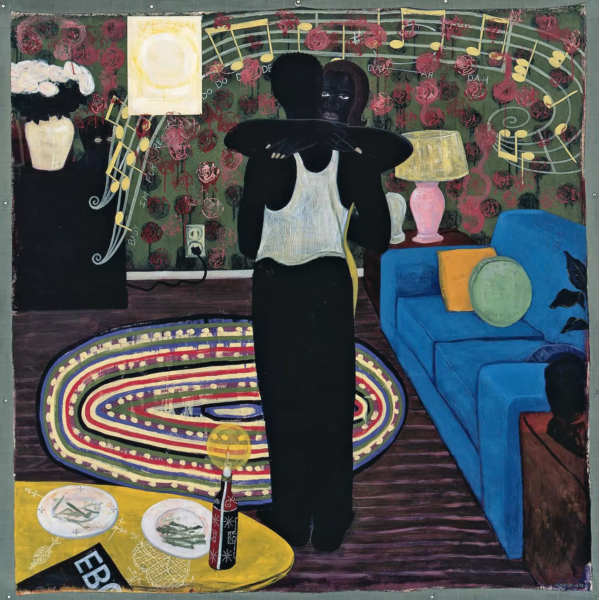
For Marshall, color begins with black.
He does not paint the protagonists of his compositions brown, for instance, but in a range of exceptionally dark tones to represent those we call “Black,” though human skin is rarely literally black. At times he even turns his figures into shadows.
The chronologically organized exhibition opens with a group of works from the 1980s titled Invisible Man. Marshall is referring to Ralph Ellison’s 1952 novel Invisible Man, curiously translated into French as Homme invisible, pour qui chantes-tu ? Ellison describes a man whom society refuses to see. This is the America of racial segregation.
In Marshall’s painting, an almost entirely black monochrome is interrupted at the top by a broad smiling mouth filled with white teeth, beneath two equally white eyes. He would return to the device in Black Painting (2003), where, within an extremely dark monochrome, the reflection of a Black couple lying in bed is barely perceptible.
Everyday life
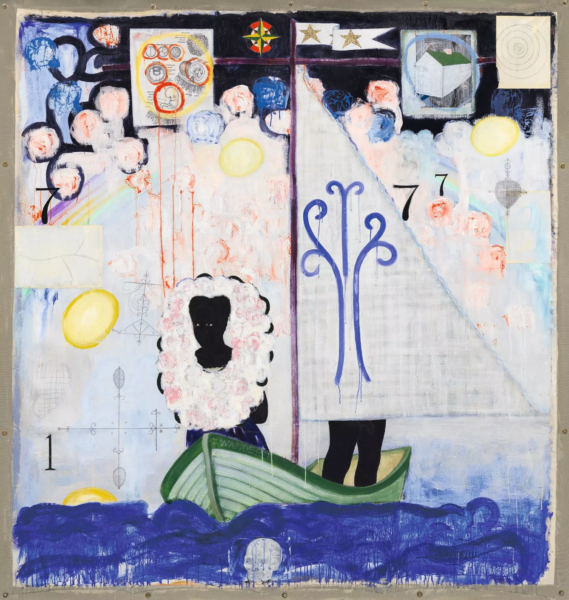
Very quickly, however, color erupts, eventually becoming omnipresent in his large-scale paintings of contemporary history.
As for his subjects, Marshall often returns to what in the 18th century would have been called “genre scenes”(scenes de genre): depictions of ordinary life, here centered on the African American community. Critics often cast Marshall as a history painter. Yet his most moving works, to my mind, are rooted in everyday life.To that he adds the influence of Diego Rivera and his taste for XXL formats.
KJM knows art history intimately. As early as 1994, he declared: “I always wanted to be a history painter on a grand scale, like Giotto or Géricault.”
The works selected for the exhibition include several masterpieces, among them Past Times, painted in 1997.
Past times
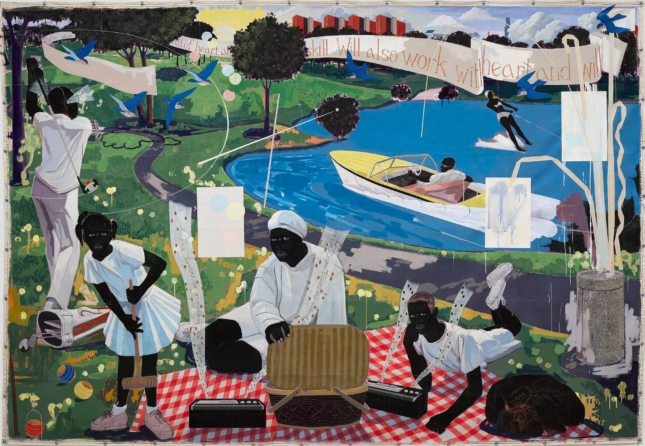
This is where Marshall’s freedom becomes especially clear. He has always kept his distance from fashion. At a moment when artists were still endlessly deconstructing easel painting, Marshall was revisiting the classics through virtuoso figuration.
In Past Times, he removes the familiar drama so often attached to narratives of African American life and instead depicts leisure: picnics, croquet, water-skiing. In doing so, he celebrates the freedom of a population long denied it. One might call that a statement.
The composition is turbulent and exuberant, animated by a multitude of Black figures surrounded by a multitude of motifs: yellow flowers, a red-and-white checked tablecloth, green grass, blue water.
The painting has been compared to Georges Seurat’s famous A Sunday Afternoon on the Island of La Grande Jatte. That work, incidentally, is housed at the Art Institute of Chicago, the city where Marshall himself has lived for many years.
Commercial success
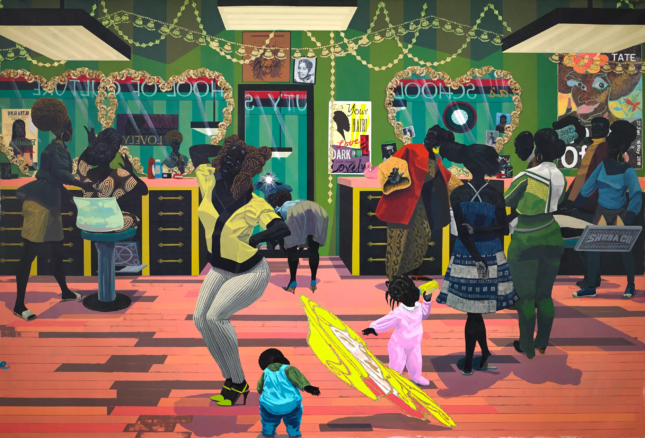
This is one of the ways KJM sets the record straight: he reintroduces African American figures into a pictorial history from which they had largely been excluded.
In 2018, Past Times also became one of the symbols of the new commercial success of African American culture. The painting was bought for the record sum of €17.9 million by the rapper then known as Puff Daddy. The canvas has made the trip to Paris, but its current ownership is unclear, while the singer is now in prison.
The title
More broadly, the meaning of Marshall’s paintings is often as complex as a rebus, with the title providing an essential clue.
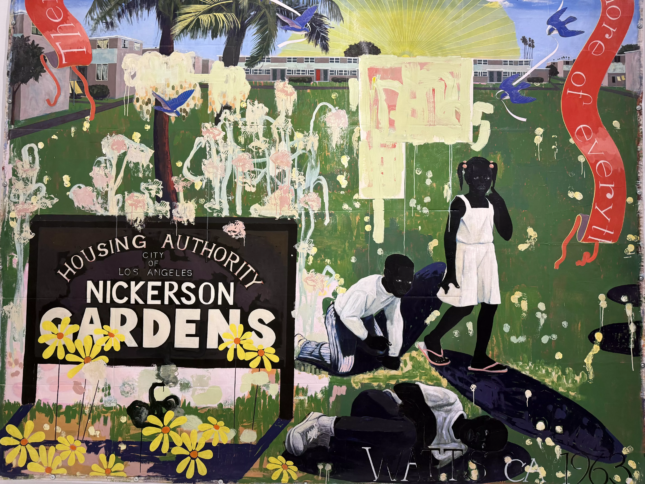
In Watts 1963 (1995), Marshall depicts, across 3.4 meters, the bucolic ecstasy of a young couple in a Los Angeles park. Palm trees, lawn, little flowers. Yet Watts was, in the mid-1960s, at the center of violent conflict between the Black community and the police.
The very young Kerry had just moved there with his parents. The events remained etched in his memory. The painting is one way of alluding to them.
Taboo
Kerry James Marshall is also a free painter because he does not hesitate to address taboo subjects.
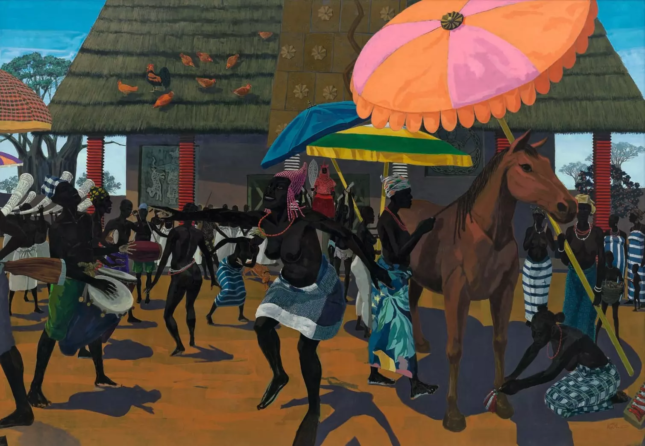
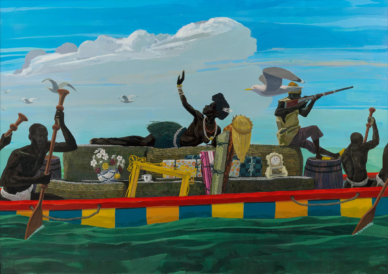
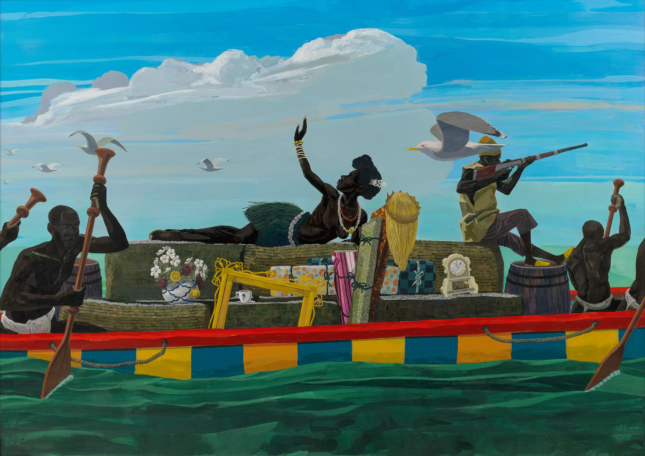
Among the most recent works in the exhibition is Six for One (2024). The title refers to a sentence he found in the notebooks of a slave trader: “They used to give twelve men for one horse. Now they only want to give six.”
Yet there is no explicit scene of violence. A horse occupies the center of the composition, surrounded by African women dancing.
As the art historian Darby English explains in the catalogue, the painting also alludes indirectly to the fact that some Africans sold other Africans. Marshall describes this as a way of offering “a more realistic view of what we are willing to do to each other in order to get some stuff.”
death
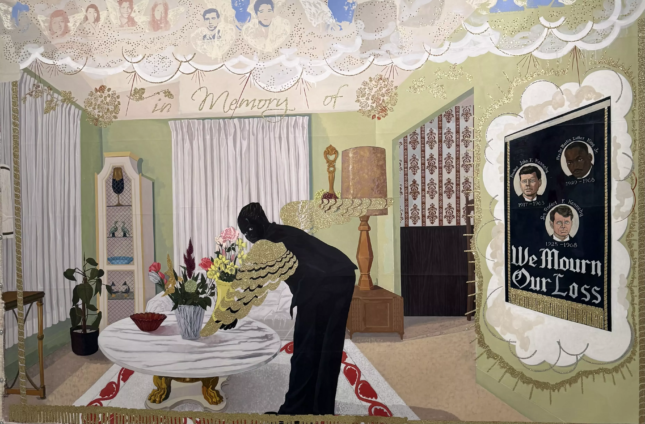
Finally, Marshall’s world is haunted by death.
Often violent, it is a constant companion to his community. Yet it is never depicted in a brutal or blood-soaked baroque form.
A remarkable series of paintings from 1998 is devoted to the subject. In the four works titled Souvenir, KJM draws inspiration from the decoration of modest elderly women’s homes, and more specifically from that of his mother-in-law.
At the center of the living room, he or she places a kind of altar devoted to the memory of victims of violence, including Martin Luther King Jr. Photographs, commemorative plates: their images are venerated.
the bigger picture
Marshall tempers the dramatic atmosphere by decorating the monumental compositions in the manner of old-fashioned greeting cards, complete with trails of golden glitter. The artist explains: “If you’re too direct, nobody thinks. People just react to what they perceive as trauma. I’m more interested in what you think about the bigger picture.”
Kerry James Marshall has succeeded in building an oeuvre that is both aesthetic and political.That is rare.