Catherine Nichols
When Catherine Nichols, a curator at Hamburger Bahnhof in Berlin, was appointed to lead the 18th Lyon Biennale, one of France’s major contemporary art events, she visited the city and became fascinated by a centuries-old local curiosity: the traboules. The Australian curator, who lives in Germany, seized upon this local peculiarity as a kind of conceptual thread running through her exhibition: the idea of taking an alternative route.
“I began by looking at Lyon as an industrial city and considering how the economy had shaped its landscape. That, after all, is how the traboules came into being. I also thought of the French artist Robert Filliou (1926–1987), who, in an earlier life, had worked as an economist at the United Nations. He spoke in terms of a poetic economy.”
Sustain Our Work with a Small Monthly Gift
Become part of the Judith Benhamou Reports circle.
Contribute, even from just €10
Robert Filliou
Robert Filliou, a conceptual artist who deliberately distanced himself from material considerations, can be regarded as one of Marcel Duchamp’s true heirs. He is best known for his definitive pronouncement: “Art is what makes life more interesting than art.”
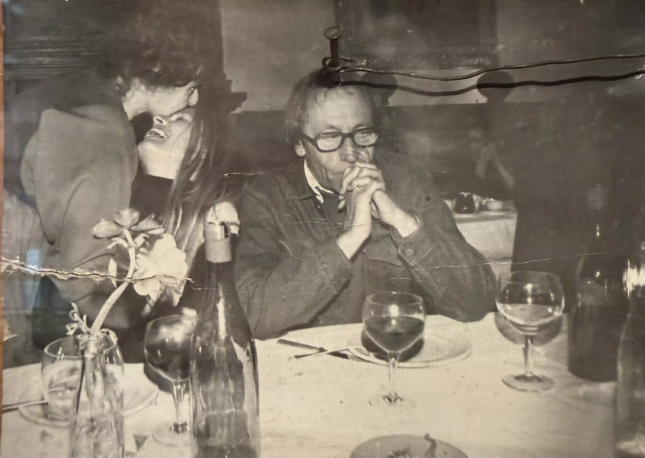
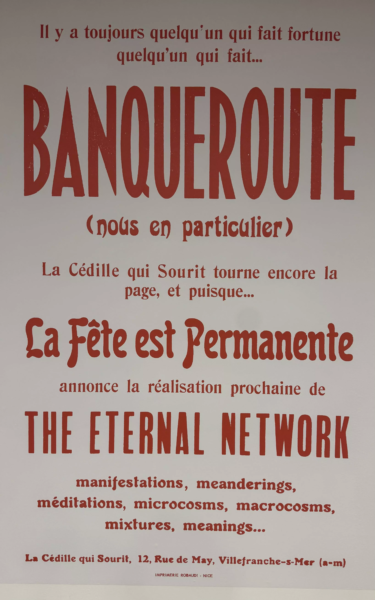
Throughout the Biennale’s 11 exhibition venues, Filliou is a recurring presence, represented through objects and documents. One could have wished for even more: an entire retrospective devoted to this genius whose art so often took immaterial forms. ( In Paris, Galerie Peter Freeman is presenting an exhibition devoted to Robert Filliou through November 7).
Still, the undertaking is an undeniable success.
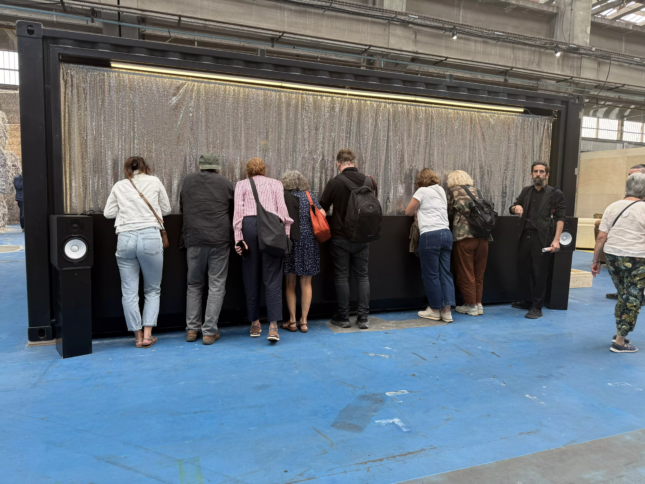
The two venues featuring the most powerful works are the Musée d’Art Contemporain (MAC) and the former Musée des Tissus, long devoted to textiles and now no longer operating as a museum.
Lucy Beech
At the MAC, British artist Lucy Beech (born 1985) has filmed vultures in the Drôme region of southeastern France. Her camera captures not only their majestic flight but also the merciless way they descend upon the carcasses of sheep and tear them apart. These scenes are interspersed with close-ups of a child’s face, watching the raw power y of nature unfold.
Minh Lan Tran
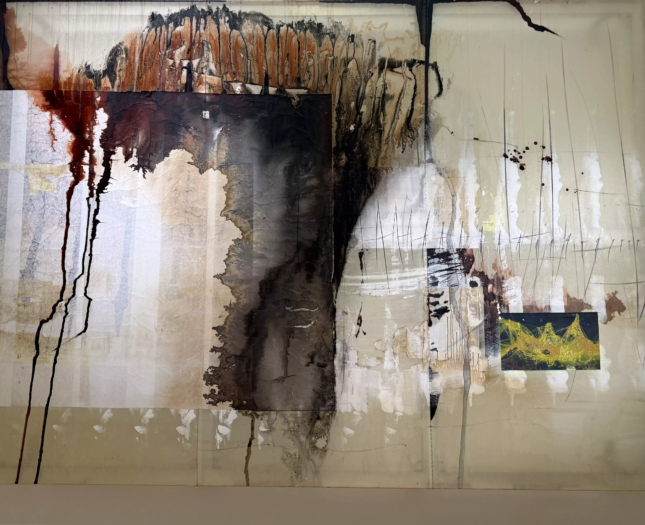
On the same floor, is French artist Minh Lan Tran (born 1997 in Hong Kong). Earlier this year she exhibited a monumental latex installation at the Museum of Modern Art in Warsaw, alongside a major exhibition devoted to Julie Mehretu.
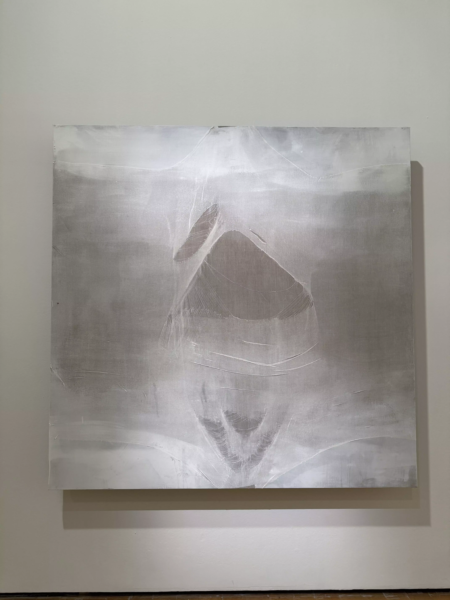
She creates large, sensual abstract paintings that are instantly recognizable often streaked with blood-red splashes and black jets of paint, the result of sweeping gestures across translucent latex surfaces. She explains, metaphorically, that she is attempting to “represent disintegration, just before things disappear, so that everything can begin again.” These spurts of blood immediately reminded me of Anish Kapoor. His retrospective at London’s Barbican was still fresh in my mind when I visited the Lyon Biennale. I mentioned to the artist that she and Kapoor seemed to share a fascination with blood as a material. Only then did she reveal that, during her studies in London, she had worked as an assistant to the British-Indian artist himself.
Shadows of mysterious, seemingly unidentifiable objects emerge from her fascinating new works, made entirely of translucent white materials. This subtle interplay of light, shadow and matter also brought to mind Andy Warhol’s Oxidation Paintings, despite the radically different processes involved in their creation.
Lucia Kagramanyan
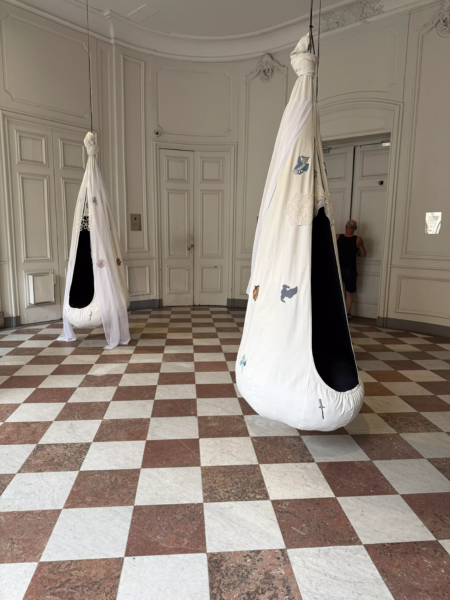
At the former Musée des Tissus, Armenian artist Lucia Kagramanyan seeks, in a very different way, to hold on to the past. She has created an installation of cocoon-like armchairs inviting visitors to settle in and listen to haunting lullabies sung by elderly Armenian women whom she sought out and recorded around the world, including in Lyon.
Ferdinand Makouvia
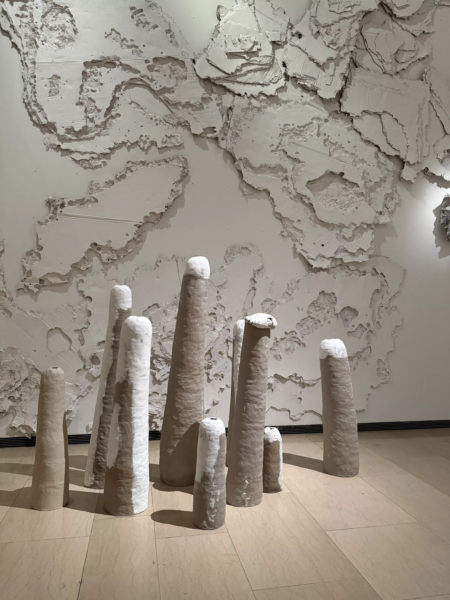
A little farther on, Togolese artist Kokou Ferdinand Makouvia (born 1989) has created an entire universe. The walls are covered with geographical maps made from torn cardboard.
On the floor are sculptures fashioned from a variety of materials, including ceramics: large mushrooms symbolizing the protection offered by ancestors.
“The past is never truly past,” Kokou explains.
As Filliou would say, “Art is what makes life more interesting than art.”
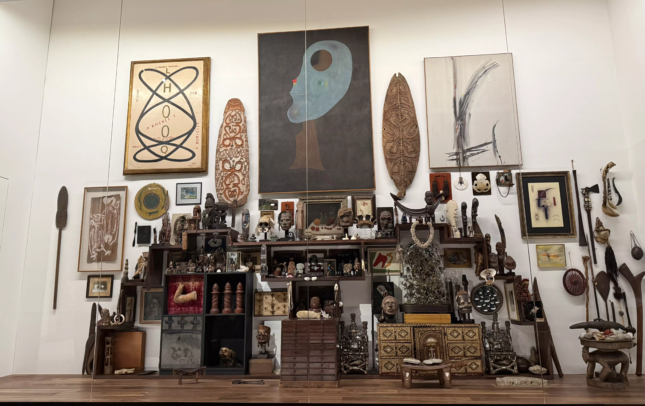
Not to be missed: at the Musée des Beaux-Arts, a temporary exhibition of works from the Centre Pompidou’s collection, exceptionally including André Breton’s famous wall, a total work of art in its own right.