Iconic symbol
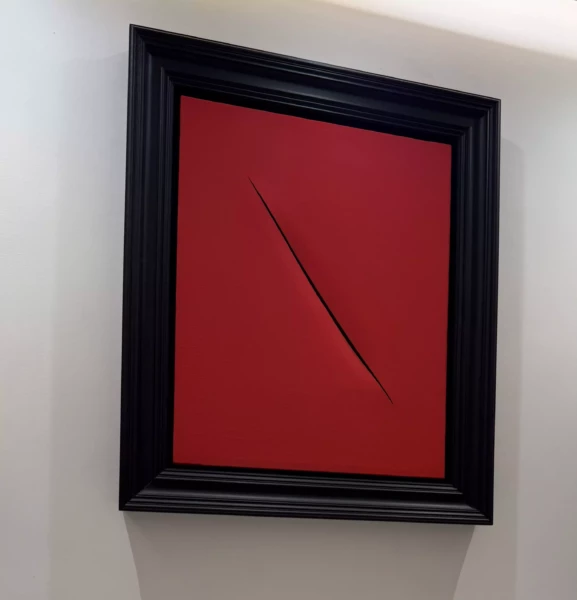
It was a simple gesture, almost casual: a box cutter drawn across a canvas. Yet it became one of the most iconic symbols in the art of the second half of the twentieth century. In 1958, the already celebrated Italian artist Lucio Fontana began making Tagli — slashes cut into monochrome canvases — a radical transcendence of traditional painting.
with a Stanley knife
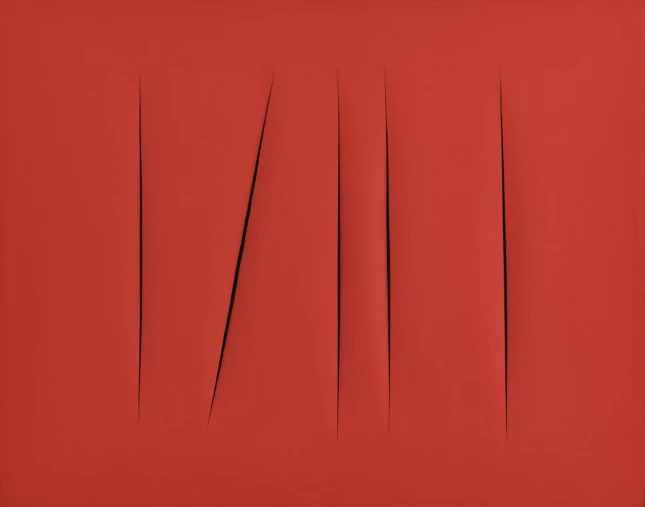
The process is precisely documented in the catalogue of the retrospective devoted to the artist at the Musée d’Art Moderne de la Ville de Paris in 2014. “The canvas and its edges were carefully prepared and coated with color in the morning. In the afternoon, after a period of concentrated stillness, Fontana would lacerate the canvas from top to bottom with a Stanley knife. The curvature of the slashes, their number, their succession, their rhythm — all gave material form to the artist’s presence and gesture. After experimenting with various canvases and surfaces, from 1958 to 1959 Fontana focused on smooth, rectangular monochrome canvases, then refined the technique further and introduced black gauze on the reverse to stabilize both form and tension.”
Sustain Our Work with a Small Monthly Gift
Become part of the Judith Benhamou Reports circle.
Contribute, even from just €10
female sexuality
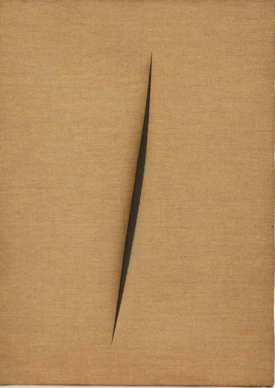
Some art critics denounced the act as a crime against painting. Others preferred to read the slash as a symbol of female sexuality. Fontana himself offered a more lyrical explanation: “the cut is a bite, a tear, a gestation (…) a search for a dimension that goes beyond the frame of the painting.” He was inviting the eye to look further, to see beyond the canvas. Conceptually, the slash transformed a work that had always been an expression in two dimensions into one that now claimed a third. From that point on, Fontana multiplied his Tagli — producing, according to the MAM catalogue, an average of 150 such paintings per year until his death in 1968. On the back of each one, he inscribed phrases that gave them a personal character: dedications, words that captured his mood, or commentaries on the work itself.
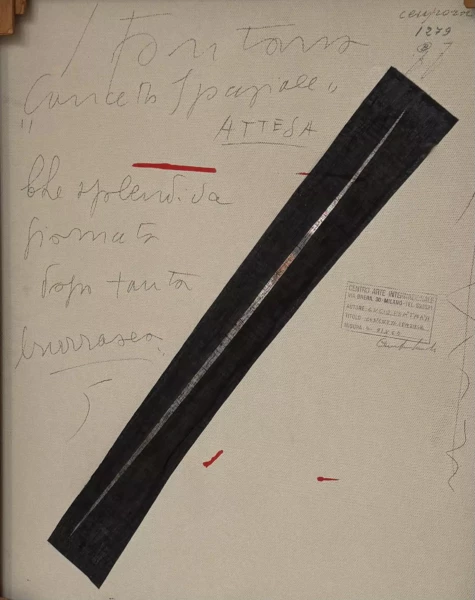
Concetto Spaziale
More broadly, all works conceived by Lucio Fontana from 1949 onward would carry the title Concetto Spaziale (Spatial Concept), a designation that unified his paintings, sculptures, and objects — including vases — under a single philosophy. The slashes became the most celebrated of these works, to the point that many people today assume Concetto Spaziale is simply the name of the cuts.
exploration of space
Born in Buenos Aires — the son of a sculptor who made funerary monuments — Fontana wrote his White Manifesto in 1946, declaring that art must engage with the subjects of time, space, and light. He sought a revolution tied to the technological upheavals of his era, and was particularly drawn to the exploration of space. “We have entered the space age,” he wrote. “Man has measured the distances between the planets and set out to discover them. Through his inventions, man has launched humanity toward the impossible.”
systems of perforation
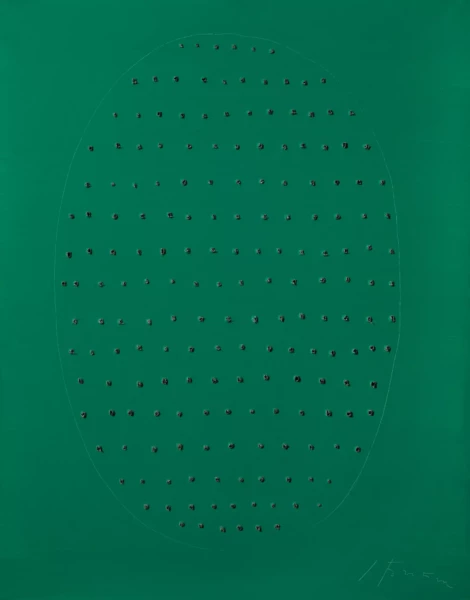
Fontana was among the first to work with neon, in 1951 installing a large, sinuous neon tube as a luminous drawing suspended in the void. Before arriving at the principle of the refined slash, he passed through other systems of perforation — most notably the Buchi (holes), developed from 1949 onward — building an entire symbolic vocabulary around the end of classical painting and sculpture. It is this radical force that the art market celebrates today.
€27.1 million
Lucio Fontana is the most expensive Italian contemporary artist at auction. His all-time price record — €27.1 million, according to the Artprice database — was set in November 2015, for a 1964 egg-shaped painting in yellow, entirely punctured with holes. It belongs to the La Fine di Dio (The End of God) series: large, ovoid canvases measuring 1.7 meters in height. These “celestial eggs,” symbols of the origin of the world, exist in only 38 examples and are considered by specialists to represent the fullest realization of Fontana’s concept of space.
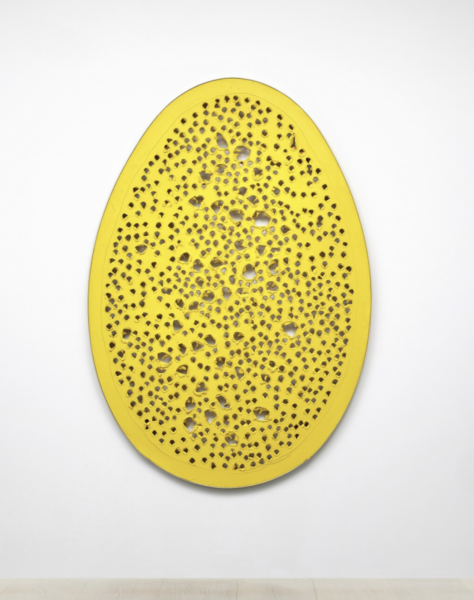
The years between 2015 and 2020 were clearly the peak of the market for this internationally sought-after artist.
In 2024, during a period of broader economic fragility, another yellow canvas from the same series sold for €21.2 million — which Artprice reads as evidence of some softening in Fontana’s values.
Yet long-term returns have proven excellent. On May 14, 2026, in New York, Sotheby’s hammered down a singular 1961 painting from the Venice series — estimated at €8.5 million — for €14.1 million. It had been acquired in 2002 for €2.1 million. Invited to exhibit at the Palazzo Grassi in 1961, Fontana created 22 works exploring the atmospheric qualities of the city. In this canvas, he evokes the sky with its silvery reflections and shimmering light.
lacerated canvases
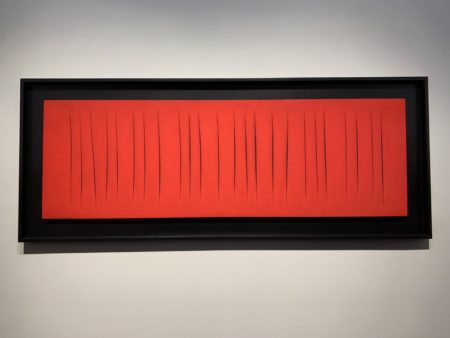
The largest portion of Fontana’s output, however, corresponds to his lacerated canvases. The auction record in that category — €15 million, also set in 2015 — belongs to a red monochrome from 1965, slashed twenty-four times across two meters of canvas. It was also exhibited in 2019 by the multinational gallery Hauser & Wirth.
In Paris, Galerie Tornabuoni — a leading specialist in the Italian avant-gardes, which presented a Morandi/Fontana exhibition through January 10, 2026 — maintains a permanent selection of Fontana works. The gallery will be showing at least one piece at Art Basel in Basel, from June 18 to 21: an intense red monochrome from 1968, offered at around €3.3 million.
Michele Casamonti
Michele Casamonti, the parisian gallery’s founder, cautions against the impression of abundance that the market can convey: “He made around 900 of them, but many are in small formats. Large canvases are increasingly rare. The market remains solid.” The field is also highly technical, governed by relatively clear hierarchies. “There is stronger demand for certain colors — red and white first, followed by yellow, green, and blue. The slash must also be harmonious. And when several slashes are present, they create a kind of dance, a form of writing, within the canvas itself,” Casamonti explains.
Karsten Greve
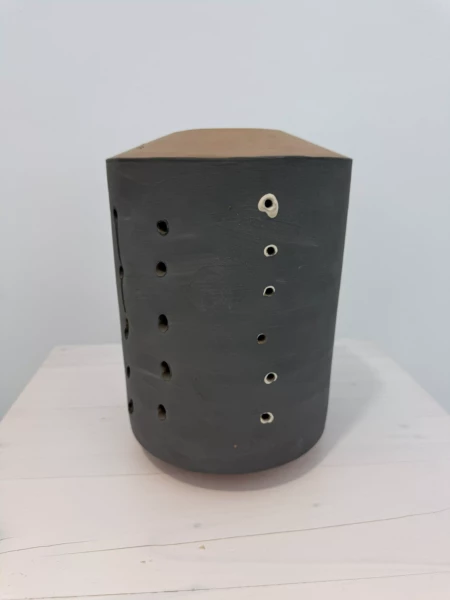
Also in Paris, in the Marais, Galerie Karsten Greve is organizing an exceptional exhibition devoted to Fontana’s ceramics, on view through September 5. It follows The Ceramics of Lucio Fontana, held at the Peggy Guggenheim Collection in Venice through March 2, 2026. This body of work spans the entirety of his career as part of his conceptual investigations. Among the 37 pieces on view in Paris, several are not for sale; prices begin at €220,000. Clay is a particularly resonant material for an artist obsessed with space.
crucifixes
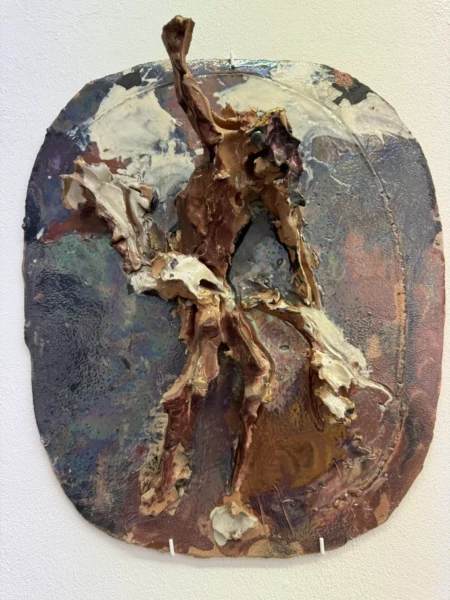
Among the most compelling works are crucifixes whose forms seem to crumble under the artist’s kneading hands. Made primarily between 1947 and the mid-1950s, these religious works — connected, it seems, to his father’s iconographic repertoire — long suffered from a profound misunderstanding when measured against his abstract production. In 2025, indeed, 85 percent of Fontana’s works sold at auction were paintings. Yet today, according to Melchior Rothstein of Galerie Karsten Greve, the ceramic work is far better regarded by the market.
The hole is the beginning of a sculpture
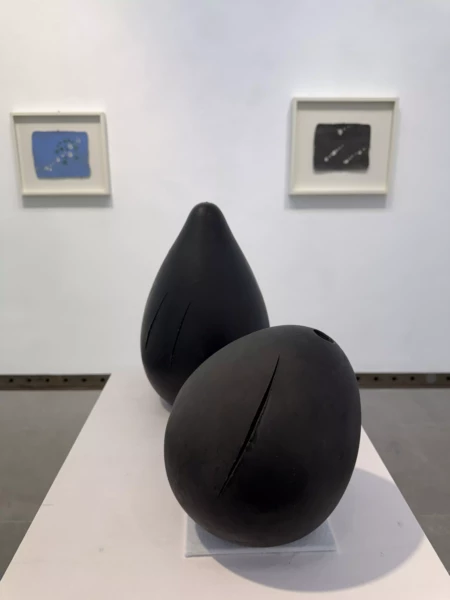
At auction, the terra cottas remain clearly the last undervalued territory for this great Italian artist. On April 16, 2026, a round white ceramic punctured with aligned holes, dated 1954, sold for €76,800. On May 27, 2026, at Sotheby’s Milan, a Madonna and Child rendered in a wholly dissolved form, covered in polychrome enamel and dated 1947, reached €192,000. These two works — more modestly priced than the lacerated canvases — are nonetheless perfect reflections, in their own medium, of the spirit of the man who once said: “The hole is the beginning of a sculpture in space.”