primordial story
“The earth was without form, and void; and darkness was upon the face of the deep.” The opening words of the Old Testament conjure a landscape of desolation, soon followed by the story of Adam — and, in his wake, Eve. In the extraordinary exhibition that Pierre Huyghe (born 1962) has conceived for the Fondation Beyeler in Basel, on view through September 13, a silent film projected on an enormous screen seems to revisit that primordial story from the very beginning. Its title is Liminals. The work has been shown before, in earlier, less resolved forms; since then, the French artist — who now lives in Santiago, Chile — has reworked it extensively.
eve is free
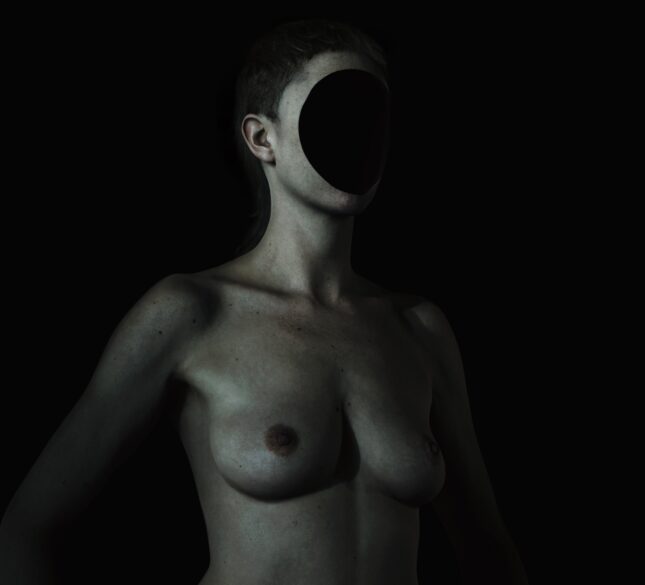
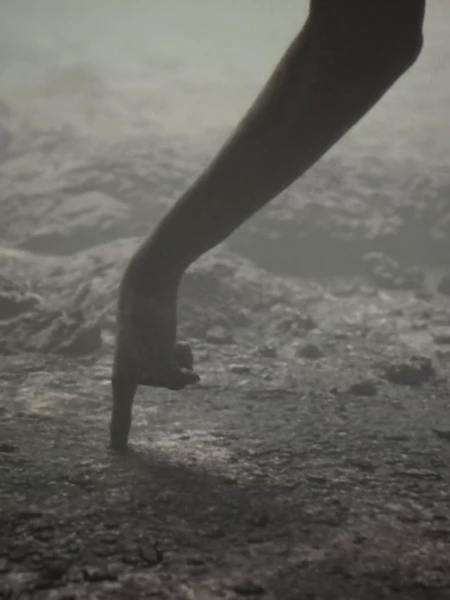
What we see here is a kind of Eve who needs no Adam: a woman literally “bathed in darkness upon the face of the deep.” She is naked. She moves slowly, crouches, presses her hands into the earth for reasons we cannot quite name. Her body is graceful but entirely real — a cesarean scar crosses her abdomen, stretch marks trace her skin.
Sustain Our Work with a Small Monthly Gift
Become part of the Judith Benhamou Reports circle.
Contribute, even from just €10
She has already given life. Her face is covered by a black concave mask, a kind of facial trepanation that strips her of individual identity and makes her, instead, every woman. Welcome to the world of Pierre Huyghe: futuristic and ancient, alien and utterly gripping.
mouna mekouar
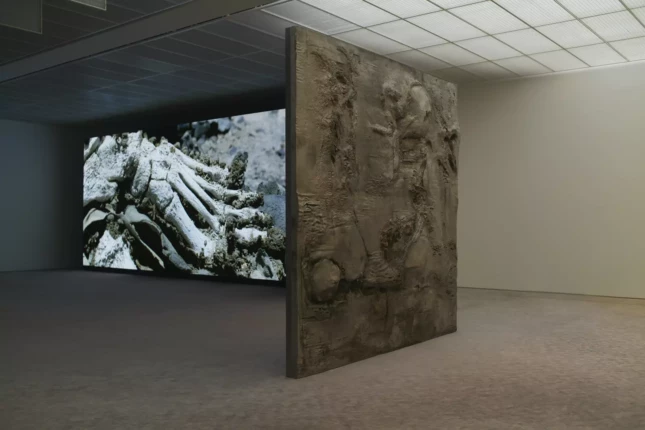
The gravitas of this fifty-minute film — which one may, without guilt, experience only in part — is tempered by a visual atmosphere that recalls the eerie, charged air of David Lynch’s Twin Peaks. “As always, he has completely adapted to the space in order to construct a narrative,” says Mouna Mekouar, co-curator of what is less an exhibition than an experience. Across some fifteen works and installations, Huyghe plays with different registers of life itself.
a colony of ants
The first image to confront the visitor is a small dark trace on a wall — a wall pierced, at its center, by a single hole. Step closer: the drawing moves. Huyghe has installed a colony of ants behind the partition; they emerge in procession, following trails of sugar, and the viewer is instantly returned to the childhood wonder of watching small creatures at their inscrutable work. Playful as ever, Huyghe also toys with appearances. Set flush into the floor is a basin carved from basalt — something like a sink without a drain.
a lot of space
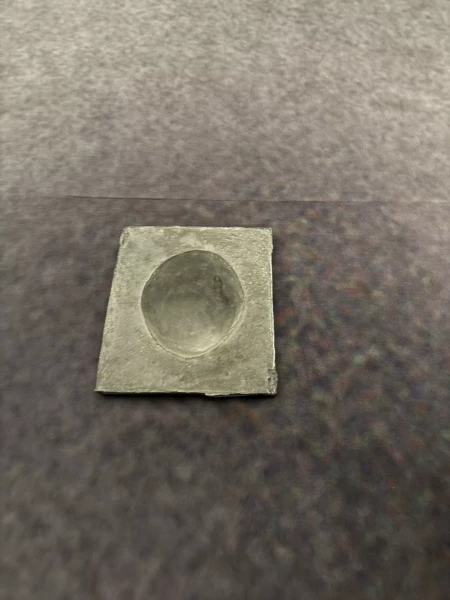
Artists from Marcel Duchamp to Robert Gober have long mined the bathroom fixture for meaning, but this object is something else entirely: it is a cast of the pregnant belly of the artist’s partner, carrying their daughter.
Throughout the relatively spare, luminous galleries, a sound plays — and periodically stops: a breath, the labored respiration of a strange white aquatic creature submerged at the bottom of an immense tank beneath a rock. It pulses. This is an artificial breathing organ whose amplified exhale travels, through an intricate system, into every room of the museum.
fukushima just after…
The dazed visitor continues, arriving at another large projection. In a deserted Japanese city — Fukushima, after the nuclear catastrophe — stands an abandoned restaurant whose only remaining clientele are cockroaches.
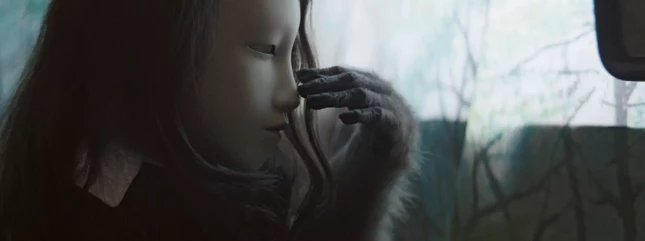
The waitress has long hair and bobs her head in a slow, rhythmic nod. This is normal: she is a dressed monkey, wigged and masked in white. Hers is the perfect face of the end of the world.
animatronic
The final act comes in the form of an enormous animated earthworm, moving across the floor with an uncanny, lifelike conviction. It is at once phallus and the serpent of Genesis: “Now the serpent was more cunning than any beast of the field which the Lord God had made.” Because of him, Pierre Huyghe’s Eve will soon know Good and Evil. To the great misfortune of us all.
Through September 13. fondationbeyeler.ch