Sense of humor
“One of the most curious exhibitions Paris has ever seen (…) Sculpture or not. Call it whatever you like, Mr. Calder’s work is superb and fascinating. He possesses a considerable sense of humor.” That was in 1929. The art critic for the Chicago Tribune had ventured into a Paris gallery to see the work of this new American sculptor who was causing such a stir. He came away stunned. Alexander Calder had arrived in Paris three years earlier. He quickly made new friends in the then-boiling avant-garde circles.
superb and fascinating
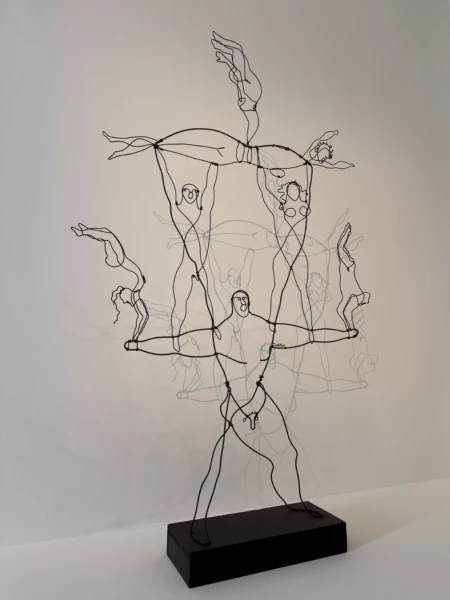
And from then on he bent wire into an entire whimsical world animated now by a London bobby, now by a dog, but also by a disjointed Joséphine Baker, a tennis champion, or a weightlifter…. As though drawing in space, Alexander—Sandy to those close to him—shaped metal wire into forms that told rather funny stories. Exactly one hundred years after his arrival in Paris, one could more than ever repeat the words of the Chicago Tribune critic. “Superb and fascinating,” his work now unfolds on an XXL scale at the Fondation Louis Vuitton in Paris.
Sustain Our Work with a Small Monthly Gift
Become part of the Judith Benhamou Reports circle.
Contribute, even from just €10
codes of childhood
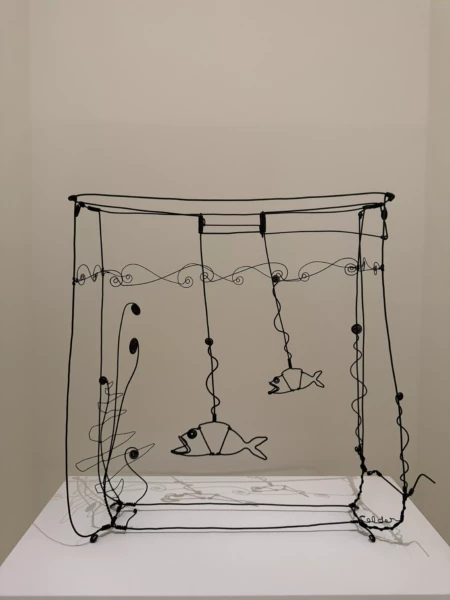
Three hundred works are on view there from April 15 through August 16. The fact that Calder is now one of the great classics of 20th-century sculpture could make us forget just how much this man displayed a “considerable sense of humor” in playing with almost nothing at all, in creating these figures that draw on the codes of childhood. But the major Paris show demonstrates above all something exceedingly rare: this artist’s grace.
assembling, tinkering
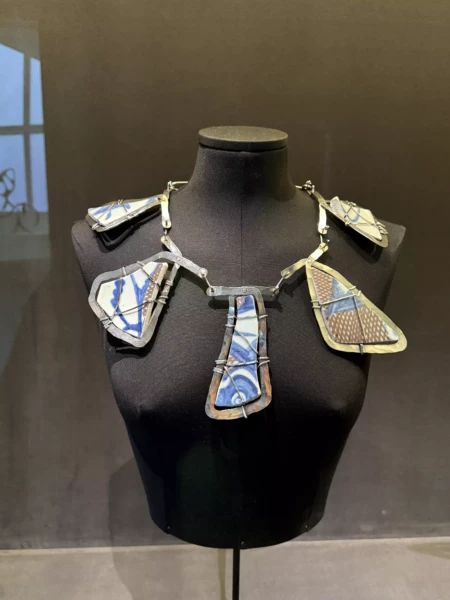
Or how, starting with next to nothing, he managed to create magical worlds by assembling, tinkering, making do—as he would throughout his life. The same is true of his jewelry—an entire room of the exhibition is devoted to it—made from stones picked up on the beach, ordinary metal, odds and ends, often created as gifts for his wife Louisa. In his hands they became spectacular adornments.
playing with lightness
Not taking himself seriously—or rather, seriously playing with lightness, in every sense of the word… That might have been his motto. In those years, before the 1930s, Sandy often staged performances using figures he set in motion himself. They were made of metal rods, corks, wood, or scraps of fabric. The show was simply called Calder’s Circus.
The ensemble, of extraordinary poetry, has been re-created in Paris from the collections of the Whitney Museum in New York. They are all there, or almost all of them: the members of his troupe—150 dancers and acrobats, but also the lion, the elephant, and all the scenery.
Films show him activating his fascinating little theater of the trivial, in which he perfectly succeeds in giving each character a distinct personality. A delight.
1929: abstraction
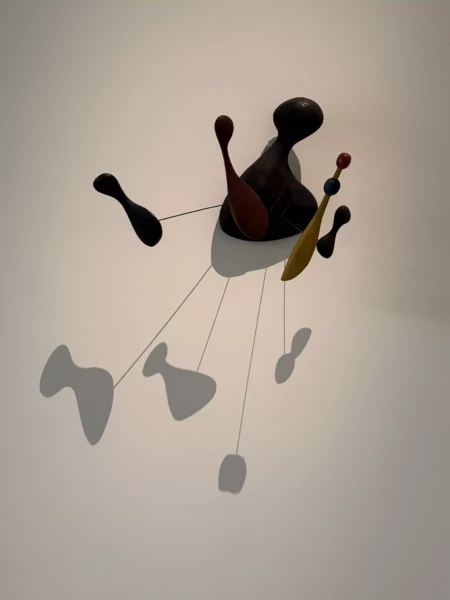
For most people, 1929 has remained etched in memory because of the worldwide economic crisis. For the American, that year marked an awakening in his work: the imperative need to move toward modernity by freeing himself from figuration. Reference to reality would no longer be an obligation. In Paris, he visited the apartment-studio of one of abstraction’s great devotees and a master of colored lines, Piet Mondrian. A prophetic sign. Mondrian lived on rue du Départ. And so here was Calder’s own new departure.
mobiles
Two years later he conceived what would make him definitively famous: the mobiles. The word itself is said to have been invented by his friend Marcel Duchamp—another artist with a taste for irony.
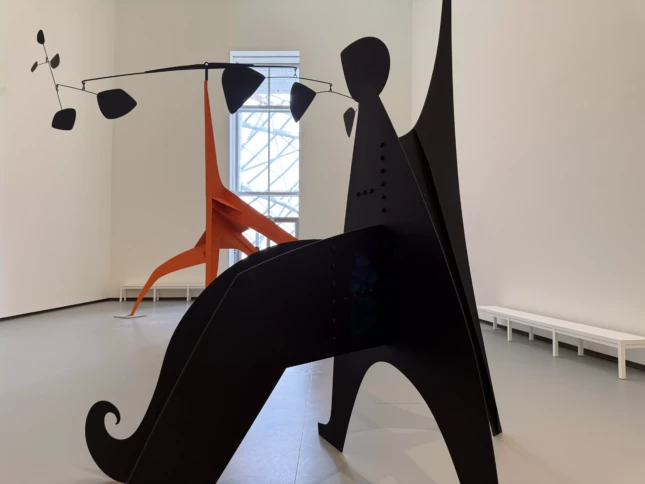
Lightness, did you say lightness… It takes a great deal of it for the wind to succeed in moving a sculpture.
the breeze does the work
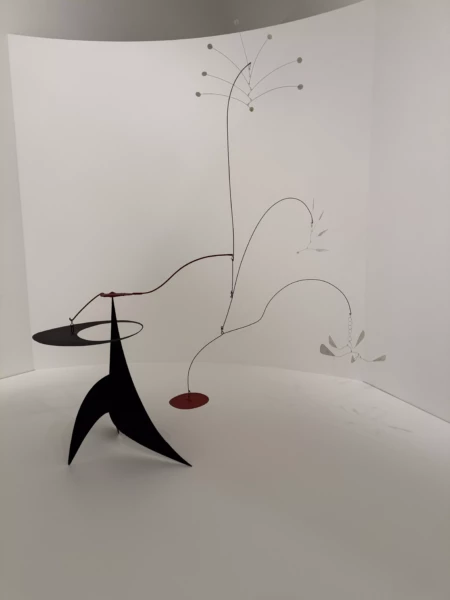
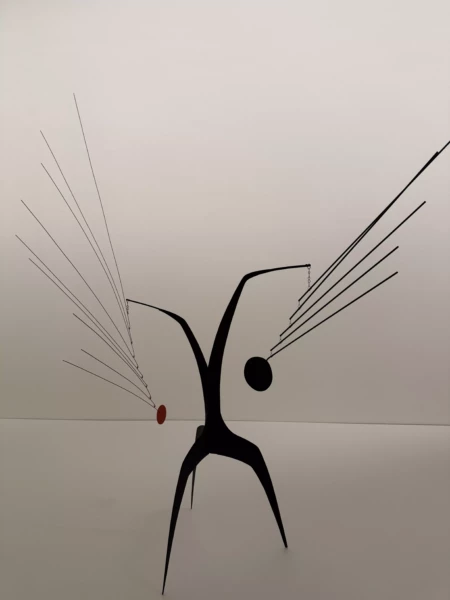
Here again, Calder used rough, humble materials: sheet metal, wood, wire…. Until then, throughout history, sculpture had by definition always been fixed. Calder loosened it up. He even gave it gangly freedom. In his three-dimensional works, reduced to colored forms hanging in space, he infused movement. At first, he thought of using a crank or a motor. Before ultimately letting the breeze do the work. “Here, the public rediscovers a child’s eyes,” comments Suzanne Pagé, the artistic director of the Fondation Louis Vuitton, adding—again quoting Marcel Duchamp—that he said of the Mobiles: “It is the sublimation of a tree in the wind.”
symphony of forms
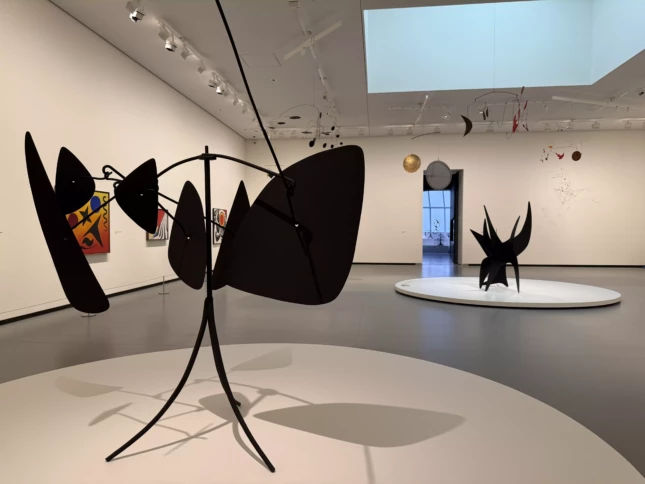
At first, his suspended forms quite literally hung by a thread. Then, gradually, the structures subtly thickened. Balanced in space, they were hung from metal rods. Within Frank Gehry’s building, the accumulation of so many Mobiles, all governed by the same principles of weightlessness and air circulation, creates a kind of symphony of forms in which all the suspended elements in black, white, red…. might be notes written into space.
Sandy Rower
The artist’s grandson, Sandy Rower, who is also president of the Calder Foundation, explains how they were conceived: “He does not make a preparatory drawing like an architect. He conceives the piece through an intuitive process that leads to continual movement.” The mix of materials and forms ensures balance.
Black widow
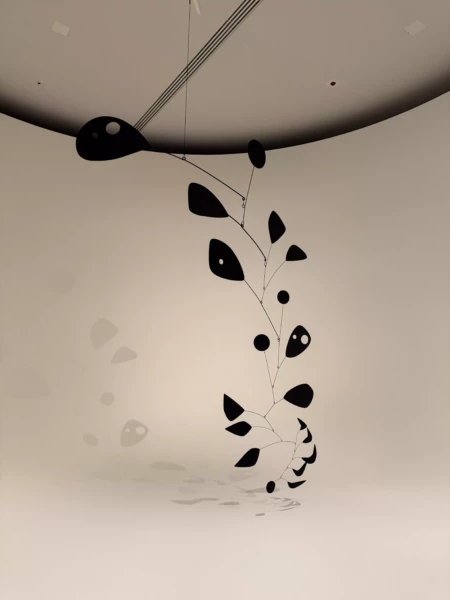
In that vein, the masterpiece that greets us early in the exhibition is Black Widow of 1948. Suspended across 3.4 meters in height is a giant branch from an imaginary tree. Its leaves are alternately solid and pierced through, in order to ensure the balance of the whole. The perforations look like the traces left by a ravenous insect. The black paint might suggest that this is the shadow of the branch rather than the branch itself.
mobile with two faces
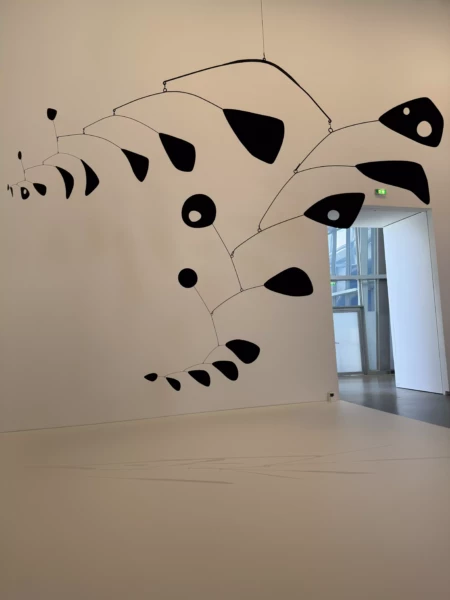
Of course, Calder also knew how to play with color. The piece titled January 31, 1950, made up of 21 giant petals—it belongs to the Musée National d’Art Moderne—is entirely white on one side and black on the other. A mobile with two faces.
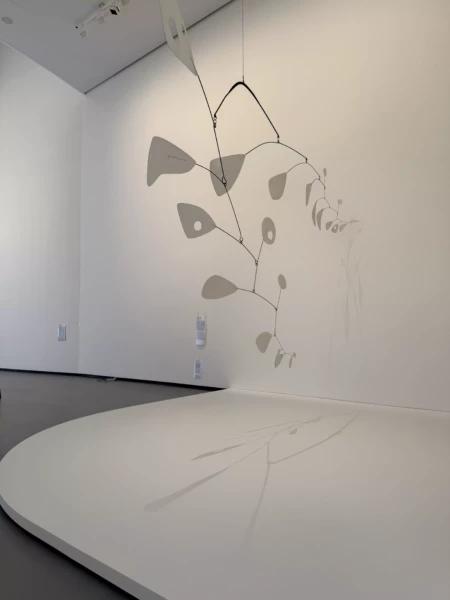
And then the artist was a master of variations. He explored every possibility without repeating himself.
Stabiles
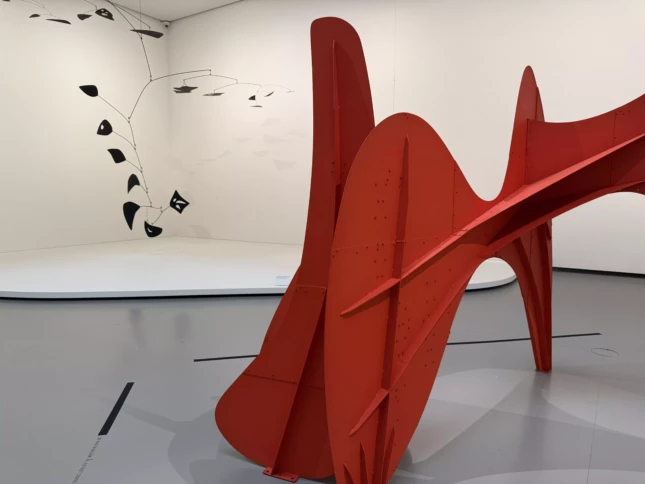
In the 1930s, moreover, he also invented the Stabiles. These are more massive sculptures, firmly planted on their legs, yet often stretched upward by their necks. The subtle reference to animals is never far away. At the end of the 1950s, Calder fell in love with large public spaces and began creating mobiles and stabiles on a giant scale.
In the Cathedral
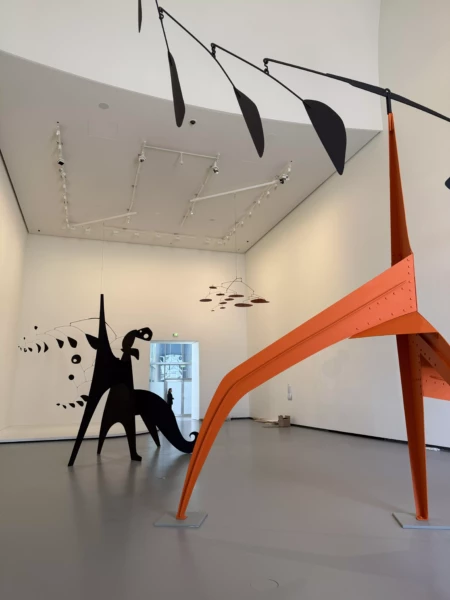
The last room of the exhibition, on the fourth floor—the one called “the cathedral”—is the climax of the display. Each work develops its own energy there in subtle dialogue with the others. The most imposing, half Mobile and half Stabile, insists on being noticed, doing a full split on red steel legs, while in the distance another, the most modest, entirely black and hanging from the ceiling, brushes the air with its great petals.
Jean-Paul Sartre
In 1946, the father of Existentialism, Jean-Paul Sartre—who could just as easily have been an art critic—wrote of the American’s brilliant assemblages: “They hang from the end of a string like a spider at the end of its thread, or else they huddle on a pedestal, dull, folded in on themselves, falsely asleep; a wandering shiver passes, gets entangled in them, animates them, they channel it and give it a fugitive form: a Mobile is born.”
Calder’s work allows the imagination to blossom.
. April 15 through August 16.