His days are numbered
The country is at war. The times are dark. In art, the Nazis have branded with the black mark of infamy the art that heralds the future. Henri Matisse, the great master of color, pattern, and simplified forms, was classified, like so many others, as “degenerate art.” It would soon become difficult to exhibit. Then came 1941: the French painter underwent surgery in Lyon for intestinal cancer. He was 72. Complications followed. According to the doctors, his days were now numbered.
Sustain Our Work with a Small Monthly Gift
Become part of the Judith Benhamou Reports circle.
Contribute, even from just €10
Saying goodbye to painting
Saying goodbye to the world is difficult. Saying goodbye to painting, perhaps even more so. This giant felt he had not yet said everything. He was irrevocably in search of “an art of balance, of purity and serenity.” Then, by some unknown miracle, he held on and lived until 1954, to the age of 84.
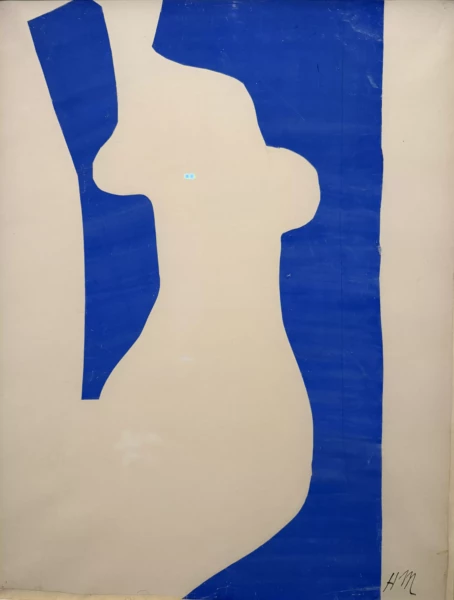
This is what the man brought back to life called “my second life.” There was every reason to turn euphoric. He wrote to his friend and fellow painter Albert Marquet: “Long live joy and fried potatoes! I am of age,” and in 1949 he confessed to Time magazine: “Gifted with this second life, I could do as I liked. I could create what I had been fighting for all these years.”
Claudine Grammont
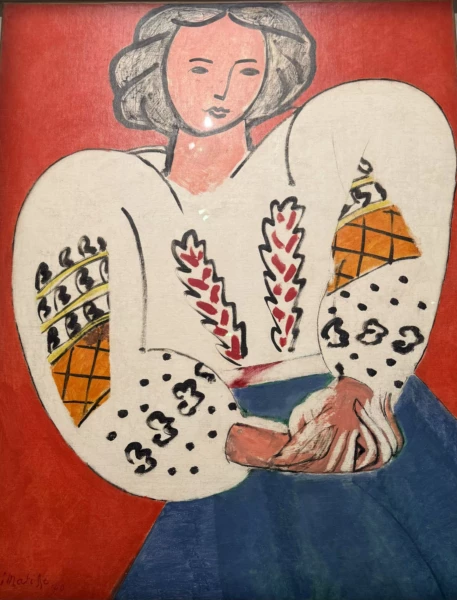
Matisse broken—he could not remain standing for long and tired quickly. But Matisse liberated! He gave birth to a new creative force. That is the story told by the rich exhibition at the Grand Palais organized by the Centre Pompidou: Matisse 1941–1954. Its curator, Claudine Grammont, has done titanic work in bringing together 320 works from the period.
last stroke of genius
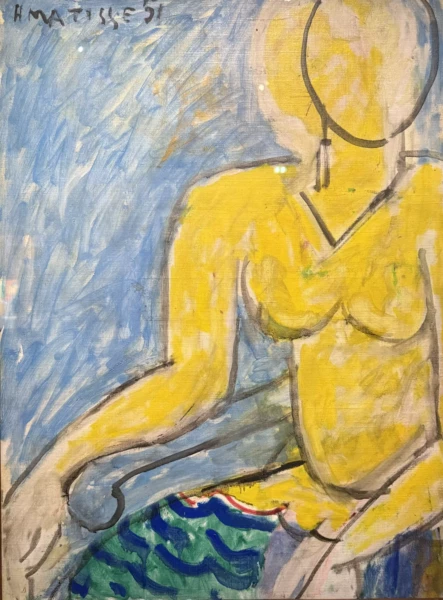
On the subject of Matisse, fans have recently been thoroughly spoiled. One might mention, among others, the delightful exhibition “Matisse: Invitation au voyage” which ended on January 26, 2026 at the Fondation Beyeler, or the highly precise “Matisse and Marguerite: Through Her Father’s Eyes,” which concluded on August 24, 2025 at the Musée d’Art Moderne de Paris. But the new show has one particular merit: an exceptional gathering of his cut-outs. Across an entire floor unfolds the artist’s last stroke of genius. He had already used cut paper in the 1930s while preparing his great mural The Dance for the Barnes Foundation in Philadelphia. But those were, in a sense, sketches.
Jazz
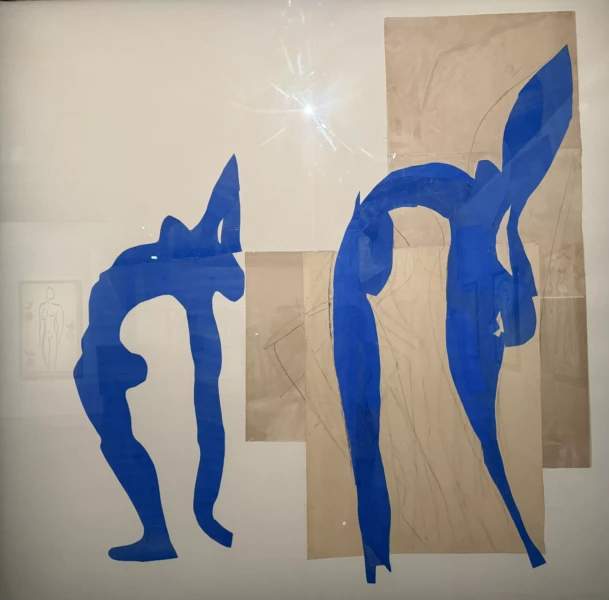
Here, since he could no longer exhibit, he turned to the creation of an artist’s book that would become a touchstone for bibliophiles: Jazz. It consists of 20 plates of gouache-painted and cut paper made between 1943 and 1944.
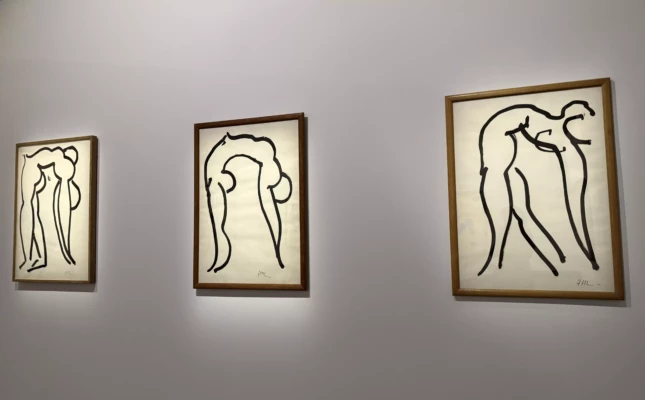
Matisse developed a process that he would thereafter apply more broadly: he used an assistant—always pretty—working day and night, since he suffered from insomnia, to prepare Canson sheets painted in an infinite range of colors. Then he would draw from this stock and deftly slide his scissors through the paper, making forms emerge—along with their negatives, which could also be used.
Like a sculptor
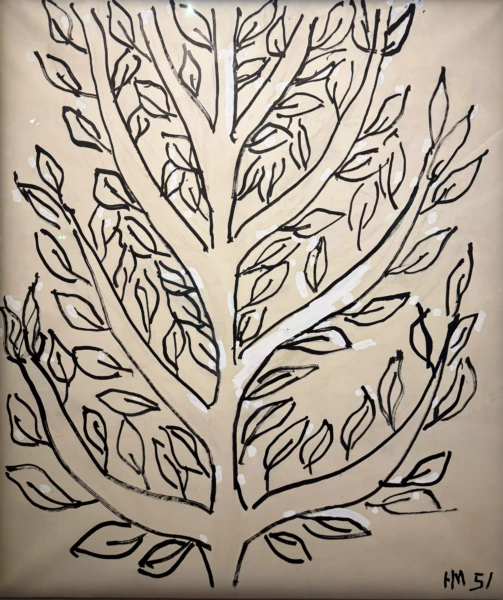
As Matisse himself put it: “Cutting directly into color reminds me of the direct carving of sculptors.” The third stage consisted in making these forms dance across the walls of his studio. The assistant pinned them up while the master indicated one variation or another, creating ever more arrangements of colors and motifs. In 1946, for example, the memory returned of his 1930 trip to Tahiti, with its observations of coral, jellyfish, and other sponges. He created the white-on-beige Oceania, the Sea, shown face to face at the Grand Palais with Oceania, the Sky. These decorative panels stretch 3.7 meters wide.
Four blue nudes
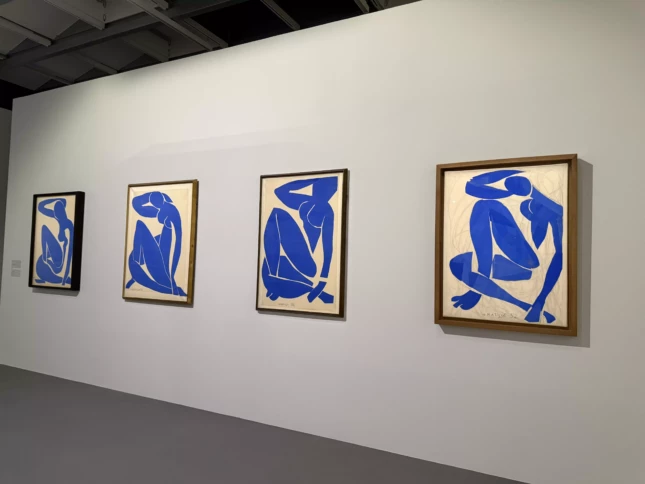
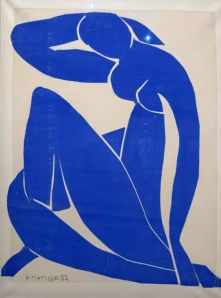
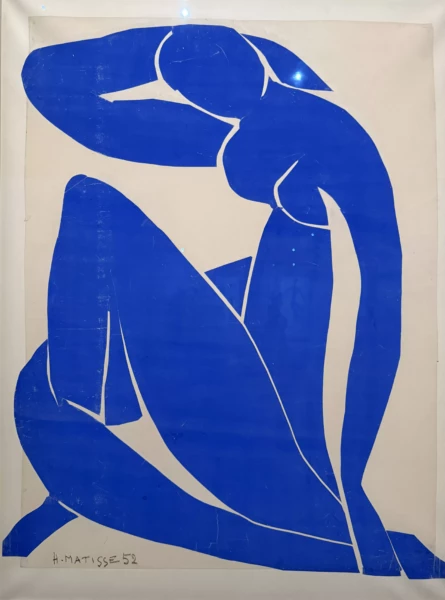
The exhibition concludes with the gathering of the four famous Blue Nudes from 1952. Each of these radically simplified creatures was conceived to illustrate the attitude of a woman almost knotted into herself. Their deep blue was inspired by that of a fresco by Giotto in Padua. This time, it truly is the final dance of the Serpentine so dear to Matisse. It has the force of a monument.
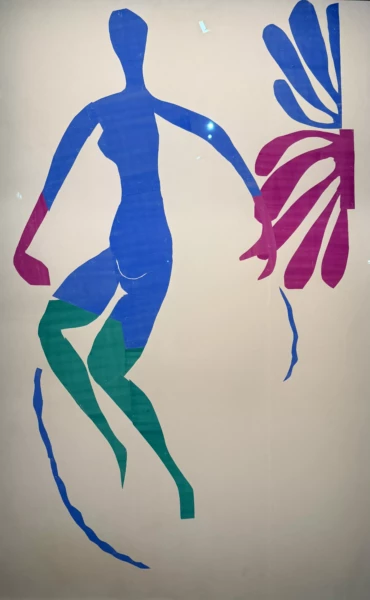
Through July 26.
Sustain Our Work with a Small Monthly Gift
Become part of the Judith Benhamou Reports circle.
Contribute, even from just €10