Profound change
If the world is undergoing profound change, it is not only in fields related to artificial intelligence or geopolitics. On a far more modest and, of course, less turbulent level, art history too is in the midst of major upheaval. Its impact should not be underestimated. This discipline shapes the way we read the facts of the past. Take Surrealism. It was a movement born on the charnel grounds of the First World War. As an antidote to misery, Surrealism gave central importance to neglected realms such as the unconscious, absurdity, magic, and ridicule too. This way of thinking still undoubtedly exerts an influence in creative circles today.
Sustain Our Work with a Small Monthly Gift
It’s very simple. Just $10 a month allows us to keep going.
Reliable information is valuable.
Male surrealism
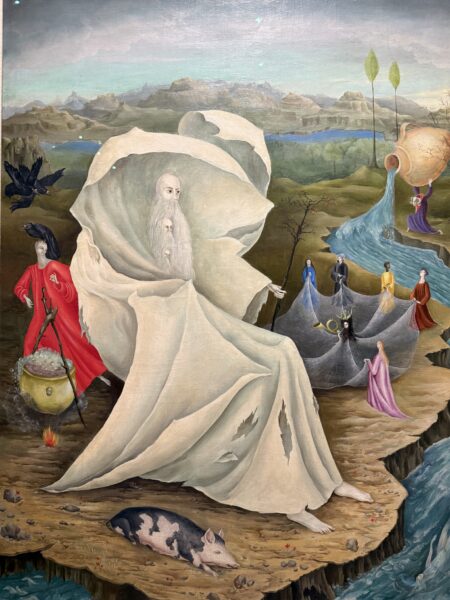
If one looks more closely at this revolutionary movement, one sees that it has long been understood primarily as a French phenomenon, led by men—poets or painters—whose creative force belonged to the years before the Second World War. What we are now learning is that in fact it remained vibrant across the globe, also after 1945, and that women were among the major standard-bearers of its iconoclastic spirit. One of them was Leonora Carrington (1917–2011), the English artist who spent most of her life in Mexico. (One could also mention the American Dorothea Tanning(1910- 2012) or the Italian Leonor Fini( 1907-1996) who have clearly been rediscovered by the art market in recent years).
Max Ernst’s girlfriend
For a long time, Carrington was presented above all as the companion of the German-born Surrealist painter Max Ernst. In fact, they lived together only from 1937 to 1939. In Paris, through July 19, the Musée du Luxembourg is devoting 126 works to asserting Leonora Carrington’s importance. Moreover, a few of Max Ernst paintings from that period are also included in the exhibition.
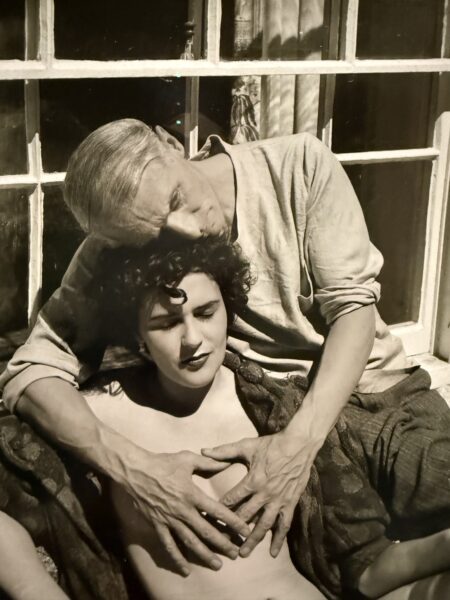
L Carrington, M Ernst
A painting like a rebus
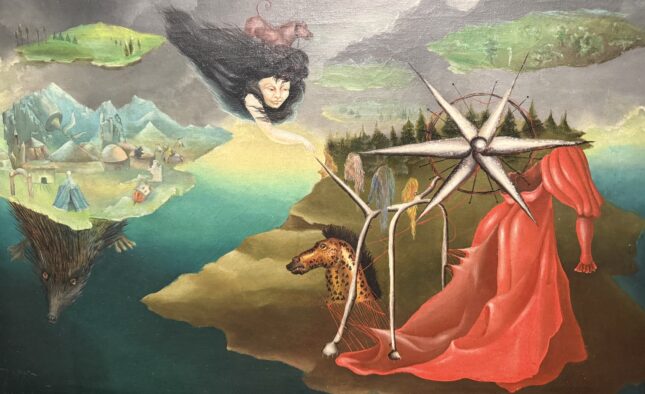
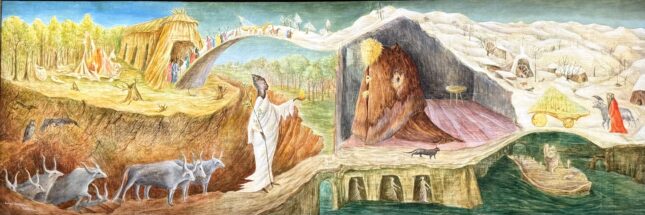
According to the exhibition’s curators, Carlos Martín and Tere Arcq, the show’s manifesto is a 1944 painting placed almost at the beginning of the exhibition route: Artes. In this composition, conceived like a rebus, a woman is seen flying from one continent to another. Like Sleeping Beauty, her finger is pricked by a needle. Carrington was steeped in the spirit of fairy tales. She would even write some herself, long before having her two sons. Her literary verve shared with her painting an obsession with alchemy, mysticism, and magic. Mexico, where she lived from 1942 until her death, with its cult of the dead and its pre-Hispanic rituals, set her imagination ablaze. She had found the country of her affinities.
To extirpate from herself all the characters
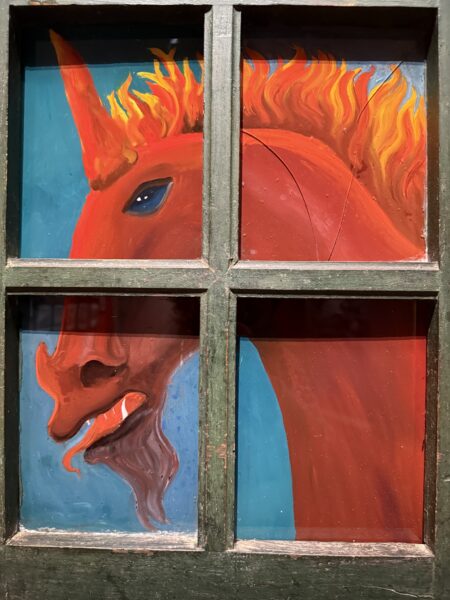
The exhibition focuses above all on her postwar Mexican production, and in that respect it is somewhat frustrating. Before that, Leonora endured severe traumas: a gang rape in Spain in 1940, after the war had separated her from Ernst, followed by her confinement in a psychiatric asylum in fascist Spain. With spectacular strength she survived and reinvented herself: “I understood that it was essential for me to extirpate from myself all the characters that inhabited me. I had to rid myself of everything that had brought about my illness (…) I felt that, under the action of the Sun, I was an androgyne, the Moon, the Holy Spirit, a gypsy, an acrobat.”
Hieronymus Bosch
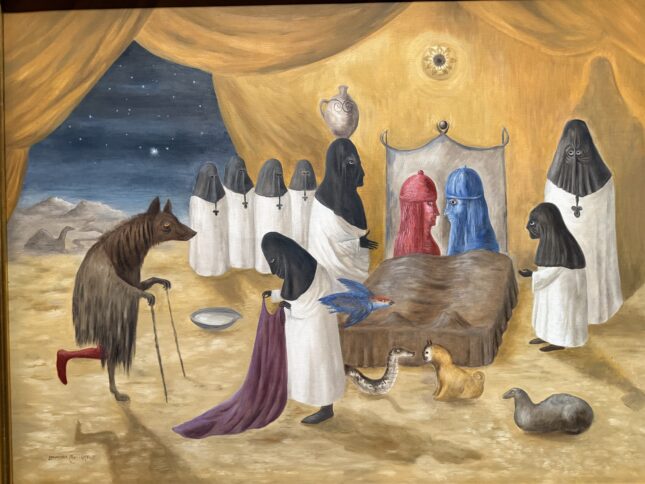
She created a universe made up of figures that often merge human, plant, and animal life—in the manner of Hieronymus Bosch. Her pictorial technique is extraordinarily precise. It is a refined, detailed, meticulous kind of painting, one in which the figures are often given a modest scale within the composition rather than spectacular, immediately effective canvases seen in the poswar work of Surrealists such as Magritte. Her pictorial technique is extraordinarily precise. THe influence of mythologies and her own imagination helped obviously transform trauma into art. The Lovers, from 1987, is among her most astonishing works. At the center of the canvas is a bed surmounted by two heads, one blue, the other red. A limping hyena—her wildest femininity—moves toward the bed. Nuns wearing black hoods stand watch over what is about to become a carnal union. In 1974 she wrote of this: “I am a female human being growing old; soon I shall be dead.”
Through July 19.
Support independent art journalist
If you value Judith Benhamou Reports, consider supporting our work. Your contribution keeps JB Reports independent and ad-free.
Choose a monthly or one-time donation — even a small amount makes a difference.
You can cancel a recurring donation at any time.