Cézanne and Us
The title was well chosen. So was the premise. “Cézanne et nous” (Cézanne and Us), the major exhibition at the Grand Palais, through January 17, tackles one of the central questions in modern art history: the colossal influence of Paul Cézanne (1839–1906) on everything that came after him. Thanks to a collaboration with the Musée d’Orsay and the Centre Pompidou, 174 works trace the extraordinary legacy of the painter Picasso called “the father of us all.”
The exhibition brings together 69 works by Cézanne and 108 paintings and photographs dating from the 19th to the 21st century, revealing the sheer magnitude of his influence.
Sustain Our Work with a Small Monthly Gift
Become part of the Judith Benhamou Reports circle.
Contribute, even from just €10
eye is overwhelmed
There is no shortage of masterpieces here, nor of compelling art-historical arguments. But for an exhibition to be truly extraordinary, it needs more than great works. It also needs a great installation. Here, the eye is overwhelmed by the sheer abundance of art. Perhaps this is the privilege of giants, but Cézanne, in particular, does not take kindly to sharing space.
For one thing, his painting is visually demanding. Cézanne has no interest in pleasing the eye. He is at once a virtuoso of color and uncompromisingly rough in his approach. “The painter gives concrete form to his sensations, his perceptions,” he explained in 1904.
The bather
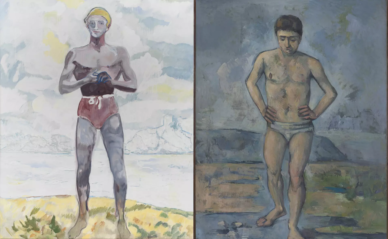
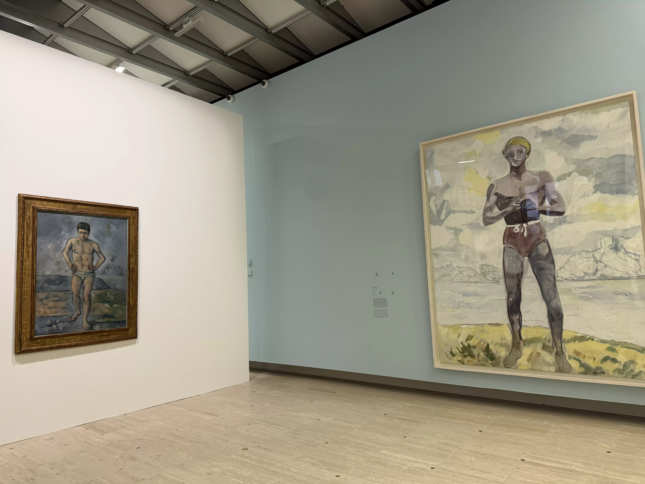
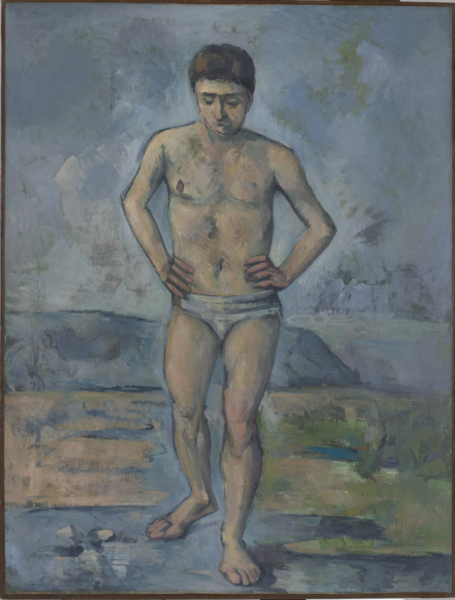
The bather from 1885 that opens the exhibition is all the more monumental for his enormous feet and oversized hands. Standing with his hands on his hips, he radiates determination. Yet behind him stretches a magnificent, almost abstract landscape, composed largely of broad blue and green brushstrokes.
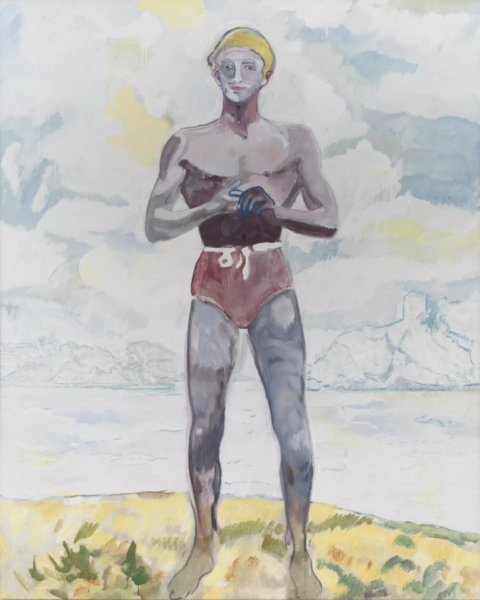
Faced with such force, it is difficult for another painting to hold its own, unless it quite literally reproduces the figure’s stance and colors on a grand scale, as does the athletic bather by British painter Peter Doig (born 1959).
his wife
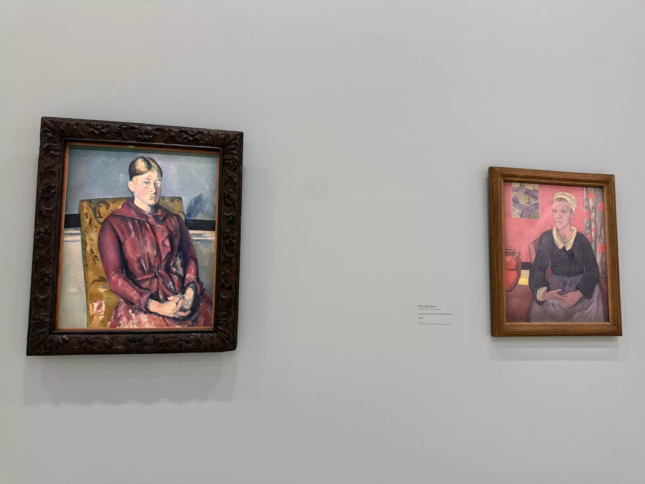
A little farther on, Paul Sérusier (1864–1927), no minor artist himself, struggles to compete with his seated Breton woman alongside Cézanne’s ugly yet captivating portrait of his wife. Seated on her chair, she seems to weigh down the entire scene with her presence. Her head is shaped like an egg. Her coarse dress hangs over a broad figure. Two olive-like eyes animate her gaze. Her hands are twisted with nervous tension.
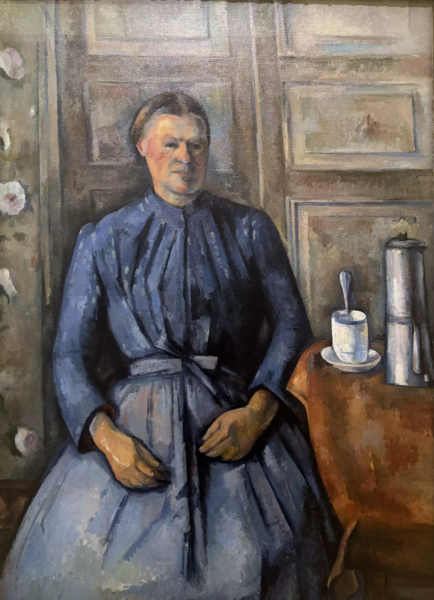
It took Cézanne a long time to acknowledge the woman who would become Madame Cézanne. Yet it is this Hortense, whose first name nobody knows, this embodiment of imperfection, who commands every gaze.
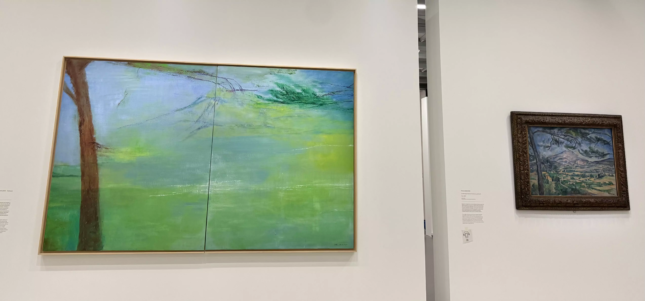
In the section devoted to Cézanne’s influence on contemporary artists, we are confronted with an indigestible parade of abstract painters that leaves the viewer bewildered, from the dark canvases of Pierre Soulages (1919–2022) to those of Irish painter Sean Scully (born 1945).
Xavier Rey
“We want to show that Cézanne’s influence is also conceptual,” explains Xavier Rey, director of the Musée National d’Art Moderne.
And yet, if there is one excellent reason to visit the Grand Palais, it is the moment of pure ecstasy that comes from seeing several extraordinarily important paintings together, even if they are not hung on the same wall.
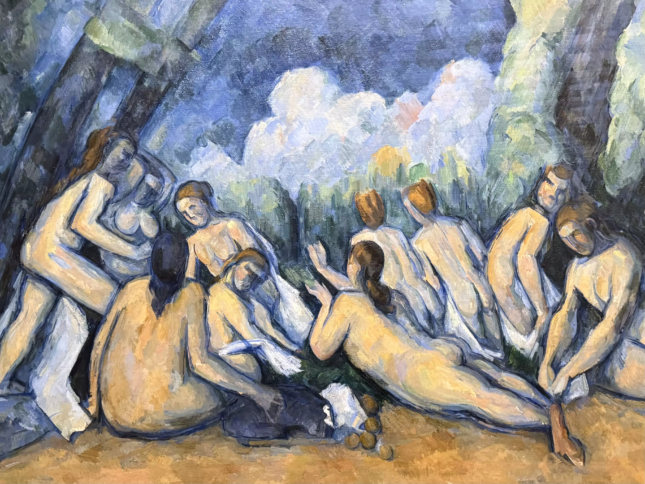
At the center are Cézanne’s Les Grandes Baigneuses (The Large Bathers), painted between approximately 1894 and 1905. The canvas depicts ten nude female bodies, seen from behind, clustered together in a sweeping curve. Their silhouettes are tinged with yellow and pink. The sky is a hard blue, scattered with white clouds. Their faces are crudely rendered. In their features, we can already see something remarkably close to Picasso’s Les Demoiselles d’Avignon, painted in 1907.
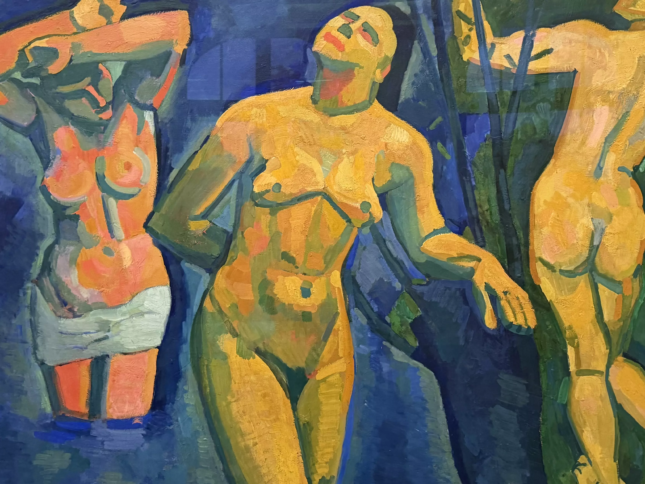
On the right side of the room hangs one of the most beautiful paintings André Derain (1880–1954) ever made: Les Baigneuses (The Bathers), from 1907. Three women, their forms simplified, whose movement and deep blue background linger in the mind.
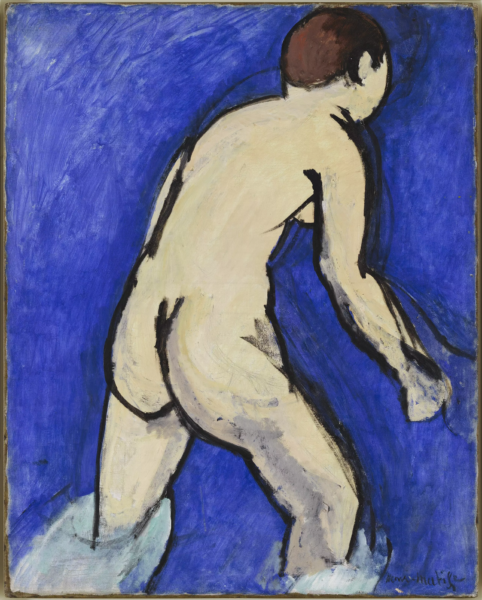
On the left, in the foreground of a large painting, another silhouette stands out against that same blue. Dated 1909, it is by Matisse.
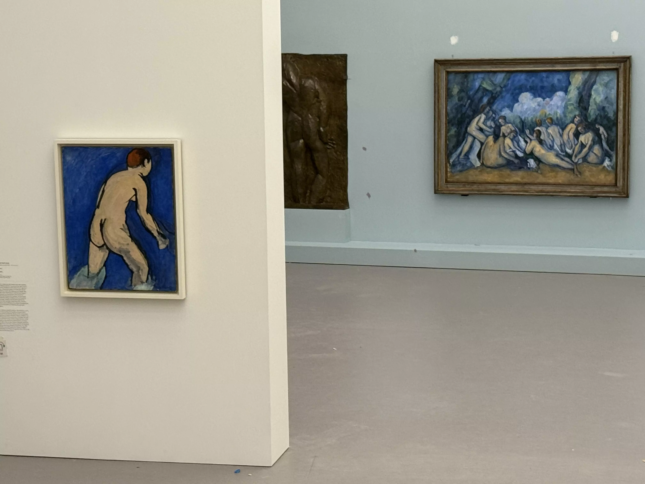
Paul Cézanne paved the way for one of the most majestic chapters in art history.