Tanizaki
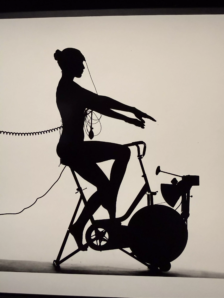
“We Orientals create beauty by making shadows in places that are themselves insignificant.” In 1933, the illustrious Japanese writer Jun’ichirō Tanizaki published In Praise of Shadows, a manifesto on the spare refinement of Japanese aesthetics.
Sustain Our Work with a Small Monthly Gift
Become part of the Judith Benhamou Reports circle.
Contribute, even from just €10
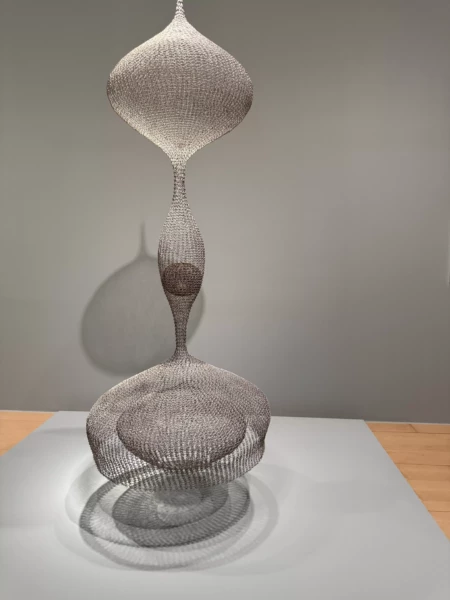
The book, which would go on to become a landmark in the field, explained, among other things, the fascination of forms that come into being through their contrast with light. On the other side of the world, in California, the modest daughter of Japanese immigrant farmers carried that principle within her and would soon give it shape through curving forms entirely of her own invention. Her name was Ruth Asawa (1926–2013).
Mexican market
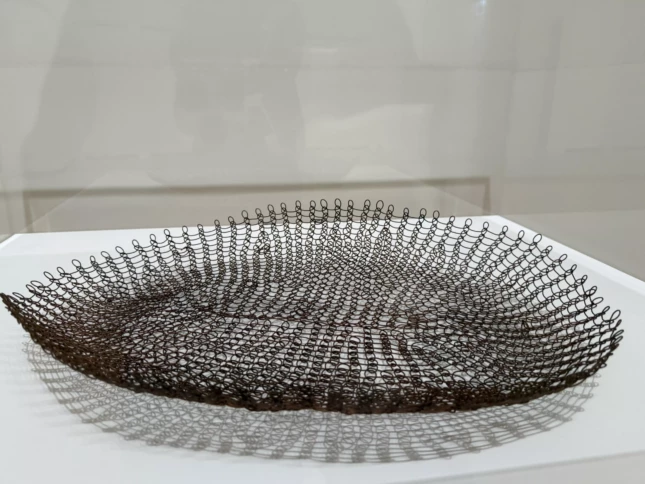
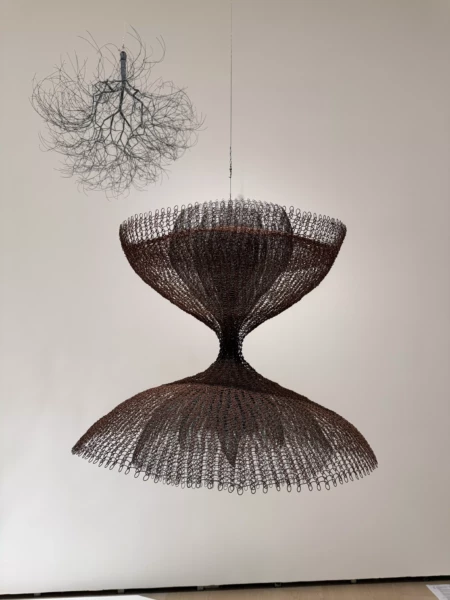
She was devoid of worldly ambition, even thought of herself as a housewife—she had six children—and cherished the vegetal world. In her spare time, this petite woman, endowed with astonishing manual dexterity, began making strange things after observing at Mexican markets woven metal baskets used to hold eggs. First, with local craftsmen, she learned how to knot thin wire into continuous loops. She would bring the technique to an exceptionally refined level.
inner volutes
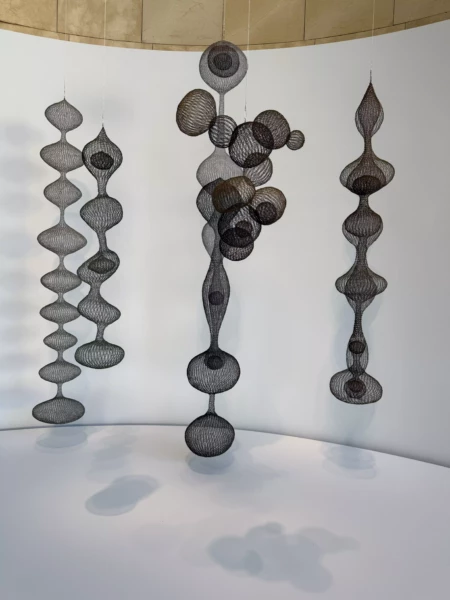
It is hard to imagine, but each piece is conceived as a sequence of inner volutes—the core—that gradually develop and expand into outer forms. These complex works, placed on the ground or more often suspended, cast shadows on the floor and walls that are an integral part of their unsettling charm. Tanizaki would have recognized in them his own creed of beauty.
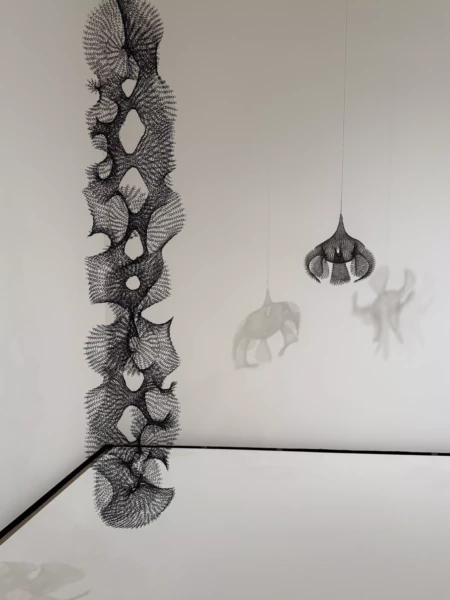
After the MoMA in New York, the Guggenheim Bilbao is devoting a well-deserved retrospective to the American artist through September 13. It must be said that the vast spaces of the Basque museum are less well suited to Asawa’s intimate work. Above all, the shadows are not given the same emphasis there as they were in New York. Even so, the show allows one to grasp the full breadth of her creativity.
janet bishop
“She loved the looped-wire technique, which she practiced assiduously from the 1940s to the 2000s. She used different kinds of wire. She also loved the transparency of the pieces,” explains the exhibition’s curator, Janet Bishop. Asked whether it was art or craft, Bishop replies that Asawa cared little about the label attached to her work.
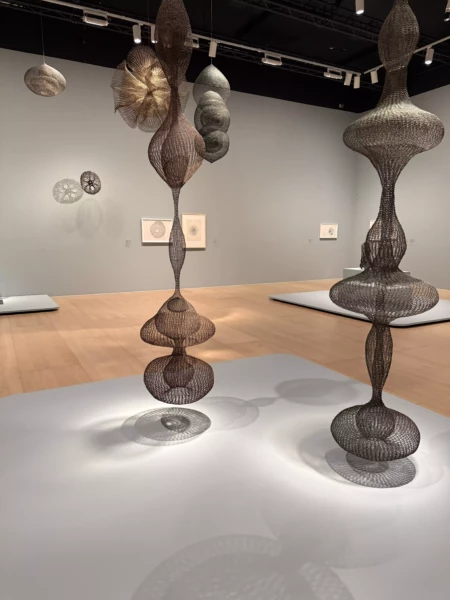
“Even though she took it very seriously. But there was a kind of fluidity between this idea of craft, from which she drew inspiration, and art.” It should be said that the artist had learned in the best possible setting, since between 1946 and 1949 she studied at the legendary Black Mountain College in North Carolina, an experimental, communal school that dissolved boundaries between techniques.
arid vegetation
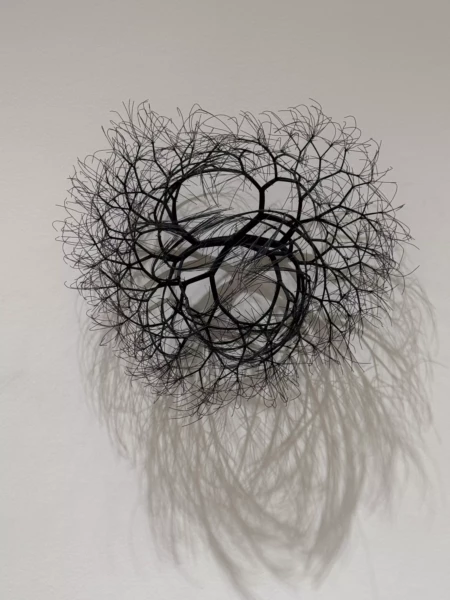
Asawa would go on exploring wire throughout her life. In 1962, for example, she was given a desert plant from Death Valley, the sort of dry, prickly tumbleweed one sees rolling across the ground in Westerns.
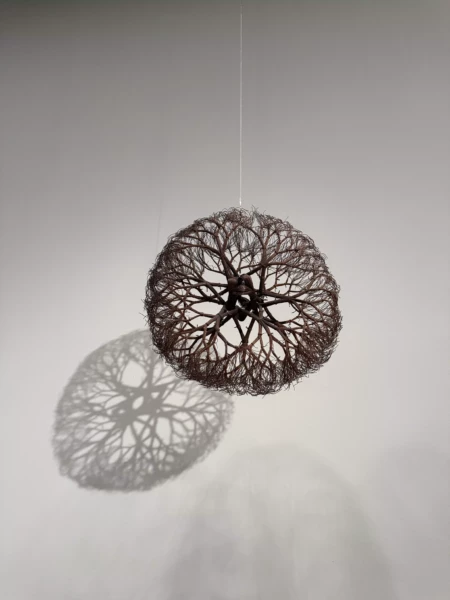
This arid vegetation became a new source of inspiration for her. To emulate this form of nature, she developed a technique in which she knotted and then splayed the wire into a succession of fan-like shapes. These suspended compositions resemble branching forms built like stars. And their shadows, of course, complete their complex designs with great beauty.
make them special
Ruth Asawa defined the artist as “an ordinary person who can take ordinary things and make them special.” No one, before or after her, has ever made anything quite like her work.