












A temptation worth €825,000
“I can resist everything except temptation.” When the legendary Irish man of letters Oscar Wilde (1854–1900) coined this famous witticism in the dialogue of one of his plays—he who was known to be extravagantly spendthrift, to the point of dying ruined—he could hardly have imagined that the line would so perfectly describe the behaviour of one of his twenty-first-century aficionados. And yet, in Paris on 5 November 2025, a book by Wilde—the only one he ever wrote in French, Salomé—was knocked down for the record price of €825,000. It was acquired by a wealthy anonymous buyer who, evidently, could not resist temptation either.
Max Beerbohm
His lover, Robert Ross
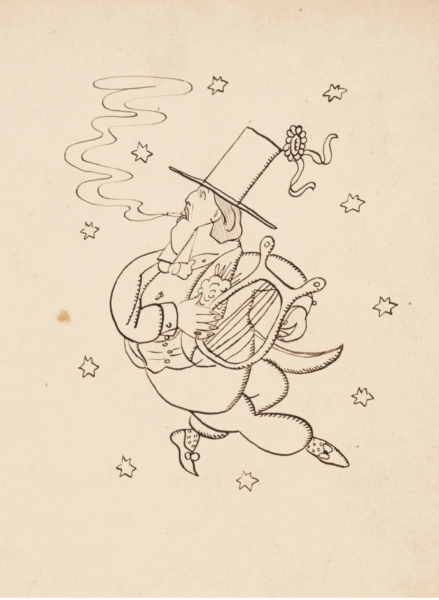
The 1893 volume possessed all the qualities that stir bibliophiles, forever in search of what renders a printed object unique. In this case, its value lay first in its provenance: it had belonged to Wilde himself, who gave and inscribed it to his lover, the literary journalist Robert Ross. It was also adorned with a substantial group of original drawings by the British caricaturist and dandy Max Beerbohm (1872–1956).
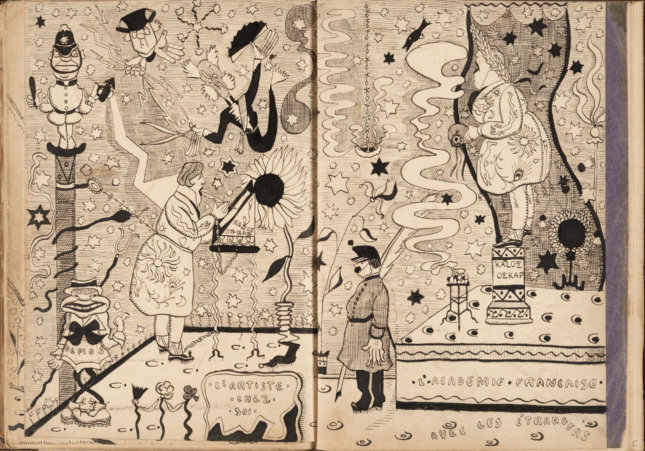
Max Beerbohm
Pierre Louÿs !
In addition, it was enriched with a sonnet signed by Wilde’s French accomplice, the novelist Pierre Louÿs, which opens beautifully with the line: “À travers le brouillard lumineux des sept voiles / la courbe de son corps se cambre vers la lune”(Through the luminous mist of the seven veils, the curve of her body arches toward the moon. The book, estimated at €100,000, had long formed part—unknown to anyone—of a Chilean literary collection.
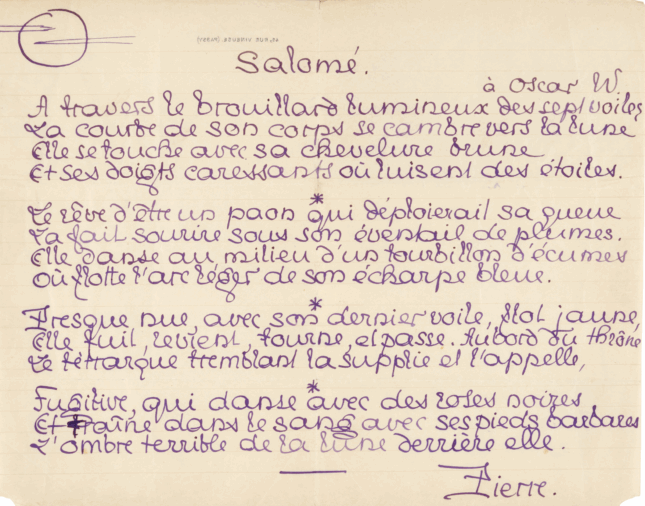
Pierre Louys
Wilde bibliophile
“Collectors from all over the world travelled to see the book in person,” explains Roxane Ricros, a specialist at Christie’s in Paris, adding: “Here the author himself behaved like a bibliophile, having the book illuminated. Above all, this price reflects the immense fascination surrounding the figure of Oscar Wilde.” Until then, the auction record for a book by the British writer corresponded to the sale of The Importance of Being Earnest. A Trivial Comedy for Serious People, published in first edition in 1899 on Japan paper, numbered 3 of 12 copies. That volume, which had also belonged to Robert Ross, was sold in New York in 2012 for $362,000.
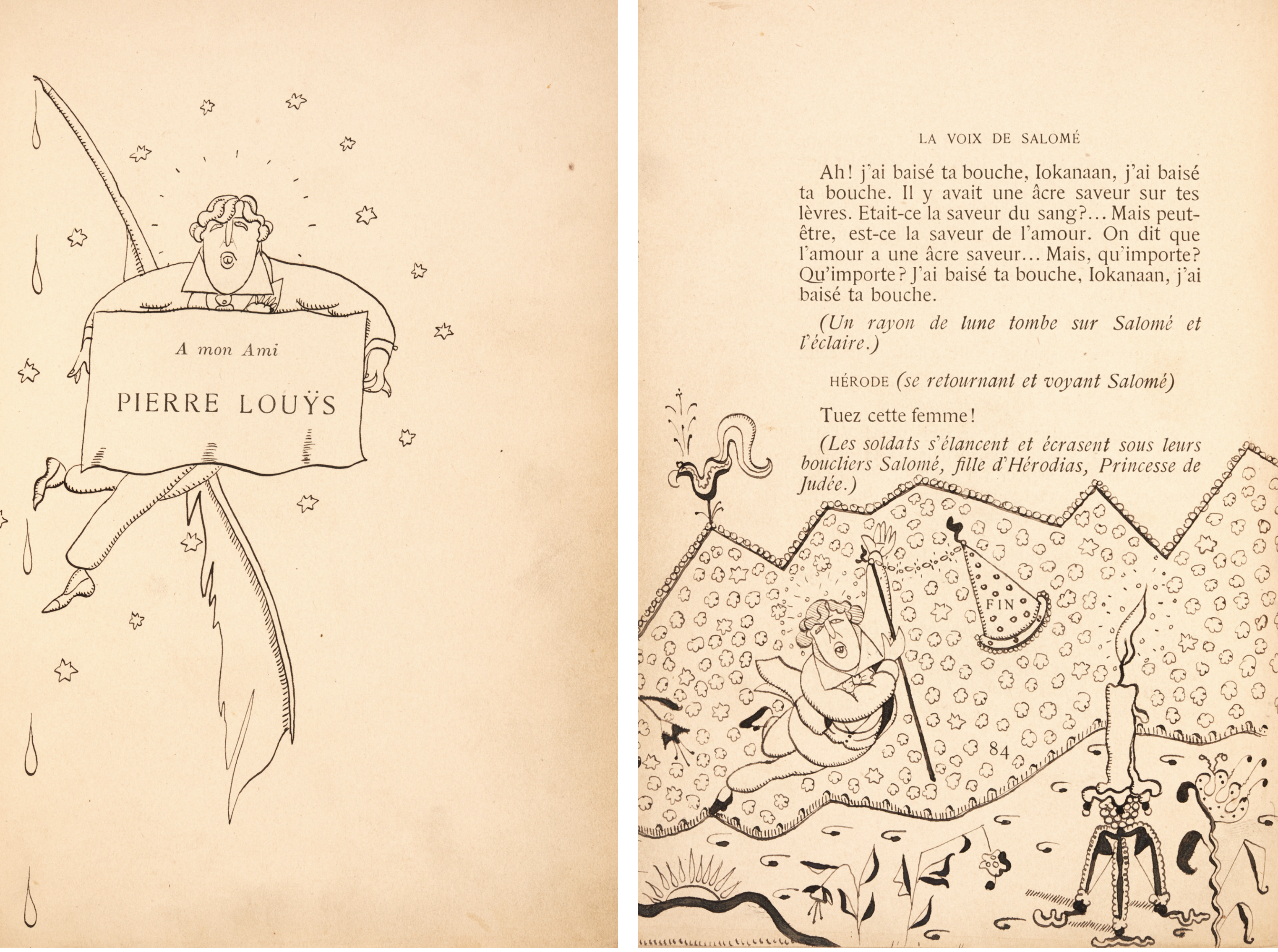 Max Beerbohm
Marcel Proust
By way of comparison, in the pantheon of modern bibliophilia on the other side of the Channel stands his contemporary Marcel Proust. In 2018, a copy of Du côté de chez Swann, numbered 1 and from the library of the businessman and Yves Saint Laurent’s partner Pierre Bergé, was sold at Hôtel Drouot for €1.5 million—a record price for the author of À la recherche du temps perdu.
Bonhams
Returning to the father of Dorian Gray, a major event is being prepared in London on 18 February 2026. On that date, the British auction house Bonhams will disperse the collection of a well-known Oscar Wilde devotee, Jeremy Mason. This former Asian-art dealer based in London amassed throughout his life items that tell the story of his favourite writer. The ensemble comprises 156 lots (around 1,000 volumes) with a total estimate of £320,000, many of them at modest estimates.
Matthew Haley
“Oscar Wilde has always been in tune with his time. Just look at the Beatles: they reproduced his portrait on the cover of their album Sgt. Pepper’s Lonely Hearts Club Band in 1967. In the Gerhard Richter exhibition currently on view at the Fondation Vuitton, there is a 1971/72 painting depicting Oscar Wilde. But of course, in the twenty-first century he is also seen as a pioneer of the gay cause, a key figure in LGBT history,” notes Matthew Haley, specialist for the sale at Bonhams.
Sadie Coles
Another illustration of a Wilde very much in tune with our times: Sadie Coles HQ, the contemporary art gallery in London, is currently presenting—through 21 March—an exhibition inspired by Oscar Wilde’s novella Lord Arthur Savile’s Crime with works by Urs Fischer Xinyi Cheng , Sanya Kantarovsky …
Oscar’s ties in France
Salomé, the play that recounts—freely adapted—the exploits of the New Testament heroine, is far from being Wilde’s most famous work. Yet one such copy is again highlighted in the Bonhams sale. It once belonged to Stuart Merrill (1863–1915), an American poet who wrote in French and assisted Wilde in his francophone production (estimate: £15,000).
A tomb with a penis
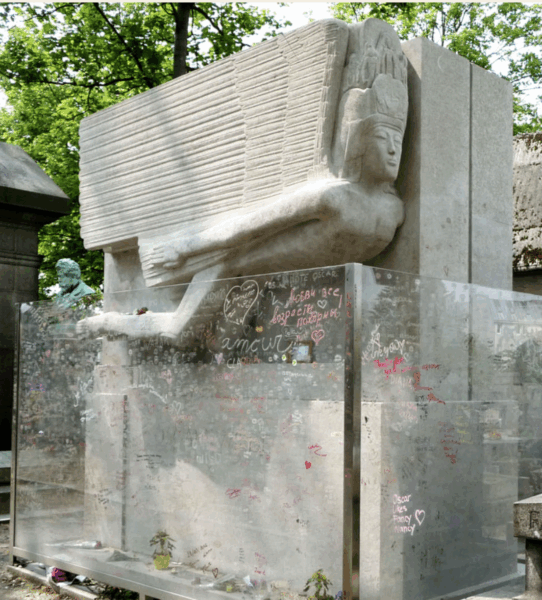
Jacob Epstein
Oscar Wilde had strong ties with France, which he visited several times, including on his honeymoon. He died in Paris, and his final resting place is at Père Lachaise cemetery. Designed by the American Cubist sculptor Jacob Epstein (1880–1959), the tomb caused a scandal because of its representation of a kind of divinity known as the “Flying Demon Angel,” which includes a penis. History repeats itself. The monument mirrors the life of the writer, who enjoyed a remarkable literary apogee, married a woman with whom he had two children, before becoming, in 1895, the object of a sensational affair that led to his imprisonment for “gross indecency”—that is, homosexuality.
Final home
It was in the aftermath of this ordeal that he chose France as his final home. Today, public collections devoted to Oscar Wilde are scattered across the world, beginning with the United States—Los Angeles—and of course London. Among private collectors, one of the most renowned is the Turkish businessman Omer Koç.
For Matthew Haley, “the most sought-after works must have a ‘physical’ link, an explicit trace of belonging to Oscar Wilde’s intimate universe. The period cherished by collectors is the height of his success between 1890 and 1895, with The Picture of Dorian Gray and Salomé.”
The role of the artist
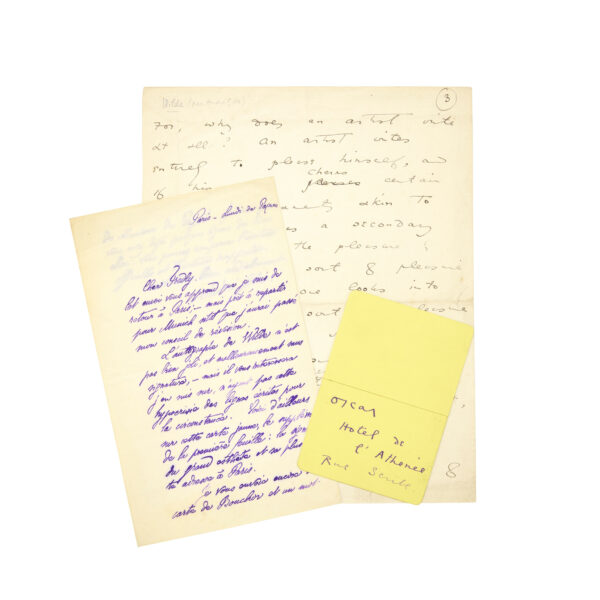
One lot expected to attract strong interest (estimate: £15,000) is a manuscript of barely one page, consisting of seventeen lines by Wilde in which he explains the role of the artist: “An artist writes entirely to please himself, and if his work charms certain artistic temperaments akin to his own, he has secondary pleasure.” According to the sale’s specialist, it was the celebrated French writer André Gide who acquired the sheet, adding a note in which he described his friend as a “great aesthete.” In 1891, following the publication of what is undoubtedly his best-known work, The Picture of Dorian Gray, Wilde spent a week in Paris. The two men met then, and Gide was fascinated by Wilde’s charisma.
Paris is very purple
Oscar Wilde enjoyed cultivating correspondence, and he displayed great talent in it, as when he wrote in 1898 to a young friend to persuade him to join him in Paris after his two years of imprisonment: “Paris is very purple and starred with gilt spangles.” Who would not yield to temptation after such a description? (estimate: £3,000 for four manuscript pages).
Deathbed
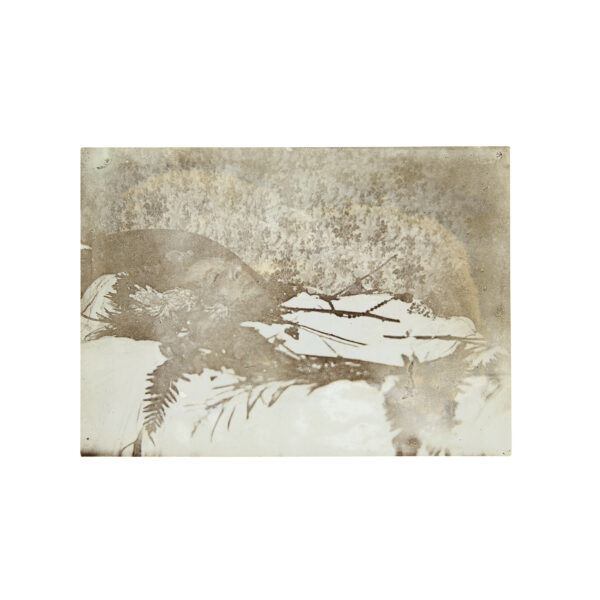
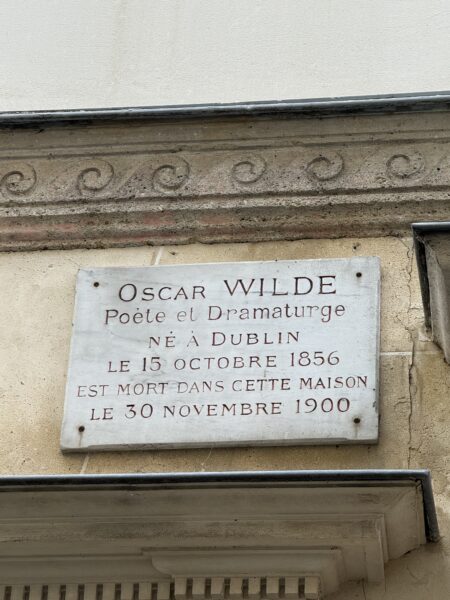
Oscar Wilde died on 30 November 1900 in his hotel room on the rue des Beaux-Arts. A plaque—bearing an error in his date of birth—still appears today on the façade of number 13. A small, very blurred photograph showing him on his deathbed, surrounded by flowers (estimate: £200), brings to a close the story of the writer, who died of meningitis at the age of forty-six.
Support independent art journalist
If you value Judith Benhamou Reports, consider supporting our work. Your contribution keeps JB Reports independent and ad-free.
Choose a monthly or one-time donation — even a small amount makes a difference.
You can cancel a recurring donation at any time.