 Absurd and poetic
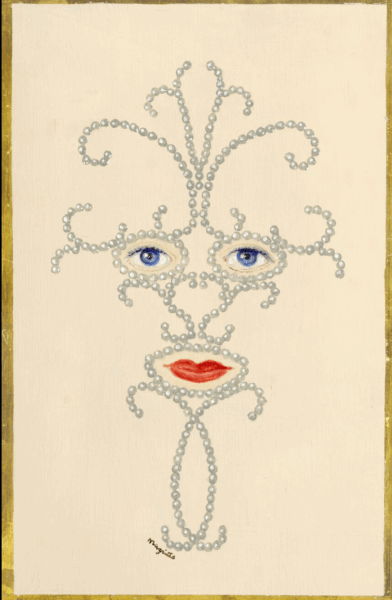
The world is uncertain. The art market is unsettled. And yet, amid a pervasive sense of insecurity, one artist’s market performance stands out for its strength. Quietly but steadily, his prices continue to rise, reaching colossal sums. His success may lie in the fact that he expresses himself through images that deploy a vocabulary both absurd and poetic. There is no need to introduce him: his repertoire — bowler hat, umbrella, or pipe set against a beautiful cloud-filled sky — has entered the collective memory. He is the most famous Belgian artist of the twentieth century: René Magritte (1898–1967).
L’Empire des lumières
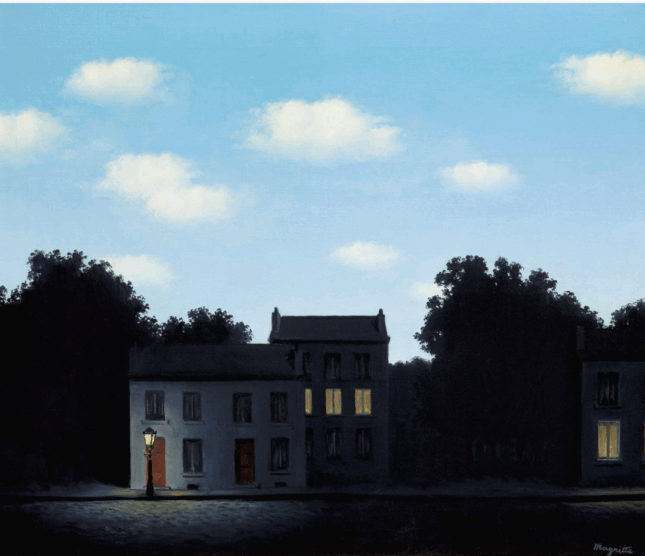
The figures speak for themselves. The art market database Artprice has tracked one of his most celebrated paintings, L’Empire des lumières, painted in 1949, which has appeared at auction three times in recent years. The work depicts an urban scene juxtaposing day and night: a house on a darkened street, faintly lit by a streetlamp, surmounted by a resplendent azure sky. The painting belonged to one of America’s most famous collectors, Nelson A. Rockefeller, and also to the renowned French Surrealism collector and press magnate Daniel Filipacchi. It sold in 2017 for $20.5 million, in November 2023 for $34.9 million, and again in May 2025 for the same amount. In 2023, that represented a 71 percent increase in six years. More broadly, between 2022 and 2024, the highest auction prices ever achieved for Magritte were recorded.

Market paradox
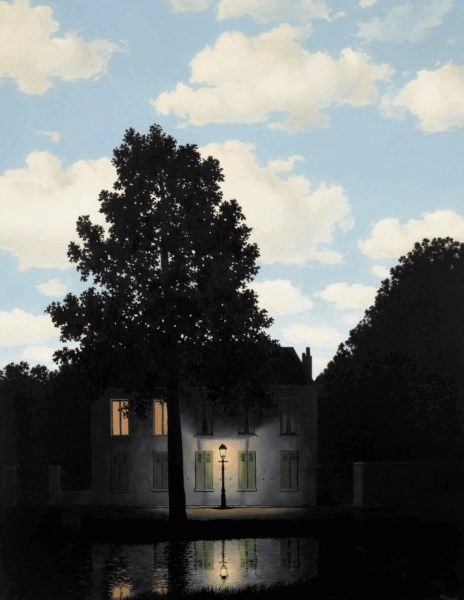
The absolute record corresponds to another version of L’Empire des lumières, a very large canvas painted in 1954, which soared to $105 million in November 2024. According to Artprice, in 2025 René Magritte ranked fourth worldwide in terms of total auction turnover by artist. One hundred ninety-nine of his works changed hands for a total of $171.6 million. Magritte sells. Magritte is bought. The market places its trust in him.Yet on closer inspection, the Belgian painter embodies a market paradox. In painting, uniqueness is traditionally prized. Magritte, however, especially in the postwar period, multiplied versions of the same subject.
Unique in various formats
Each canvas remained unique, but systematically reiterated identical imagery. There are some twenty versions of L’Empire des lumières. In varying formats, the house changes shape, the tree takes on different silhouettes, and the position of the streetlamp shifts. “In that respect, he anticipates the practice of Andy Warhol. Multiply the examples to intensify desire for successful images,” comments Paolo Vedovi, a Belgian dealer specializing in the painter. He adds: “I know a collector who owns several versions of L’Empire des lumières.” It is often overlooked that before establishing himself as a painter, Magritte worked in advertising in 1924 and 1925. Perhaps this is where he developed his virtuosity in crafting effective images. When that clarity falters, works tend to sell less well. “We observe that when a single image juxtaposes too many symbolic elements at once, when it loses its simplicity, it is less desired,” notes Olivier Camu, Christie’s specialist in Surrealism.
For rich people with no taste
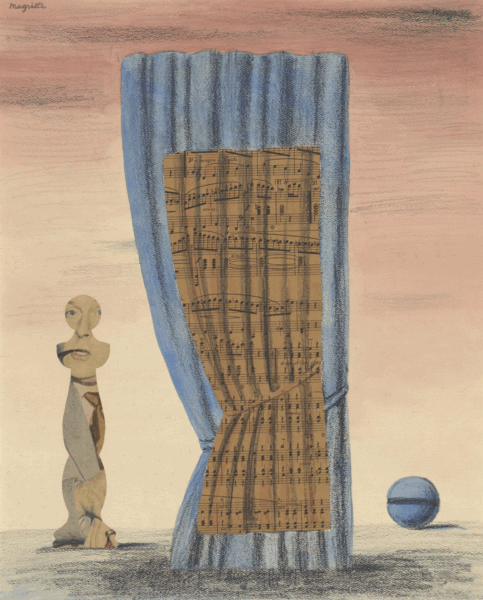
Commercial success came to the Belgian painter only from 1947 onward, when he began collaborating with a New York–based dealer, Alexandre Iolas. In a 1950 letter, the artist wrote to him: “Like you, I wish to sell a great deal. It is obvious that I could make a lot of money by producing a certain kind of painting for rich people with no taste, and you too could make more by selling that kind of horror. We must accept it: we must come to terms with the commerce of art!” This correspondence, revealing the artist’s highly pragmatic mindset, is no secret; it is reproduced in his catalogue raisonné. Today, it is precisely this period — conceived, as he put it, “for rich people with no taste,” that is, from 1947 until his death — that enjoys the greatest market favor.
Title reveals nothing
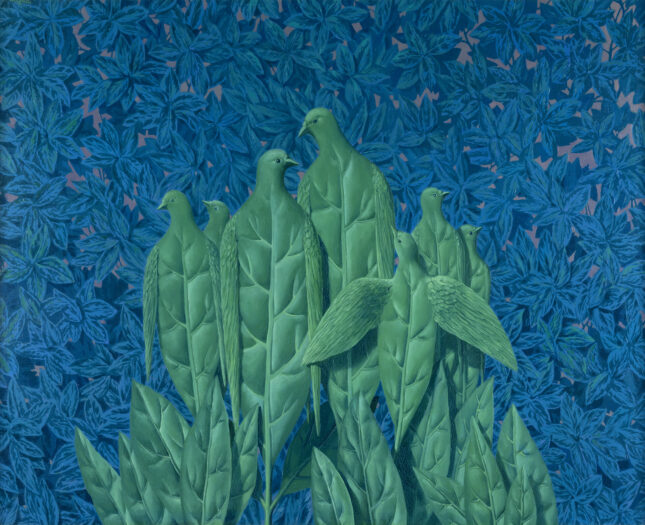
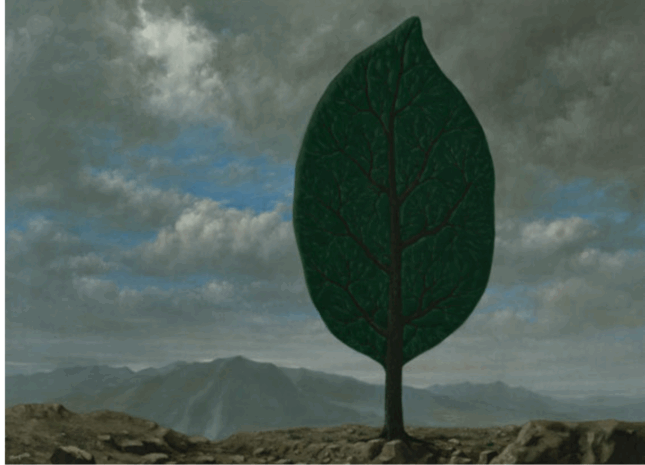
On March 5, 2026, in London, Christie’s will offer no fewer than ten paintings by the artist — further proof of the confidence currently placed in his name. The star lot of the Surrealist sale is Les Grâces naturelles, painted around 1961 and estimated at €7.6 million ($8.9 million). As always with Magritte, the title reveals nothing of the content. One sees birds, wings lowered, formed from a material of green leaves against a background of blue foliage. “The postwar years are also those in which his message becomes less dark and fully resolved,” explains Olivier Camu. “He painted around seventeen leaf-birds. The subject challenges our understanding of tree and bird. He fuses the two.” Camu adds: “Yes, Magritte wanted to sell — sometimes even to the point of backdating works in order to sell them directly to clients, thereby avoiding going through Iolas.”
Rise of Nazi power
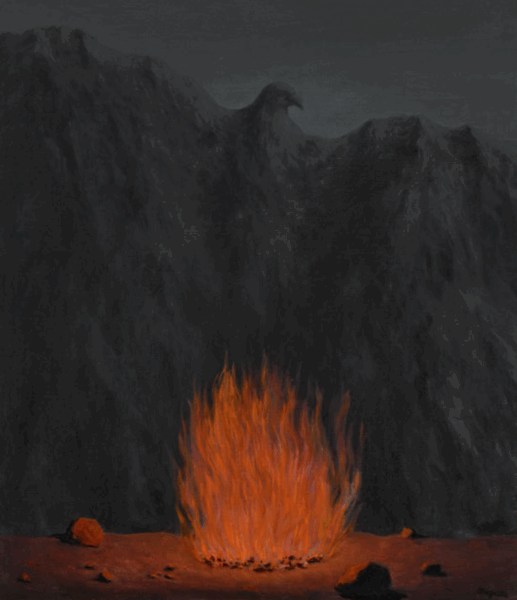
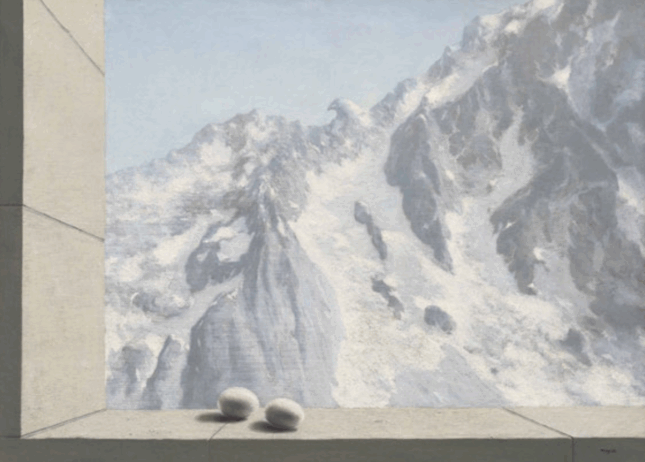
Christie’s will also disperse, on March 5, the remarkable Belgian collection of Roger and Josette Vanthournout. It includes two Magrittes, among them a striking painting. Le Lieu dit (1955) shows a black sky transforming into an eagle with outstretched wings, which themselves turn into a dark mountain. The bird of prey watches over a glowing red fire (estimate: €2.4 million / $2.8 million). It seems to symbolize the catastrophe of an authoritarian regime. As early as 1938, in Le Domaine d’Arnheim, Magritte had painted an eagle merging with a mountain — this time snow-covered — perhaps foreshadowing the rise of Nazi power. The work sold in 2017 for $12.7 million. Clearly satisfied with the potency of the image, he reused it in 1949 in another composition bearing the same title, sold in 2023 for $18.9 million.
Charly Herscovici
If repetition was already one of the keys to the Belgian artist’s success during his lifetime, for Charly Herscovici, president of the Magritte Foundation, “today it is also the multiplication of institutional exhibitions that creates a global desire to own his works, including recently in the Middle East. After a major tour of American museums, including MoMA in New York, and a hugely successful exhibition at the KMSKA in Antwerp, which runs through February 22, 2026, we are planning in 2027 an exhibition at the Grimaldi Forum in Monaco, in 2029 in Japan in Kyoto and Yokohama, and in 2030 in Basel at the Fondation Beyeler.”He adds: “Magritte painted 1,300 canvases and 500 gouaches. There simply aren’t enough paintings to meet global demand.”
The figure of René Magritte — the artist who reassures the art market — seems destined for many more prosperous days ahead.
“