Royal Academy
In London, the Royal Academy is the country’s most renowned custodian of art. Inside, its neo-classical palace—with mouldings shaped like temples—fits squarely within the aesthetic canons of the late British Empire. Yet, paradoxically, one could not dream of a better setting for the major exhibition devoted to the Afro-American artist Kerry James Marshall (born 1955), who speaks about Black working-class life.
Visual explosion
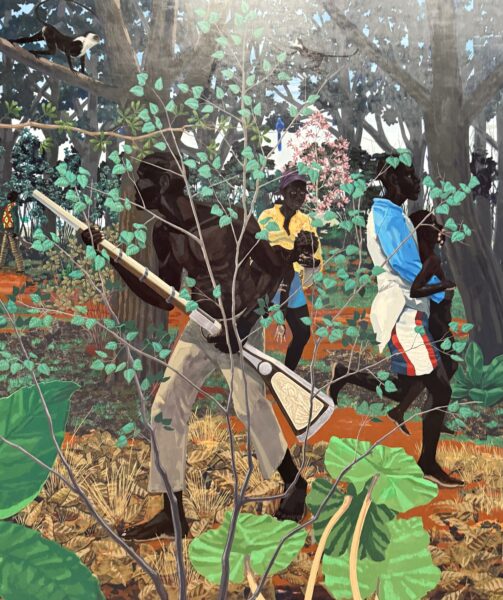
Here, this temple of English art amplifies fifty years of the artist’s work into a true visual explosion. The painter brings into being a chronicle of a minority long ignored by art history. He offers a form of painting that continues the history of figuration and that connects—through style—to some of its most illustrious predecessors. “I have always wanted to be a painter of history on a grand scale, like Giotto or Géricault,” he was already writing in 1994.
History and genre
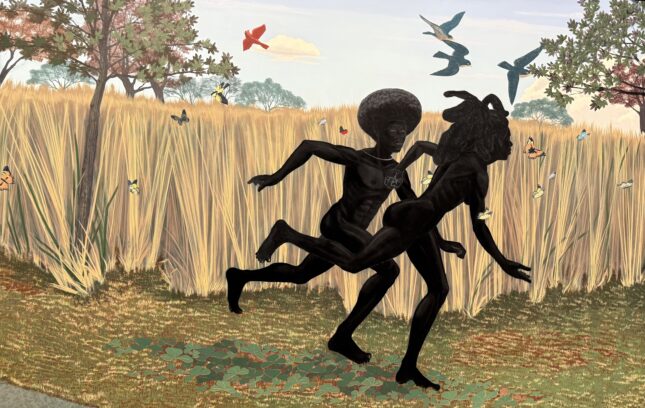
Rather than using the academic category of “history painter,” one might evoke what are called “scene de genre (genre scenes). This repertoire was popularised by Flemish painting and has flourished ever since. It lends an aesthetic turn to moments of everyday life that appear, on the surface, insignificant. The exhibition is organised by the British curator Mark Godfrey into eleven chronological sequences. (He did not respond positively to my several interview requests.)
Born in Alabama
The artist was born in Alabama before his parents moved to Los Angeles—where, as a child, he witnessed the famous 1965 riots in the Watts neighbourhood. Kerry James Marshall is steeped in Afro-American reality. But he does not relate it literally. It expresses itself on the canvas in sophisticated forms. As he explains in the exhibition catalogue: “I’m not interested at all in black as a metaphor. I’m interested in ‘blackness’ independent of any meaning.” Likewise, he uses different dark shades to represent the Black body.
The Invisible man
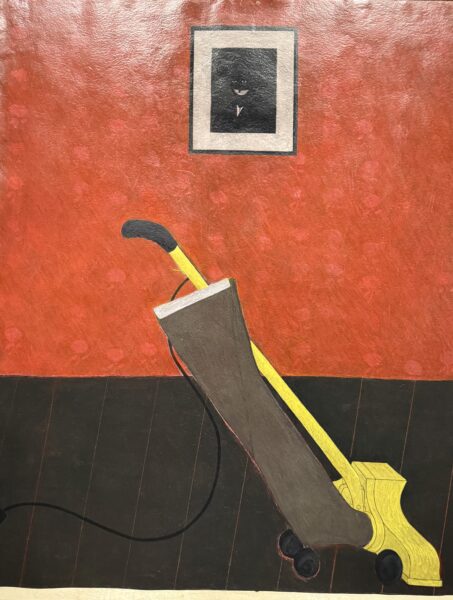
The most important painting from his early years dates from 1980 and sums up his state of mind at the time: A Portrait of the Artist as a Shadow of His Former Self . It depicts a “truly” Black man against a black background. Only the eyes, teeth, and shirt are visible in white. This is a direct reference to the notion of the invisibility of Afro-Americans in society, theorised by the novelist Ralph Ellison in Invisible Man, published in 1952.
His use of colour
But it is also through his use of colour that Kerry James Marshall stands apart. In the 1990s, he asserts his style, with a marked taste for large formats referring, among other things, to the visual power of the Mexican muralist Diego Rivera’s work. He produced, for example, Past Time in 1997, a canvas more than four metres long.
€17.9 million
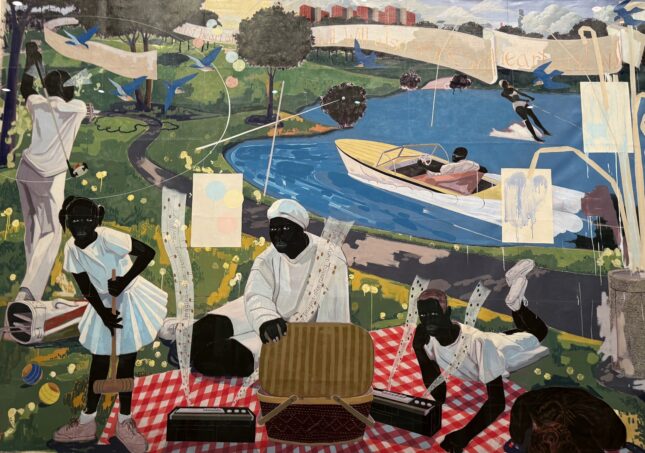
Today an archetypal media image of Afro-American art (it was sold in 2018 for the record sum of €17.9 million to the rapper, now in prison, Puff Daddy), it depicts leisure activities in the Black community—picnics, croquet, waterskiing… A multitude of figures—always Black—a multitude of motifs: clothing, flowers, the gingham tablecloth, the green lawn…
Léopold Sédar Senghor
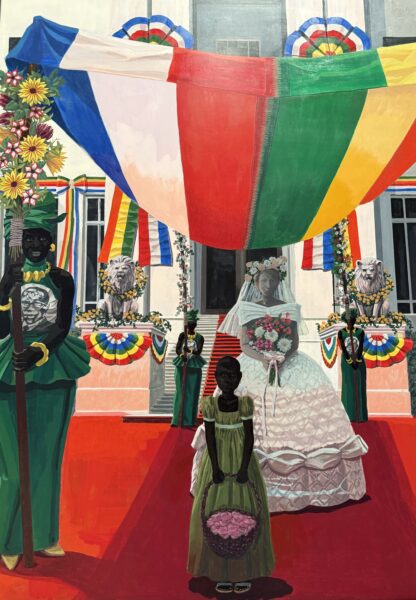
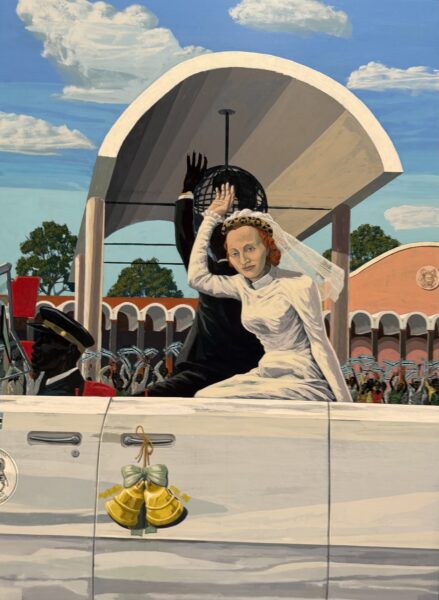
The exhibition concludes with paintings from 2025, including a dazzling wedding scene that, strangely, shows only the future wife of the inventor of the concept of Négritude, the Senegalese Léopold Sédar Senghor.
Never literal
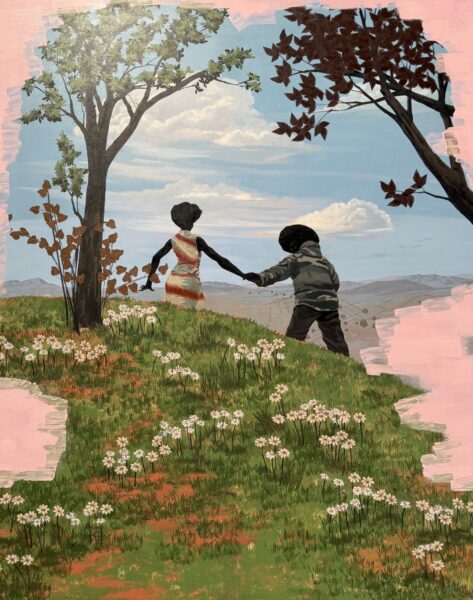
KJM is never in a literal vein. The exhibition will arrive, in a new setting, at the Musée d’Art Moderne de la Ville de Paris on 18 September 2026.
I hope I’ll have the chance(and the honour) to speak with the artist then.
HAPPY HOLIDAYS!!
Through 18 January. Royal Academy
I had the opportunity to interview the curator of the exhibition “Kerry James Marshall: Mastry”, Ian Alteveer, in 2016 at the Met Breuer in New York.You can watch it here:
Support independent art journalist
If you value Judith Benhamou Reports, consider supporting our work. Your contribution keeps JB Reports independent and ad-free.
Choose a monthly or one-time donation — even a small amount makes a difference.
You can cancel a recurring donation at any time.