Let’s be frank.
Among the art lovers of this world – that vast group of individuals that loves flaunting its coffee table books and haunts Moma, the Centre Pompidou and the Tate Modern – how many can tell you why Carl Andre is an important artist?
Sustain Our Work with a Small Monthly Gift
Become part of the Judith Benhamou Reports circle.
Contribute, even from just €10
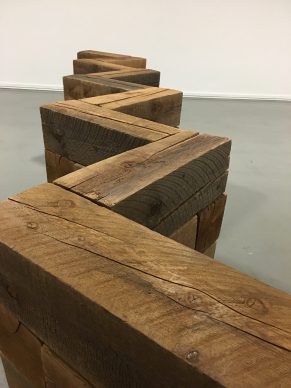
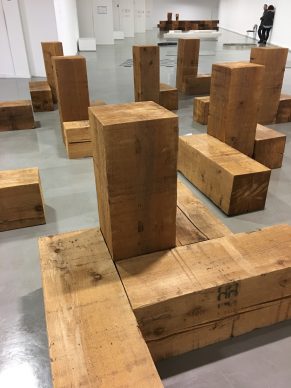
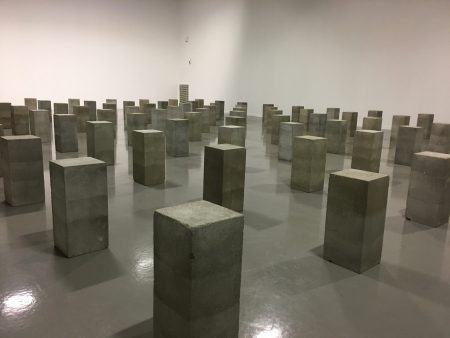
Why exactly should this man whose output includes sheet metal ‘carpets’, blocks arranged on the floor, bits of wood scattered in space, be viewed as a major artist?
Primarily because art in the 20th century was focused on questioning the need to reproduce figurative forms in painting like it did ‘readable’ vertical forms in sculpture.
And among the most radical exponents in this vein is the star of American art, Carl Andre (born in 1935).
A new retrospective includes some thirty monumental sculptures (we would have liked to see more) and will be at the Musée d’art moderne de la ville de Paris, MAM until 12 February. Its importance resides in the way it shows the diversity of his work, as the museum director Fabrice Hergott explains:
Hergott also explains how the artist, who travels little, was involved in laying out the exhibition over the internet with a helping hand from his wife.
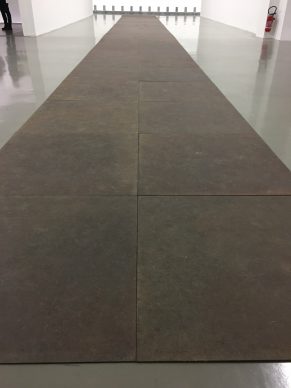
The best-known Carl Andre work is a floor piece made of assembled square steel panels, which you can actually walk over.
Art is not some deified object here. It becomes a place, as the title of the exhibition – ‘Sculpture as place’ – makes clear.
To comprehend how he arrived at such a radical point that puts into question sculpture and its function, you have to be in possession of a few biographical facts.
Carl Andre’s father worked in the shipyards. It was here in all likelihood that a young Carl Andre came into contact with raw wood and these massive materials.
We also know that he was fascinated by the work of Constantin Brancusi, the giant of modernist sculpture, he of the smooth surfaces.
Lastly, we know that he visited the extraordinary English site, Stonehenge, a stone circle of monoliths arranged in a concentric pattern that dates from between 2800 and 1100 BC.
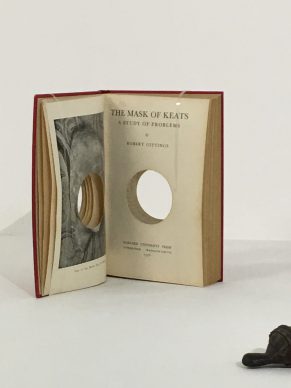
We should add that he was particularly fond – and this is very important for understanding the origin of his work – the Dada movement from the beginning of the 20th century that rode the wave of absurdity. As the exhibition shows, he creates ‘sculptures’ from ordinary objects (including a perfect hole piercing a book).
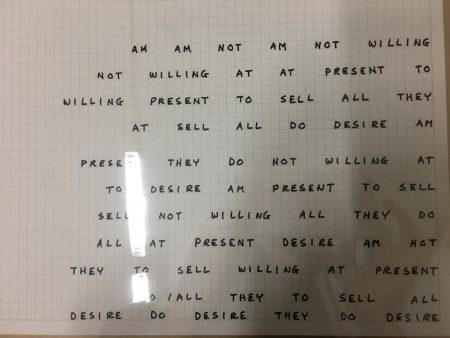
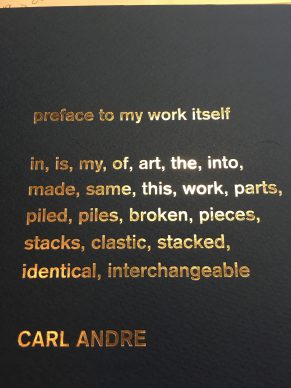
Finally, still in the Dada vein, he makes sculptures out of words (arranged on the page along a rhythmic principle, through repeating shapes and letters).
It makes one think about Kurt Schwitters and his Ursonate
Thus do we understand that the minimal art of Carl Andre is a revolutionary aesthetic principle which can apply to life in all circumstances.
Carl Andre loves materials and allows the viewer to feel this fully.
Carl Andre offers landscapes in three dimensions that soberly play with the spectator’s sensations through the principles of scale and repetition.
His art is at once urban, contemporary, wholly a product of industrial society, but also completely contemplative, and even mystical.
You have to make your way slowly through this exhibition to fully take stock.
It travels to Los Angeles MOCA on 12 March.
www.mam.paris.fr/en/expositions/exhibitions-carl-andre