inventing a world
To be a young painter in the twenty first century is no easy matter. Nearly everything seems to have been explored long ago, whether in the realm of figuration or abstraction. It is therefore deeply moving to encounter an artist who has succeeded in inventing a world entirely his own. Such is the case of Michael Armitage, a British citizen born in 1984 in Nairobi who now lives in Indonesia.
MOma, Kunsthalle…
His work is far too powerful not to have been noticed for some time already. In 2019, in New York, at the opening of the Moma renovated he was one of the guest stars of the great museum. In recent years he has also been shown at the Kunsthalle Basel, in Madrid at the initiative of collector Patrizia Sandretto Re Rebaudengo, and in winter 2021 at Palais de Tokyo.
Sustain Our Work with a Small Monthly Gift
Become part of the Judith Benhamou Reports circle.
Contribute, even from just €10
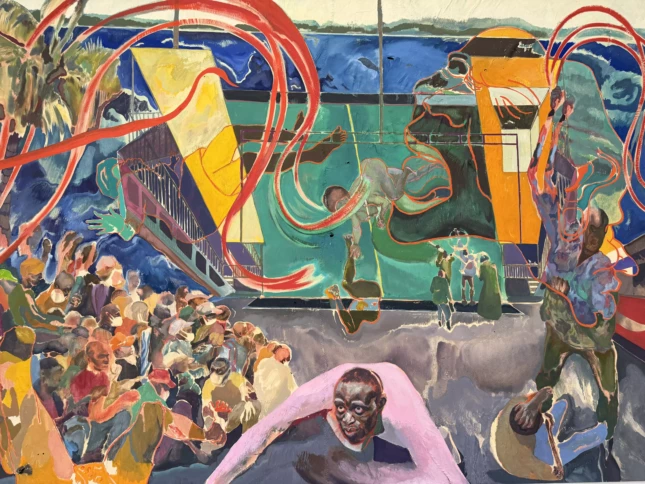
I was fortunate enough to visit his highly anticipated exhibition in Venice, at Palazzo Grassi even before the inauguration of the Venice Biennale, expected in the first week of May 2026. I had already interviewed him four years ago in Madrid.
Through January 10, one can admire the majority of his oeuvre: 45 paintings and around one hundred studies.
paradise and hell
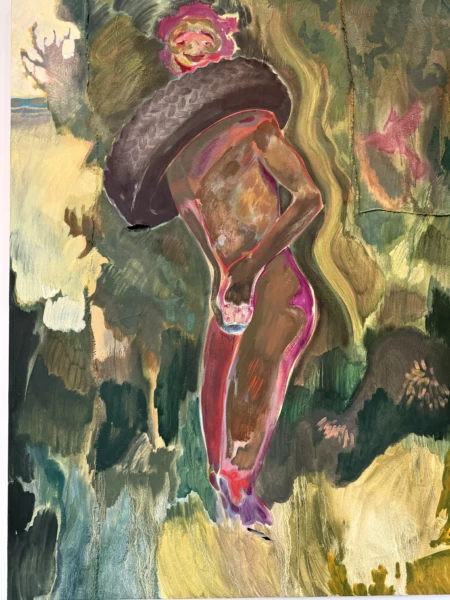
Armitage works very slowly. He is first distinguished by the support he has developed. He does not paint on canvas but on lubugo, a material made from tree bark according to a Ugandan tradition. Its surface is irregular, and the artist makes full use of that fact. Holes, folds, roughness all become integral parts of the compositions.
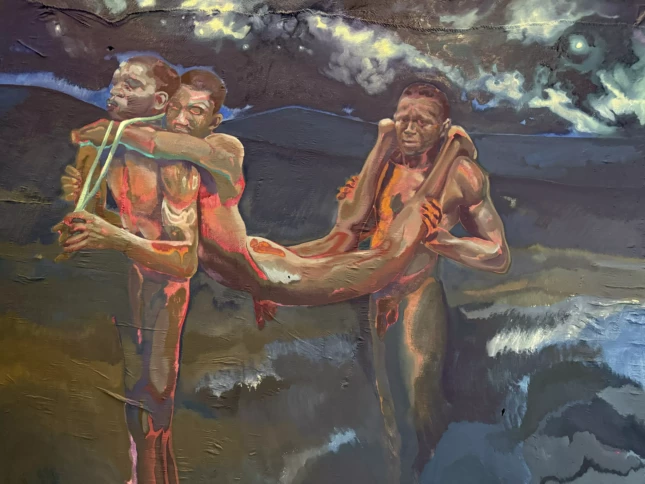
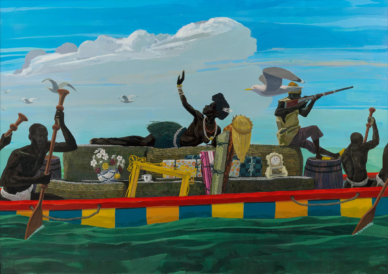
As for the force of the work itself, it lies in a contrast. Michael Armitage depicts dramatic subjects in a sinuous style filled with swirls, and in colors of astonishing beauty. The hues and forms of paradise are applied to the representation of hell on earth.
Gauguin , Munch
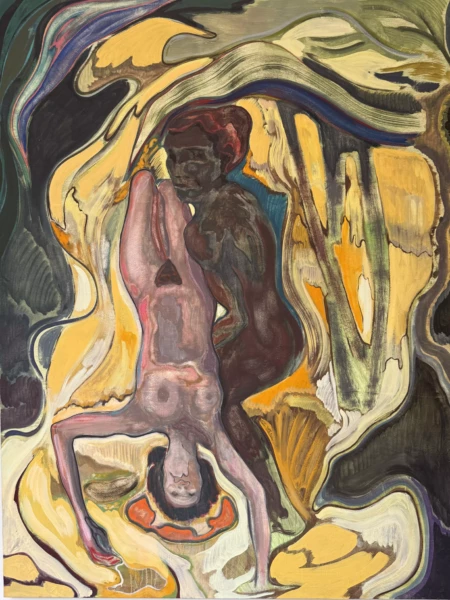
Armitage has undoubtedly looked closely at his predecessors. Beyond Paul Gauguin, whose palette he willingly borrows, one also thinks, for example, of the expressionist landscapes of Edvard Munch.
The effect produced by Armitage lies in a tension between the beautiful and the painful, perfectly summed up in literature by the father of Quasimodo and Esmeralda, Victor Hugo: “From the fruitful union of the grotesque and the sublime is born modern genius.”
Piled bodies
A perfect illustration of this theory is the 2021 painting Holding Cell. At first one perceives a vast central field made of waves of color in shades of violet. These tones evoke the glistening reflections on pebbles freshly lifted from the sea. Then, once the eye adjusts, one understands that this lovely gradation is composed of piled bodies. The bluish and greenish heads of men compressed against one another form the true subject of the composition. Here the artist evokes the overcrowded and inhumane police holding cells of Nairobi.
my dress:my choice
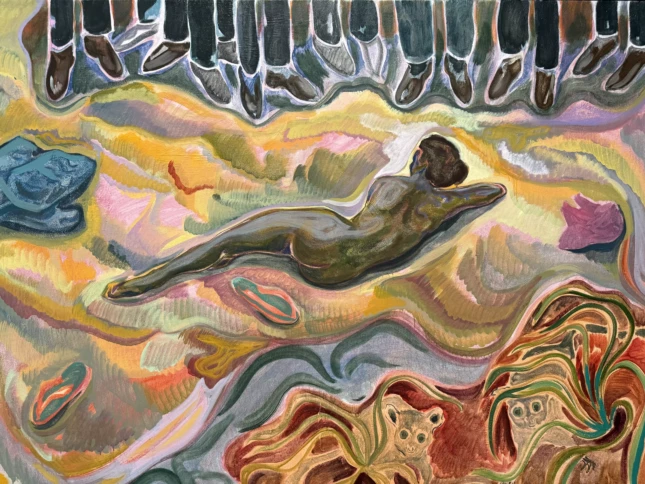
Another painting recounts, in symbolic form, how in 2014, again in Nairobi, a young woman was attacked by a crowd at a bus stop because she was wearing a miniskirt. A year later Armitage painted #mydressmychoice. What one first sees is a beautiful nude woman from behind, her sinuous body buried beneath a landscape composed of undulating strata in tones of ocher and pink. The whole is magnificent. A closer look reveals, in the upper section, a row of men’s legs, one imagines watching the scene. The heroine lies six feet under, yet remains as seductive as the odalisques of art history, from Diego Velázquez to Jean-Auguste-Dominique Ingres.
the abyss
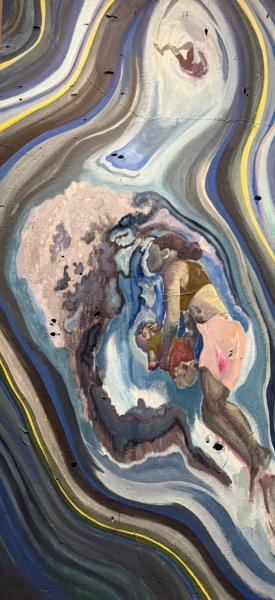
In the same vein, in 2024 he imagined an immense whirlpool of blues, grays and yellows, at the center of which stand a woman and her baby, drawn inexorably downward. It is the fatal story of the final blurred moment of consciousness of a migrant woman sinking at sea. A figuration of the abyss populated by the dead.
That is Armitage: a painting rooted in the grandeur of art history, joined to the most tragic dimensions of contemporary history.
Palazzo Grassi. Venice. Through January 10.