Big effects
The Californian Doug Aitken is what is usually described, somewhat vaguely, as a “multidisciplinary artist.” His mode of operation, however, is anything but vague. He deftly deploys every means at his disposal—not only painting or sculpture—to express himself. Aitken is something of an entrepreneur in art. He likes big effects. In that sense, he is very much a child of the world capital of cinema. He does not hesitate to mobilize colossal technological resources. Rather than settling into a single medium as a comfort zone, he leaps from one to another depending on the site and the nature of his subject.
Inhotim
He made art history, for instance, with an installation conceived for the remarkable sculpture park of Inhotim, in the Brazilian state of Minas Gerais. Entitled Sonic Pavilion, the work allows us to hear the hidden sounds of the deepest layers of the earth. A hole was drilled that seems to answer the fantasies of Jules Verne when he imagined a journey to the center of the earth: the shaft descends to a depth of 202 meters. The drilling made it possible to install microphones that capture, in real time, the sounds of these mineral-rich underground layers.
Sustain Our Work with a Small Monthly Gift
Become part of the Judith Benhamou Reports circle.
Contribute, even from just €10
Mirage in Gstaad
For Desert X in California, and later in 2019 in the snowy landscape of Gstaad in Swiss , Aitken developed a work whose title could more generally describe his practice: Mirage. A house made entirely of mirrors, playing with the changing landscape across the seasons. “Here, the environment itself can become the work of art,” he explained to me in January 2019. Mirage has since been dismantled, regrettably so.
Nita Mukesh Ambani Cultural Centre
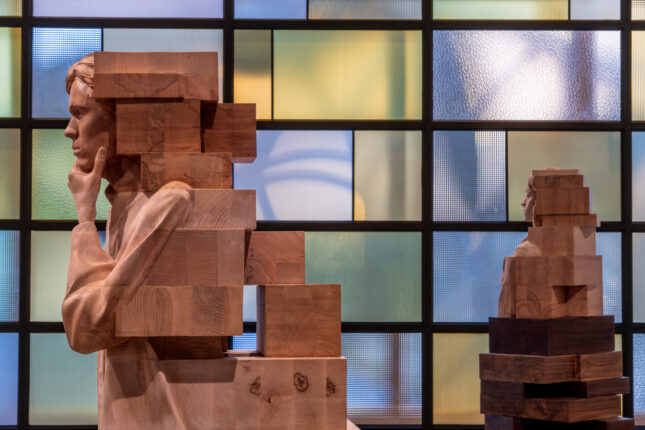
Aitken is an artist made for carte blanche projects. He was recently given one in Mumbai, at the Nita Mukesh Ambani Cultural Centre, created in 2023 at the initiative of the Ambani family. Its lavish inauguration attracted the attention of every celebrity-focused media outlet worldwide. Today, the venue’s programming is overseen by the family’s daughter, Isha Ambani. The space is not an easy one: it unfolds across four floors inside a shopping mall. Doug Aitken has used three of them to tell a story about time.
Andrei Tarkovsky
Everything has been custom-designed, starting with the exhibition booklet, which takes the form of an origami. “Under the Sun” unfolds as a journey in three distinct parts. The artist explains: “For this project, I thought about the words of filmmaker Andrei Tarkovsky, who spoke of ‘sculpting time.’” The three temporal layers that make up the exhibition form an unexpected succession of aesthetic positions.
Great Indian tradition
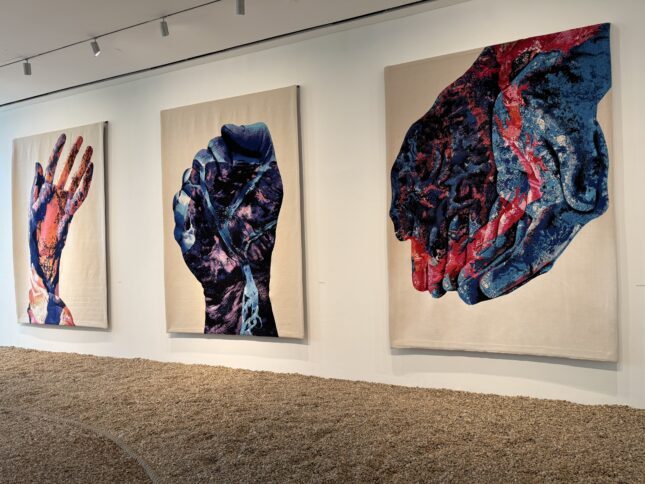
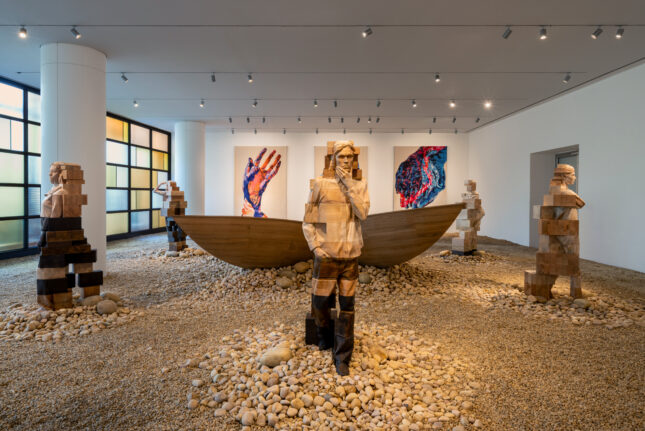
The journey begins with a staging of the past, Aitken-style. For the crossing, there are entangled wooden boats, surrounded by sculpted figures that echo people from his everyday life. “One of the women works at a restaurant that I go to almost every day. It was just the world around you, and you’re kind of sharing that world and transporting it.” On the walls are works depicting hands marked with the tracery of the country’s rivers, conceived in the great Indian tradition. “I think one of the things I found in India was the artisanship.”
Telephone
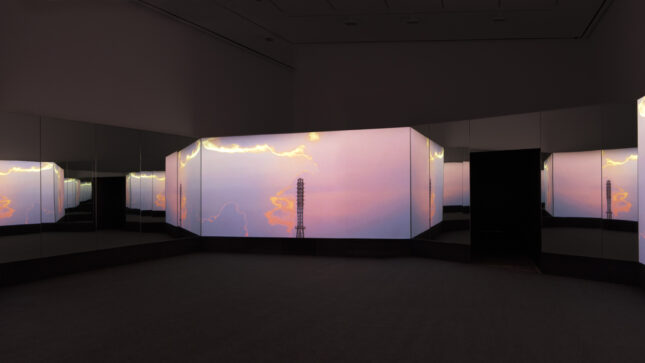
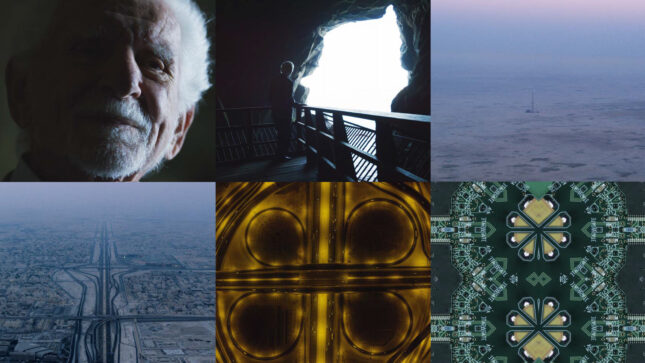
Climbing Aitken’s ladder of time means, on the first floor, being abruptly plunged into a world of giant screens. Because what defines our lives today? The omnipresence of the mobile phone. “In India, whether you’re rich or poor, you have a phone,” he remarks. In this immersive video installation, originally conceived in 2018, he addresses the story of the inventor of the cellular telephone, Martin Cooper. In 1973, Cooper made the first call from a mobile phone on a street in New York. And thus, for better or worse, the revolution in human cell communication began.
Streams of light
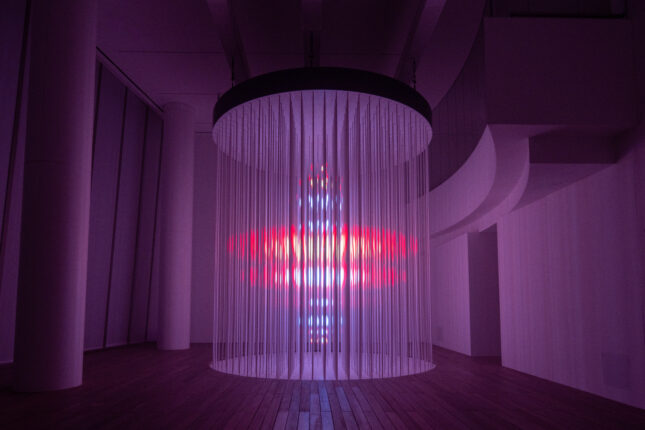
“Welcome to the future.” On the second floor, a very courteous gentleman invites us into yet another world. The room is flooded by a large column composed of constantly evolving streams of light. The environment is bathed in music with futuristic overtones. He composed it. The visitor is hypnotized, seized by this psychedelic vision. We are left stunned. The installation is as beautiful as a nuclear explosion and as mysterious as the future itself. What will our future be made of? Doug Aitken—who delights in not answering questions—is hardly going to point the way. He simply concludes: “The mystery of the future? Ah, I love that idea.”