Tristes tropiques
In 1955, Claude Lévi-Strauss published a masterpiece that would change minds forever: Tristes tropiques (published in 1961 in English). Not only did he dare to take on a literary tone in this anthropological travel narrative, but—something too often forgotten today—at the time it amounted to a radical questioning of the colonial gaze, with all its commonplace assumptions of superiority toward Indigenous peoples of the Americas.Just one year earlier, the scholar had married a brilliant yet discreet woman. Monique, an English speaker through her mother, was to play a decisive role in the dissemination of Lévi-Strauss’s work, particularly in the United States. Personally, she went on to become a specialist in antique textiles.
Sustain Our Work with a Small Monthly Gift
Become part of the Judith Benhamou Reports circle.
Contribute, even from just €10
The beginning of friendship
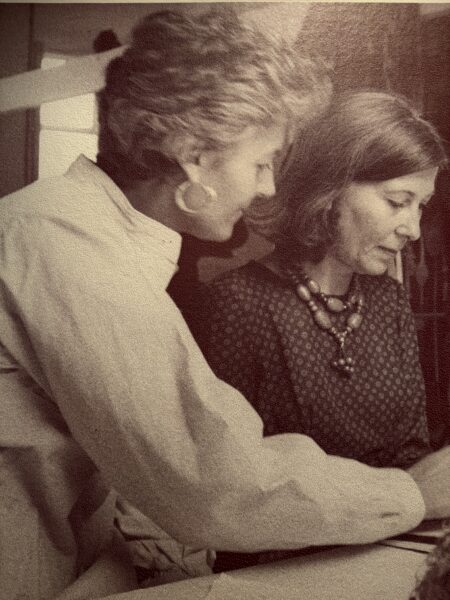
In 1968, she met an American artist living in Paris whose chosen material was thread and weaving: Sheila Hicks (born 1934). A solid complicity developed over the years, and fifty-seven years later—through March 8, 2026—the two women are co-curators of Le fil voyageur (The Traveling Thread), a small yet captivating exhibition at the Musée du Quai Branly devoted to a dialogue between Hicks’s sumptuous installations and the institution’s textile holdings.
First in Detroit
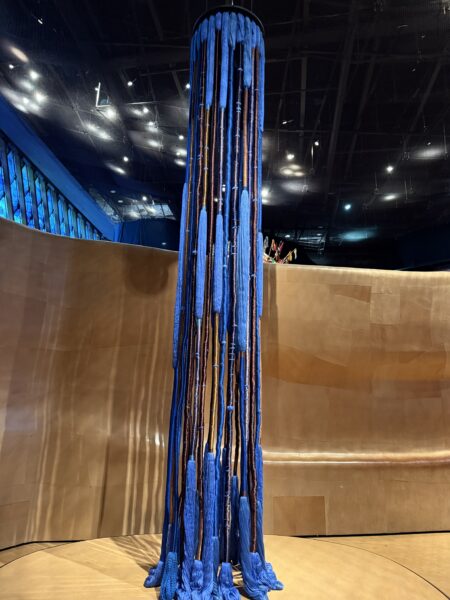
Sheila Hicks recounts for us—exclusively, in this joint video interview with the two grandes dames—how her passion for thread first began: “Sitting on the steps of a house on Navajo Street in Detroit during the Second World War, we had very little, very few things to play with, my brother and I. So we would find things that were discarded in the street. And we would play with these leftovers. Of course some of it was clothes and some of it was cigarette butts and aluminum paper too. We would make balls, aluminum balls, and we’d take threads and make fishnets, bird nests, and all kinds of sculptural objects sitting on the porch and we’d leave them there as a display. The neighbors would come and admire them like an exhibition.Yes, it was my first show. So we were maybe six, seven years old.”
Josef Albers
Time has passed, Today Monique Lévi-Strauss, still intellectually sharp, is 99 years old. Sheila Hicks, for her part, has become an international star of contemporary art.One of the key moments in her training was studying with the great German-born artist Josef Albers.
She returns to the simple principle of the colored thread, using carefully orchestrated tonal juxtapositions to create explosions of color and evocations of sensation. It is as if, metaphorically, she had unraveled painted canvases in order to transform them into sculpture.
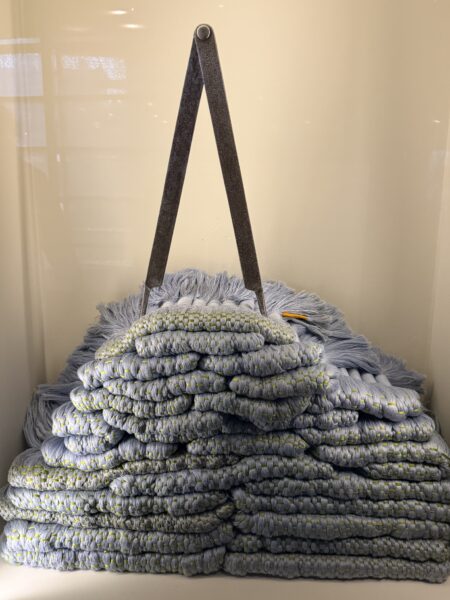
Thread is everywhere
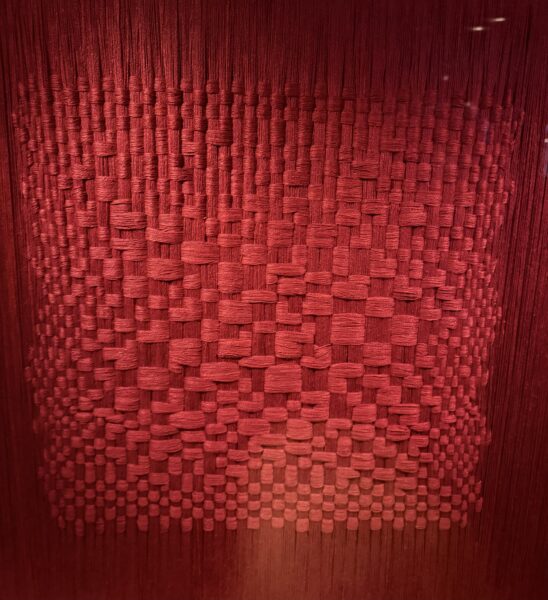
“Thread is everywhere. It unfolds in space. It begins in the morning when you get dressed or when you comb your hair,” Hicks explains.
Follow the Thread
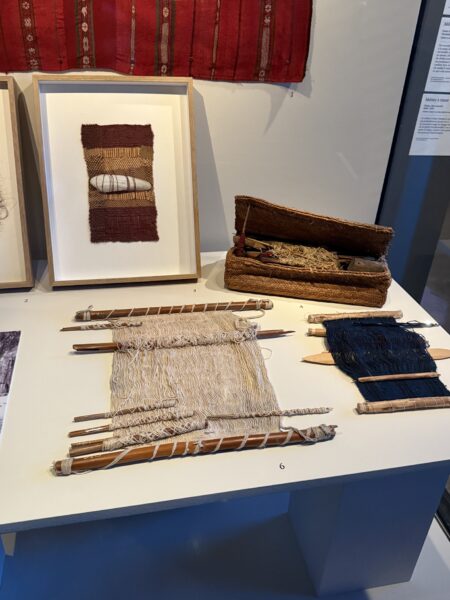
To which Monique adds: “If you follow that thread, you understand more of what you see and what people also feel. It helps you a lot to understand. Like watching their dietary habits, too. Claude [Lévi-Strauss] would say, watch what they eat. And when you eat their food, you find—you start to know their taste. It’s great information. So this is one of the basic languages of international communication.”
Peruvian cap
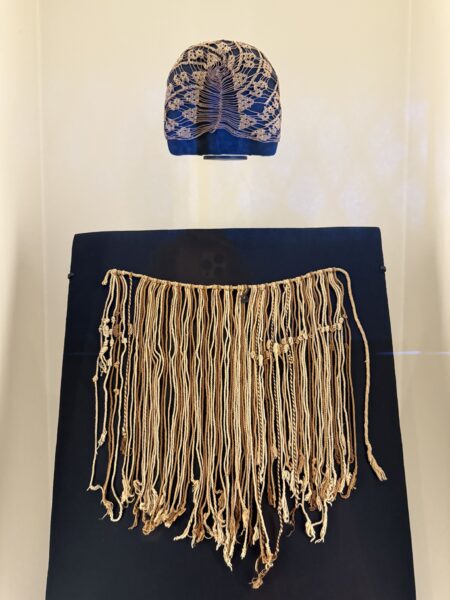
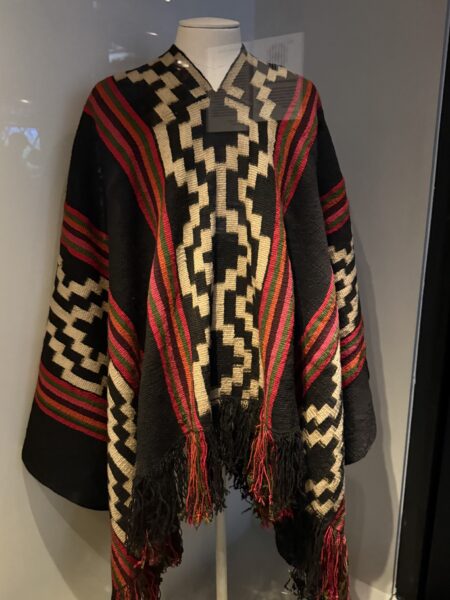
Among the historical pieces on display is a striking Peruvian cap dating to around the 12th century, made of knotted cotton threads forming a frieze of birds. Hardly a “primitive” object… no more so than the 20th-century poncho made by the Mapuchas of Chile, a learned intersection of weaving and dyeing that yields geometric motifs.
Tie and untie
On one of the exhibition’s walls, a phrase by Sheila Hicks is written—one that could well sum up one of life’s keys, already practiced in her day by Ulysses’ wife, Penelope in The Odyssey:
” I tie knots and then I untie them to understand” .
Through March 8. Musée du Quai Branly.
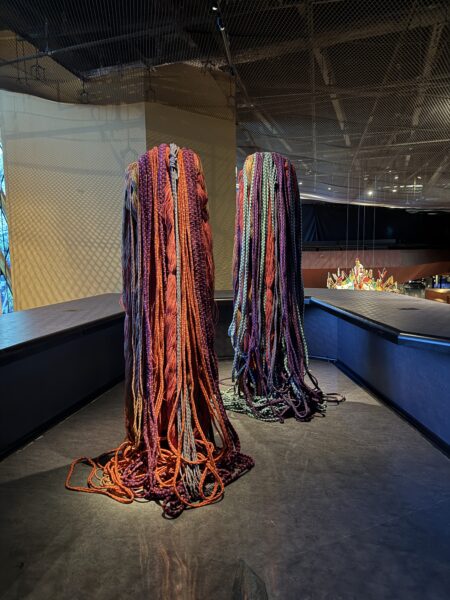
The two friends’ exhibition is part of a global cycle that travels to Brazil, Italy, and China.